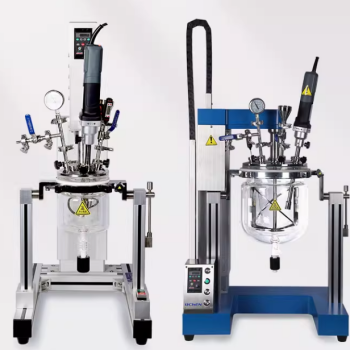
An ultrasonic homogenizer acts as the primary mechanism for de-agglomeration in the preparation of nickel nanoparticle colloids. By generating intense acoustic cavitation, it provides the physical force necessary to shatter the tight clusters caused by magnetic attraction, ensuring the particles remain effectively suspended in a liquid medium without compromising their crystalline integrity.
Core Takeaway Nickel nanoparticles naturally clump together due to strong magnetic forces, creating "secondary aggregates" that ruin material performance. The ultrasonic homogenizer solves this by using high-frequency sound waves to physically blast these clumps apart, enabling the creation of long-term stable suspensions required for high-tech conductive inks and nanofluids.
The Challenge of Magnetic Aggregation
Overcoming Natural Attraction
Nickel is inherently magnetic. Unlike non-magnetic materials, nickel nanoparticles do not just settle due to gravity; they actively attract one another.
The Problem of Secondary Aggregates
This magnetic attraction leads to the formation of secondary aggregates. These are large, irregular clusters of particles that act like much larger debris, destabilizing the fluid and reducing its conductive or thermal properties.
Why Standard Mixing Fails
Traditional mechanical stirring is often insufficient to overcome these magnetic bonds. It may move the fluid, but it lacks the localized intensity required to separate the individual nanoparticles once they have latched onto each other.
The Mechanism: Acoustic Cavitation
Generating Shock Waves
The ultrasonic homogenizer functions by creating cavitation effects. This involves the rapid formation and collapse of microscopic bubbles within the liquid.
Localized Energy Spikes
When these bubbles collapse, they generate extreme localized conditions: high temperatures, high pressures, and strong shock waves.
Breaking Bonds, Not Crystals
These shock waves impact the particle aggregates with immense force. Crucially, this force is tuned to break the loose bonds between particles (the aggregates) without damaging the internal crystal structure of the nickel itself.
Application in Synthesis and Control
Creating Microemulsions
Beyond dispersing solid particles, ultrasonic homogenization plays a role in the chemical synthesis phase. It generates significant local shear forces that can break an aqueous phase into stable droplets.
Sub-Femtoliter Confinement
As detailed in supplementary contexts, these forces can disperse droplets down to diameters of several hundred nanometers. This confines metal ions within sub-femtoliter volumes.
Controlling Stoichiometry
This precise confinement allows for strict control over the chemical stoichiometry. This is particularly vital when synthesizing alloy nanoparticles via microemulsion systems, ensuring the chemical makeup remains consistent across the batch.
Understanding the Trade-offs
The Necessity of the Right Matrix
While the homogenizer provides the physical force to separate particles, it does not permanently neutralize magnetic attraction on its own.
Physical vs. Chemical Stability
The primary reference notes that the particles achieve distinct long-term stability in specific matrices or solvents.
The Limit of Physical Dispersion
If the solvent does not support the suspension, the particles will eventually re-agglomerate due to magnetic forces once the ultrasound stops. The homogenizer is the tool for dispersion, but the chemical environment maintains it.
Making the Right Choice for Your Goal
To maximize the effectiveness of ultrasonic homogenization in your nickel colloid process, consider your specific objective:
- If your primary focus is producing conductive inks or nanofluids: Focus on the homogenizer's ability to break secondary aggregates. Ensure your solvent matrix is optimized to keep the particles separated after the ultrasonic energy is removed.
- If your primary focus is synthesizing new alloy nanoparticles: Utilize the homogenizer to generate high shear forces for microemulsions. This will help you control droplet size and ensure precise chemical stoichiometry.
The ultrasonic homogenizer is not just a mixer; it is a precision stress-test that forces magnetic particles to behave as a uniform fluid.
Summary Table:
| Feature | Impact on Nickel Nanoparticle Preparation |
|---|---|
| Primary Mechanism | Acoustic cavitation (bubble formation and collapse) |
| Aggregation Control | Breaks magnetic 'secondary aggregates' without damaging crystals |
| Shear Forces | Generates localized intensity for sub-femtoliter droplet confinement |
| Chemical Impact | Enables precise control of stoichiometry in alloy synthesis |
| Result | Long-term stable suspensions for conductive inks and nanofluids |
Optimize Your Nanomaterial Dispersion with KINTEK
Are you struggling with magnetic aggregation or inconsistent particle distribution? KINTEK specializes in high-performance laboratory solutions designed to overcome the toughest material science challenges.
Our advanced ultrasonic homogenizers deliver the precise cavitation energy needed to ensure uniform nickel nanoparticle colloids, while our broader portfolio—including high-temperature furnaces, crushing and milling systems, and high-pressure reactors—supports your entire research and production workflow. From battery research tools to specialized ceramics and crucibles, KINTEK provides the reliability your lab demands.
Ready to achieve superior dispersion and material integrity?
Contact KINTEK Today for Expert Solutions
References
- Nuru-Deen Jaji, Muhammad Bisyrul Hafi Othman. Advanced nickel nanoparticles technology: From synthesis to applications. DOI: 10.1515/ntrev-2020-0109
This article is also based on technical information from Kintek Solution Knowledge Base .
Related Products
- High Shear Homogenizer for Pharmaceutical and Cosmetic Applications
- High Performance Lab Homogenizer for Pharma Cosmetics and Food R&D
- Lab Sterile Slapping Type Homogenizer for Tissue Mashing and Dispersing
- Laboratory High Throughput Tissue Grinding Mill Grinder
- Laboratory Disc Rotary Mixer for Efficient Sample Mixing and Homogenization
People Also Ask
- Why Use a High Shear Homogenizer for Cathode Slurries? Optimize Double-Layer Solid-State Battery Production
- What is the function of high-shear dispersion equipment in corona-resistant nanocomposites? Elevate Your Insulation
- What is the necessity of using an industrial-grade high-shear homogenizer for biomass washing? Ensure Process Efficiency
- What are the advantages of using a high-shear homogenizer for BED/GMA coatings? Achieve Superior Nano-Dispersion
- What role does a high-shear homogenizer play in ODC catalyst suspensions? Unlock Superior Electrochemical Efficiency