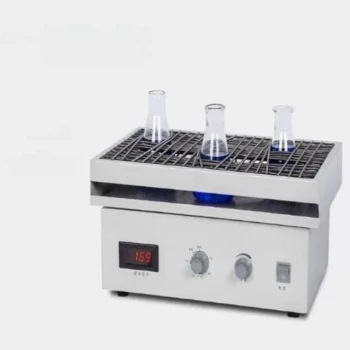
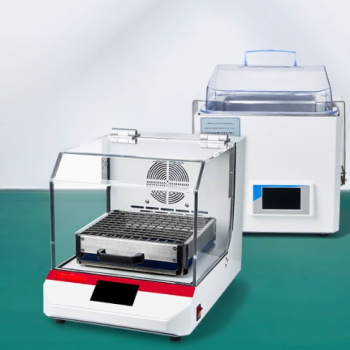
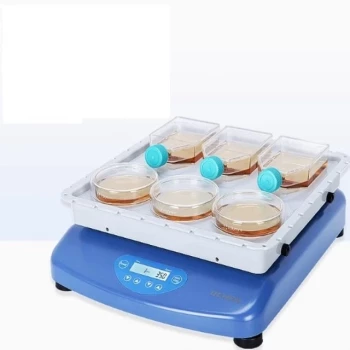
Constant temperature shakers and Erlenmeyer flasks function as the primary reactor system for laboratory-scale bio-oxidation of refractory gold sulfide concentrates. Together, they create a controlled kinetic environment where specific rotation speeds ensure mineral particles remain suspended and in uniform contact with the necessary microbial communities.
The core purpose of this equipment combination is to facilitate mass transfer. By maintaining continuous agitation, the system maximizes the availability of Oxygen and Carbon Dioxide, which are essential fuels for the bacteria responsible for breaking down the sulfide matrix and liberating the gold.
The Physical Mechanics of Bio-Oxidation
Establishing Kinetic Conditions
The Erlenmeyer flask serves as the vessel, but the constant temperature shaker provides the energy required for the reaction.
By setting specific rotation speeds, the shaker creates a hydrodynamic environment that mimics larger industrial processes. This ensures that the solid mineral particles do not settle at the bottom of the flask.
Ensuring Uniform Contact
For bio-oxidation to occur, the bacteria must physically interact with the mineral surface or the chemical species in the solution.
The agitation provided by the shaker ensures uniform contact between the refractory gold concentrate and the microbial communities. This suspension allows the bacteria to access the sulfide minerals consistently throughout the entire volume of the liquid.
Fueling Bacterial Metabolism
Promoting Gas Transfer
The most critical role of the shaker is aiding the transfer of gases from the air into the liquid leaching solution.
The physical agitation breaks the surface tension of the liquid, increasing the dissolved oxygen levels. It also facilitates the absorption of Carbon Dioxide, which is often the limiting factor in static systems.
Supporting Specific Bacterial Strains
The bio-oxidation process relies heavily on iron-oxidizing and sulfur-oxidizing bacteria.
These microorganisms require specific inputs to drive their metabolic activities. Oxygen serves as the essential electron acceptor, while Carbon Dioxide acts as the primary carbon source for building cell mass.
Maintaining Reaction Efficiency
Without the continuous supply of these dissolved gases, bacterial growth would stall.
The shaker ensures that these inputs are replenished as quickly as the bacteria consume them. This maintains efficient bioleaching reactions, allowing the bacteria to continuously oxidize the sulfur and iron, thereby exposing the gold.
Critical Control Factors
The Importance of Stability
While the agitation drives the chemistry, the constant temperature feature of the shaker is equally vital for biological stability.
Bacterial enzymes function optimally within narrow temperature ranges. Fluctuations caused by external environmental changes can slow down metabolic rates or even kill the microbial population.
Balancing Agitation Speed
There is a necessary balance in setting the rotation speed.
If the speed is too low, oxygen transfer becomes inefficient, and solids settle out of the solution. Conversely, while not explicitly detailed in the primary text, standard practice suggests that excessive speed must be controlled to maintain the intended kinetic conditions without causing spills or mechanical instability.
Optimizing Your Bio-Oxidation Strategy
If your primary focus is maximizing reaction kinetics:
- Ensure your rotation speeds are high enough to keep all particles fully suspended, maximizing the surface area available for bacterial attack.
If your primary focus is biological health:
- Prioritize the stability of the temperature settings and ensure the flask design allows for adequate headspace to facilitate gas exchange (O2 and CO2).
The success of bio-oxidation relies on treating the shaker and flask not just as storage, but as an active life-support system for your microbial workforce.
Summary Table:
| Component | Primary Function in Bio-Oxidation | Critical Benefit |
|---|---|---|
| Constant Temp Shaker | Provides kinetic energy and thermal stability | Ensures uniform particle suspension and optimal metabolic rates |
| Erlenmeyer Flask | Reaction vessel with specific geometry | Facilitates headspace gas exchange (O2 and CO2) |
| Agitation (RPM) | Breaks surface tension and facilitates mass transfer | Maximizes dissolved oxygen as an electron acceptor |
| Temperature Control | Maintains narrow enzymatic window | Prevents microbial stalling or population collapse |
Maximize Your Bioleaching Efficiency with KINTEK
Precise control over kinetic and thermal environments is the key to successful refractory gold bio-oxidation. KINTEK specializes in high-performance laboratory equipment designed to meet the rigorous demands of mineral processing and biotechnology.
Our extensive portfolio includes constant temperature shakers and shakers, specialized glassware, and advanced high-temperature reactors to help you scale your research from the benchtop to production. Whether you need reliable crushing and milling systems for sample preparation or precise cooling solutions for process control, KINTEK provides the high-quality tools your lab deserves.
Ready to optimize your microbial workforce? Contact KINTEK today to discuss your laboratory equipment needs!
References
- Natalia J. Marchevsky, Edgardo Donati. Microbial oxidation of refractory gold sulfide concentrate by a native consortium. DOI: 10.1016/s1003-6326(17)60133-x
This article is also based on technical information from Kintek Solution Knowledge Base .
Related Products
- Laboratory Small Constant Temperature Heated Magnetic Stirrer Heater and Stirrer
- High Temperature Constant Temperature Heating Circulator Water Bath Chiller Circulator for Reaction Bath
- 5L Heating Chilling Circulator Cooling Water Bath Circulator for High and Low Temperature Constant Temperature Reaction
- 50L Chiller Water Bath Cooling Circulator Low Temperature Constant Temperature Reaction Bath
- 100L Heating Chilling Circulator Cooling Water Bath Circulator for High and Low Temperature Constant Temperature Reaction
People Also Ask
- What role does a magnetic stirrer with heating play in ZnO nanoparticle synthesis? Precision Control for Quality Results
- What role does a constant temperature heating magnetic stirrer play in MFC-HAp synthesis? Achieve Material Homogeneity
- What is the function of a laboratory magnetic stirrer in Ni–Cr–P electrodeposition? Optimize Ion Transport & Coating
- Why is a laboratory magnetic stirrer required for benzoic acid esters? Boost Reaction Speed & Yield with High RPM
- What role does a laboratory magnetic stirrer play in TiO2 and TiO2-Ag sol preparation? Master Chemical Kinetics