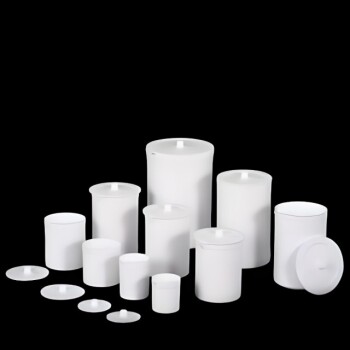
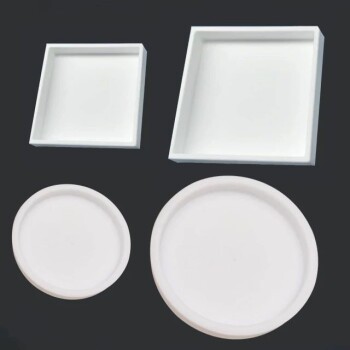
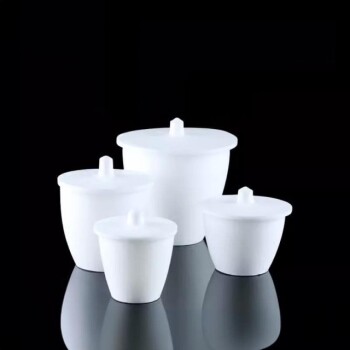
The preference for Polytetrafluoroethylene (PTFE) beakers stems from their unique combination of chemical inertness and low surface energy. When preparing complex mixtures involving fluorosilicone rubber and POSS-V, these vessels are critical for managing high viscosity and aggressive solvents. They ensure that the physical constraints of the materials do not compromise the chemical formulation.
Core Takeaway PTFE beakers serve a dual purpose: they act as a physical barrier against material loss due to adhesion and a chemical barrier against contamination from solvent interactions. This safeguards the precise stoichiometric ratios required for accurate material formulation.
Overcoming Physical Mixing Challenges
Handling High-Viscosity Materials
Fluorosilicone rubber is inherently viscous and prone to sticking to standard surfaces.
When mixing this rubber with crosslinking agents and POSS-V, significant material can be lost to the walls of a standard container. PTFE prevents this adhesion, ensuring that all components remain in the mixture rather than coating the beaker.
Preserving Formulation Ratios
In precise chemical formulations, the loss of even small amounts of reactants can skew the final properties of the material.
By eliminating surface adhesion, PTFE ensures that the exact mass of ingredients added to the vessel ends up in the final dispersion. This is particularly critical for additives like POSS-V, where specific concentrations are required for performance.
Ensuring Chemical Integrity
Resistance to Aggressive Solvents
The dispersion process often utilizes tetrahydrofuran (THF), a powerful solvent capable of interacting with or degrading many standard plastic containers.
PTFE is chemically inert to THF. This prevents the solvent from breaking down the container surface during the mixing process.
Preventing Sample Contamination
Using a vessel that reacts with the solvent introduces foreign impurities into the mixture.
A PTFE beaker ensures that no dissolved impurities from the container wall leach into the fluorosilicone rubber mixture. This guarantees that the experimental results reflect the properties of the material, not the contaminants of the vessel.
Understanding the Risks of Alternative Vessels
The Cost of Adhesion
If a standard glass or plastic vessel is used, the high viscosity of the rubber leads to significant "hold-up" volume.
This results in a discrepancy between the calculated formulation and the actual mixture, potentially leading to incomplete crosslinking or inconsistent material performance.
The Risk of Leaching
Solvents like THF are excellent at extracting plasticizers or other chemicals from non-PTFE containers.
In a sensitive formulation involving POSS-V, these leached impurities can act as unintended contaminants, altering the chemical reaction or the final mechanical properties of the rubber.
Making the Right Choice for Your Goal
To ensure the success of your formulation, select your equipment based on the specific chemical and physical demands of your mixture:
- If your primary focus is Formulation Accuracy: Use PTFE to prevent high-viscosity components from sticking to the walls, ensuring the final mix matches your calculated ratios.
- If your primary focus is Chemical Purity: Use PTFE when utilizing aggressive solvents like THF to completely eliminate the risk of container impurities leaching into your sample.
Ultimately, the use of a PTFE beaker is not just a preference but a technical necessity for maintaining the integrity of fluorosilicone and POSS-V dispersions.
Summary Table:
| Feature | Advantage of PTFE in Mixing | Benefit to Formulation |
|---|---|---|
| Surface Energy | Low surface energy/Non-stick | Prevents material loss of viscous rubber |
| Chemical Resistance | Inert to aggressive solvents (e.g., THF) | Prevents container degradation and leaching |
| Material Purity | Zero contaminant leaching | Guarantees integrity of POSS-V dispersions |
| Accuracy | Eliminates "hold-up" volume | Maintains precise stoichiometric ratios |
Elevate Your Lab's Formulation Precision with KINTEK
Don't let material loss or solvent contamination compromise your research results. KINTEK specializes in high-performance laboratory equipment and consumables designed for the most demanding chemical environments.
Whether you are working with high-viscosity fluorosilicone rubber or sensitive POSS-V dispersions, our premium PTFE products, ceramics, and crucibles ensure maximum recovery and zero contamination. Beyond essentials, we provide a comprehensive range of advanced tools including high-temperature furnaces, hydraulic presses, and battery research equipment to support your entire workflow.
Ready to optimize your material mixing process? Contact KINTEK today to discuss your specific laboratory needs and discover how our specialized solutions can bring unmatched accuracy to your experiments.
References
- Jae Il So, Yingjie Qian. Improvement of Heat Resistance of Fluorosilicone Rubber Employing Vinyl-Functionalized POSS as a Chemical Crosslinking Agent. DOI: 10.3390/polym15051300
This article is also based on technical information from Kintek Solution Knowledge Base .
Related Products
- Custom PTFE Teflon Parts Manufacturer PTFE Beaker and Lids
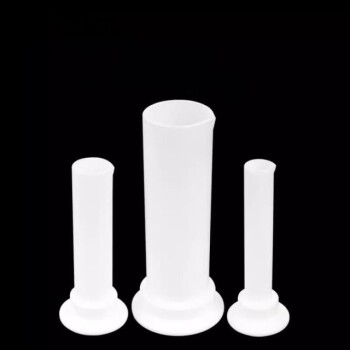
- Custom PTFE Teflon Parts Manufacturer for PTFE Measuring Cylinder 10/50/100ml
- Custom PTFE Teflon Parts Manufacturer for Magnetic Stirring Bar
- Custom PTFE Teflon Parts Manufacturer for PTFE Mesh F4 Sieve
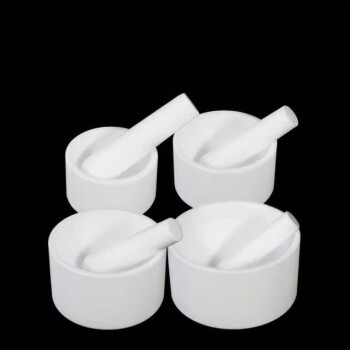
- Custom PTFE Teflon Parts Manufacturer Grinding Bowl
People Also Ask
- Why are PTFE beakers required for hafnium metal ICP-OES validation? Ensure Pure Sample Dissolution
- Why are PTFE containers required for PCT leaching tests? Ensure Chemical Inertness and Analytical Precision
- What role do PTFE containers play in trace metal detection? Ensure Analytical Precision in Photocatalysis Studies
- Why is a PTFE container required for acid leaching of silicon nanosheets? Ensure High Purity and Safety
- Why is PTFE Mandatory for Hydrofluoric Acid (HF) Handling? Ensure Safety and Data Integrity in Corrosion Testing