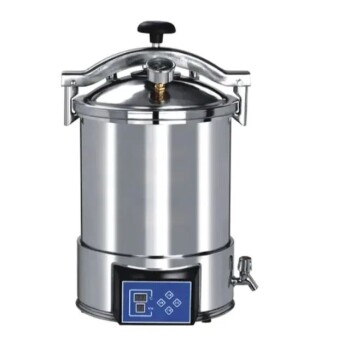
High-pressure reactors create a sealed, high-energy environment that is essential for overcoming the kinetic barriers of bismuth reduction. This setup allows liquid-phase reactions to occur at temperatures far exceeding the boiling point of the solvent, resulting in a hydrothermal or solvothermal state. Under these conditions, the reactor generates autogenous pressure that significantly enhances the solubility and reactivity of bismuth salt precursors like bismuth nitrate.
A high-pressure reactor enables the synthesis of 2D bismuthene by providing a subcritical or supercritical fluid environment where high temperatures and autogenous pressure accelerate precursor reduction and allow for precise control over nanosheet morphology.
The Role of the Hydrothermal and Solvothermal Environment
Achieving Temperatures Beyond Boiling Points
The primary function of the high-pressure reactor is to maintain a sealed environment that prevents the solvent from escaping. This allows the internal temperature to rise well above the atmospheric boiling point of the solvent being used.
By operating in this regime, the reactor provides the thermal energy necessary to initiate the wet chemical synthesis of bismuthene. These elevated temperatures are critical for ensuring that the reduction of the bismuth precursor proceeds to completion.
The Impact of Autogenous Pressure
As the temperature inside the reactor increases, the internal autogenous pressure rises accordingly. This pressure is a direct result of the heating process within the confined space of the autoclave.
This high-pressure environment increases the solubility of reactants and enhances the penetration of the solvent into the molecular structure of the materials. Such conditions are indispensable for creating the specific two-dimensional morphology required for bismuthene.
Kinetics and Morphology Control
Accelerating Precursor Reduction
The combination of high temperature and pressure significantly accelerates the reduction process of bismuth salt precursors. In bismuthene synthesis, this typically involves the transformation of bismuth nitrate into pure bismuth nanosheets.
The high-energy environment facilitates faster reaction rates than could be achieved under standard laboratory conditions. This ensures a more efficient conversion and a more uniform chemical distribution within the final product.
Tuning Nanosheet Geometry
Precise control over the size and thickness of bismuthene nanosheets is achieved by modulating the internal reactor conditions. By adjusting the pressure and temperature, researchers can influence the growth rate of the crystals.
Furthermore, the interaction between these physical conditions and surfactants within the autoclave determines the final 2D structure. This synergy allows for the engineering of bismuthene with specific surface areas and electronic properties.
Understanding the Trade-offs
The Complexity of Interdependent Variables
One of the primary challenges in using a high-pressure reactor is the interdependence of variables. Temperature, pressure, and chemical concentration cannot be adjusted in isolation, as changing one often affects the others.
This complexity requires rigorous process monitoring to ensure consistency between batches. Small fluctuations in the heating rate can lead to variations in the thickness of the bismuthene, potentially impacting its performance in applications.
Technical Safety and Material Limits
Operating at subcritical or supercritical levels places significant stress on the reactor hardware. Specialized materials and seals are required to prevent leaks or mechanical failures under extreme autogenous pressure.
Furthermore, while higher pressure generally increases reactivity, it can also lead to unwanted secondary reactions. Over-reduction or the formation of bulk bismuth instead of 2D bismuthene can occur if the pressure and temperature are not carefully calibrated.
Applying These Conditions to Your Project
Recommendations for Synthesis Goals
To achieve the best results in bismuthene synthesis, consider the following strategic focuses:
- If your primary focus is minimizing nanosheet thickness: Prioritize the precise calibration of surfactant concentrations in tandem with moderate autogenous pressure to inhibit vertical crystal growth.
- If your primary focus is maximizing reaction yield: Focus on reaching the subcritical fluid state to ensure full solubility and rapid reduction of the bismuth nitrate precursor.
- If your primary focus is morphology uniformity: Implement a highly controlled heating ramp to maintain stable pressure conditions throughout the entire solvothermal process.
Utilizing the unique environment of a high-pressure reactor is the most effective method for producing high-quality, two-dimensional bismuthene with tailored structural characteristics.
Summary Table:
| Key Processing Condition | Mechanism | Critical Benefit for Bismuthene |
|---|---|---|
| High Temperature | Exceeds solvent boiling points | Overcomes kinetic barriers for bismuth reduction |
| Autogenous Pressure | Generated in a sealed environment | Increases reactant solubility and solvent penetration |
| Fluid Environment | Subcritical/Supercritical states | Enables precise control over nanosheet morphology |
| Thermal Stability | Controlled heating ramps | Ensures uniform chemical distribution and geometry |
Elevate Your Nanomaterial Synthesis with KINTEK
Precision is the difference between bulk material and high-quality 2D bismuthene. KINTEK specializes in advanced laboratory solutions designed to meet the rigorous demands of wet chemical synthesis. Our premium high-temperature high-pressure reactors and autoclaves provide the stable, autogenous environments essential for subcritical and supercritical fluid reactions.
Beyond reactors, KINTEK offers a comprehensive portfolio to support your entire workflow, including:
- Thermal Processing: Muffle, tube, and vacuum furnaces for post-synthesis treatment.
- Material Preparation: Crushing, milling systems, and hydraulic presses.
- Lab Essentials: Cooling solutions, PTFE products, and high-purity ceramics.
Whether you are a researcher refining nanosheet thickness or a distributor seeking reliable laboratory hardware with proven performance, KINTEK is your partner in innovation.
Contact KINTEK today to find the perfect high-pressure reactor for your research!
References
- R. Shwetharani, R. Geetha Balakrishna. Recent advances in ecofriendly 2D monoelemental bismuthene as an emerging material for energy, catalysis and biomedical applications. DOI: 10.1039/d3tc00587a
This article is also based on technical information from Kintek Solution Knowledge Base .
Related Products
- High Pressure Laboratory Autoclave Reactor for Hydrothermal Synthesis
- Stainless High Pressure Autoclave Reactor Laboratory Pressure Reactor
- Mini SS High Pressure Autoclave Reactor for Laboratory Use
- Customizable High Pressure Reactors for Advanced Scientific and Industrial Applications
- Portable High Pressure Laboratory Autoclave Steam Sterilizer for Lab Use
People Also Ask
- What role does a high-pressure reactor (autoclave) play in the synthesis of NiCuFe-LDH? Master Hydrothermal Growth
- What Role Does a High-Pressure Reactor or Autoclave Play in HA Catalyst Synthesis? Achieve High Surface Area Materials
- What equipment is required for hydrothermal synthesis of Ga0.25Zn4.67S5.08? Optimize Your Semiconductor Production
- What is the function of a high-pressure reactor in the hydrothermal synthesis of boehmite? Expert Process Insights
- What role does an autoclave play in the synthesis of MnO2 nanofibers? Mastering Hydrothermal Growth