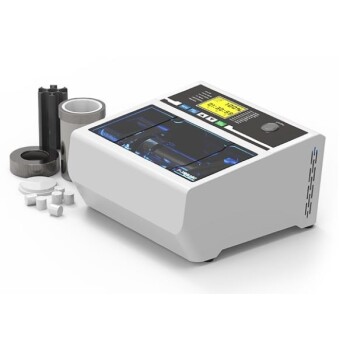
Airtight stainless steel milling jars and balls are utilized primarily to create a sealed, inert environment that prevents highly reactive sulfide precursors from degrading upon contact with air. Simultaneously, the inherent hardness and density of stainless steel provide the high-impact kinetic energy required to drive the mechanochemical reaction, transforming crystalline raw materials into an amorphous glass state.
Core Takeaway The synthesis of oxysulfide glass electrolytes relies on two critical factors: total isolation from atmospheric moisture and the delivery of intense mechanical energy. Airtight stainless steel equipment satisfies both requirements by maintaining an argon shield and delivering the impact force needed to bypass traditional high-temperature melting.
Protecting Reactive Precursors
Preventing Hydrolysis and Oxidation
The primary function of the airtight design is to maintain a protective argon atmosphere throughout the milling process.
Sulfide-based precursors are chemically unstable when exposed to standard atmospheric conditions. Even trace amounts of moisture or oxygen can trigger hydrolysis or oxidation, effectively ruining the ionic conductivity of the final electrolyte.
Containing Hazardous Reactions
Without a sealed environment, the reaction with moisture can generate toxic hydrogen sulfide (H₂S) gas.
The airtight stainless steel jar acts as a safety containment vessel, ensuring that the chemical composition remains pure and the laboratory environment remains safe.
Facilitating Amorphization
Generating Kinetic Energy
Stainless steel grinding media are chosen for their high density and hardness.
During planetary ball milling, the rotation generates significant mechanical collision energy. This impact transfers kinetic energy into the raw material powder, creating localized high temperatures and intense pressure.
Enabling Mechanochemical Alloying
This high-energy environment facilitates a mechanochemical reaction rather than simple mixing.
The force exerted by the stainless steel balls drives the amorphization of the mixture, allowing the raw materials to react completely. This results in the formation of homogeneous glass powders directly, eliminating the need for complex high-temperature melting and quenching steps.
Understanding the Trade-offs: Steel vs. Zirconia
While stainless steel is effective for impact and sealing, it is important to recognize the limitations highlighted by advanced materials science.
The Risk of Metallic Contamination
Stainless steel is susceptible to wear during high-energy milling processes.
Prolonged impact can introduce iron or metallic impurities into the electrolyte mixture. For electrochemical applications, these impurities can negatively affect the stability and performance of the solid-state electrolyte.
The Case for Zirconia Alternatives
To mitigate metallic contamination, Zirconia (ZrO₂) is often used as a superior alternative.
Zirconia offers higher hardness and wear resistance compared to steel. Its chemical inertness prevents metallic doping, ensuring the final electrolyte retains the highest possible purity and ionic conductivity.
Making the Right Choice for Your Goal
When selecting milling equipment for oxysulfide glass electrolytes, your choice depends on balancing impact requirements with purity standards.
- If your primary focus is mechanical efficiency and cost: Stainless steel provides the necessary impact force and atmospheric sealing required for successful amorphization.
- If your primary focus is electrochemical purity: Consider Zirconia (ZrO₂) media to eliminate the risk of metallic contamination while maintaining high wear resistance.
Summary: Airtight stainless steel jars enable the synthesis of sensitive electrolytes by combining atmospheric isolation with the kinetic power needed for mechanochemical alloying.
Summary Table:
| Feature | Airtight Stainless Steel Jars | Purpose in Electrolyte Synthesis |
|---|---|---|
| Airtight Design | Maintains Argon/Inert Atmosphere | Prevents hydrolysis and oxidation of sulfide precursors. |
| High Density Media | High-Impact Kinetic Energy | Drives amorphization and mechanochemical reactions. |
| Material Hardness | Durable Stainless Steel | Provides the impact force required to bypass high-temp melting. |
| Safety Containment | Sealed Vessel | Prevents the release of toxic hydrogen sulfide (H₂S) gas. |
| Purity Consideration | Risk of Iron Contamination | May require Zirconia alternatives for ultra-high purity needs. |
Elevate Your Battery Research with KINTEK Precision Equipment
Achieving the perfect amorphous state for oxysulfide electrolytes requires the right balance of protection and power. KINTEK specializes in providing high-performance laboratory solutions, including crushing and milling systems featuring airtight stainless steel and Zirconia jars, as well as planetary ball mills designed for sensitive material synthesis.
Whether you are developing solid-state electrolytes or advanced battery components, our range of glovebox-compatible milling tools, vacuum furnaces, and hydraulic pellet presses ensures your materials remain pure and your results reproducible.
Ready to optimize your mechanochemical synthesis? Contact KINTEK today to find the ideal milling solution for your lab!
Related Products
- Laboratory Jar Ball Mill with Alumina Zirconia Grinding Jar and Balls
- Laboratory Single Horizontal Jar Mill
- Laboratory Ball Mill Jar Mill with Metal Alloy Grinding Jar and Balls
- Laboratory Jar Mill with Agate Grinding Jar and Balls
- Laboratory Four-Body Horizontal Jar Mill
People Also Ask
- What are the primary functions of using a ball mill for BZCY72 powder? Achieve High Purity and Enhanced Sintering
- In what way does a laboratory ball mill affect material properties when modifying PHBV/pulp fiber composites?
- Why is a laboratory ball mill required for ultra-fine fly ash? Unlock Nano-Scale Adsorption Power
- What is the function of a laboratory ball mill in the preparation of AMMCs? Optimize Dispersion & Grain Refinement
- What is the function of a laboratory ball mill in the pretreatment of waste tire char (WTC)? Optimize Material Reactivity