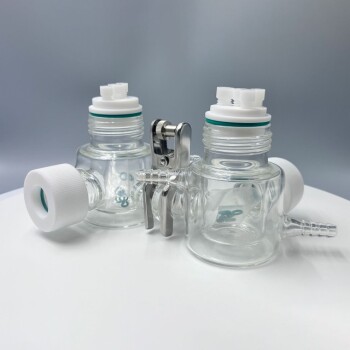
The popularity of H-type dual-chamber electrolytic cells for carbon dioxide electroreduction stems from their ability to physically isolate the reduction reaction from the oxidation reaction. By utilizing an ion exchange membrane to separate the cathode and anode chambers, these cells prevent the valuable products generated during reduction from migrating to the anode and being destroyed.
The H-type cell's separated architecture is the standard for ensuring chemical stability and experimental accuracy. It effectively eliminates the re-oxidation of products while allowing for independent optimization of the electrolyte environment for each electrode.
Preserving Product Integrity
The Mechanism of Separation
The defining feature of the H-type cell is the ion exchange membrane.
This barrier physically divides the electrolytic cell into two distinct compartments: the cathode chamber (where CO2 reduction occurs) and the anode chamber.
Preventing Product Crossover
Without this physical separation, reduction products generated at the cathode would freely diffuse through the electrolyte.
Common products of CO2 reduction include carbon monoxide, formic acid, and various hydrocarbons.
Eliminating Re-oxidation
If these products were allowed to migrate to the anode, they would undergo re-oxidation.
This process would revert the products back to their oxidized forms or degrade them entirely. The H-type design blocks this migration, ensuring that the work done to reduce the CO2 is not immediately undone by the counter electrode.
Optimizing Reaction Conditions
Independent Electrolyte Environments
The dual-chamber structure allows researchers to use different electrolytes in the cathode and anode chambers.
This is a critical advantage for fine-tuning the reaction thermodynamics and kinetics.
Tailoring the Half-Reactions
You can optimize the chemical environment specifically for the CO2 reduction half-reaction without being constrained by the requirements of the anode.
This decoupling ensures that the conditions at the cathode are ideal for maximizing product selectivity and activity.
Ensuring Complete Collection
By preventing product loss through re-oxidation, the H-type cell facilitates complete product collection.
This is essential for accurately calculating Faradaic efficiency and understanding the true performance of the electrocatalyst.
Operational Considerations
Managing Cell Complexity
While the dual-chamber design offers significant chemical advantages, it introduces structural complexity compared to single-chamber cells.
The use of an ion exchange membrane requires careful selection to ensure it permits the necessary ion flow while blocking product molecules.
Electrolyte Compatibility
Leveraging the ability to use different electrolytes requires strict attention to chemical compatibility.
Operators must ensure that the membrane remains stable when exposed to the distinct chemical environments of both the anode and cathode chambers.
Making the Right Choice for Your Goal
When designing a CO2 electroreduction experiment, the H-type cell is generally the preferred starting point for fundamental research.
- If your primary focus is product quantification: The H-type cell is essential to prevent product loss via re-oxidation, ensuring your efficiency calculations are accurate.
- If your primary focus is catalyst optimization: This design allows you to isolate the cathode environment, letting you tune the electrolyte specifically for your catalyst without interference from the anode.
By isolating the half-reactions, the H-type cell transforms a chaotic mixture of competing chemical processes into a controlled, quantifiable system.
Summary Table:
| Feature | Benefit for CO2 Electroreduction |
|---|---|
| Ion Exchange Membrane | Physically isolates cathode and anode compartments to prevent product crossover. |
| Product Integrity | Eliminates re-oxidation of CO, formic acid, and hydrocarbons at the anode. |
| Decoupled Environments | Allows independent optimization of electrolyte pH and concentration for each electrode. |
| Experimental Accuracy | Facilitates complete product collection for precise Faradaic efficiency calculations. |
Elevate Your Electrochemical Research with KINTEK
Precision in carbon dioxide electroreduction requires high-performance hardware. KINTEK provides researchers with specialized H-type dual-chamber electrolytic cells and high-quality electrodes designed to maximize product selectivity and experimental stability.
Beyond our industry-leading electrolytic cells, we offer a comprehensive suite of laboratory solutions, including:
- High-Temperature & Pressure Reactors for advanced catalysis.
- Crushing, Milling, and Sieve Systems for catalyst preparation.
- Precision Hydraulic Presses for pelletizing materials.
- Battery Research Tools and cooling solutions like ULT freezers.
Don't let product re-oxidation compromise your data. Contact KINTEK today to discover how our high-precision consumables and equipment can streamline your laboratory workflow and deliver more accurate results.
References
- Jian Zhao, Xuebin Ke. An overview of Cu-based heterogeneous electrocatalysts for CO<sub>2</sub>reduction. DOI: 10.1039/c9ta11778d
This article is also based on technical information from Kintek Solution Knowledge Base .
Related Products
- H-Type Double-Layer Optical Electrolytic Electrochemical Cell with Water Bath
- H Type Electrolytic Cell Triple Electrochemical Cell
- Double Layer Five-Port Water Bath Electrolytic Electrochemical Cell
- Double-Layer Water Bath Electrolytic Electrochemical Cell
- Customizable PEM Electrolysis Cells for Diverse Research Applications
People Also Ask
- What is the overall structure of the H-type double-layer optical water bath electrolytic cell? Precision Design for Controlled Experiments
- How is the electrolyte managed in H-type electrolytic cells for specific reactions? Achieve Precise Control and High Purity
- What checks should be performed on the H-type electrolytic cell before use? Ensure Accurate Electrochemical Data
- What is important regarding temperature control for the H-type electrolytic cell? Ensure Precision and Data Integrity
- What is the overall structure of the H-type electrolytic cell? Understanding Dual-Chamber Electrochemical Designs