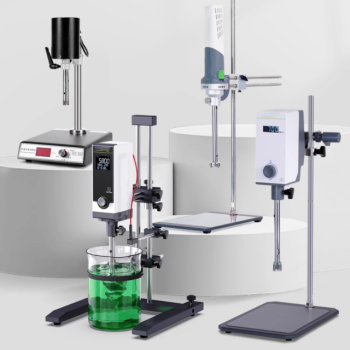
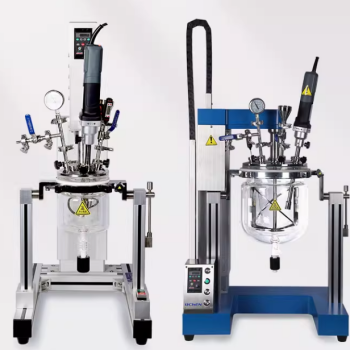
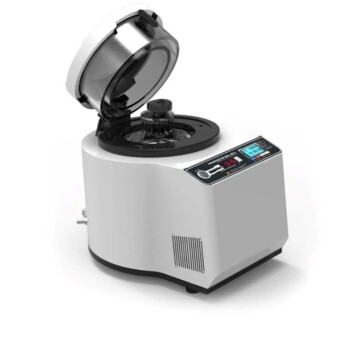
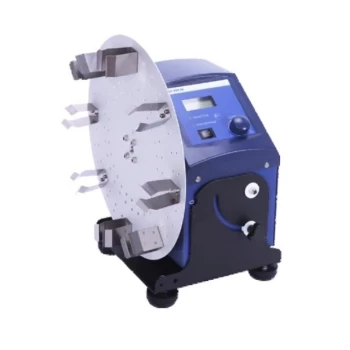
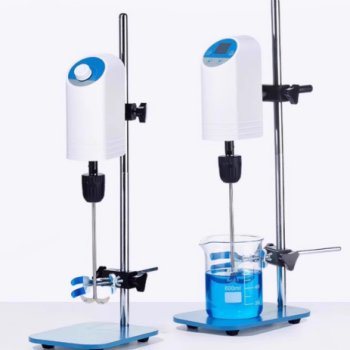
High-energy homogenizers and mechanical stirring systems are required to generate the intense shear forces necessary for breaking down and dispersing nanofillers. In the context of microbial biopolymer composites, simple mixing is often insufficient to overcome the natural tendency of nanoparticles to clump together. These high-energy systems ensure a uniform distribution of fillers within the matrix, which is the foundational requirement for high performance.
The performance of microbial biopolymer composites relies entirely on the uniformity of their internal structure. High-shear processing eliminates microscopic defects by evenly distributing fillers, directly unlocking superior tensile strength and thermal stability.
The Role of Shear Force in Composite Structure
Overcoming Particle Agglomeration
Nanofillers utilized in biopolymers have a strong natural tendency to cluster together due to surface energy. Intense shear forces are the only mechanical means capable of disrupting these clusters.
By breaking these agglomerations, homogenizers allow individual nanoparticles to integrate fully into the biopolymer matrix.
Creating a Uniform Matrix
Once the particles are separated, the stirring system distributes them evenly throughout the material. This ensures that the composite material is consistent at a microscopic level.
Without this uniformity, the material would act as a mixture of separate components rather than a single, reinforced composite.
Eliminating Internal Defects
Preventing Stress Concentrations
In a composite material, clumps of undispersed filler act as internal defects. Under stress, these defects become the starting points for cracks and structural failure.
High-energy homogenization removes these potential failure points by ensuring no large clusters remain.
Enhancing Material Integrity
A defect-free internal structure allows the biopolymer to handle higher loads. This is particularly critical for materials like polyhydroxyalkanoates (PHA) or bacterial cellulose films.
The reduction of defects directly correlates to the reliability and longevity of the final product.
Impact on Material Performance
Boosting Tensile Strength
The primary benefit of uniform dispersion is a significant increase in tensile strength. When fillers are evenly spread, they can effectively bear and transfer mechanical stress across the matrix.
This transforms a naturally brittle or weak biopolymer into a robust engineering material.
Improving Thermal Stability
Beyond physical strength, uniform dispersion enhances the material's resistance to heat. Thermal stability is improved because the well-dispersed nanofillers impede the motion of polymer chains when heated.
This allows the composite to maintain its structural integrity at temperatures that would typically degrade the base biopolymer.
Common Pitfalls to Avoid
Under-processing the Mixture
A common mistake is assuming standard mixing is sufficient for nanocomposites. Low-energy mixing leaves behind micro-agglomerations that are invisible to the naked eye but fatal to material performance.
If the shear force is not high enough, the expensive nanofillers will not contribute to the material properties effectively.
Inconsistent Processing Times
Applying high shear for an insufficient duration can result in a partially dispersed matrix. The process must be maintained long enough to ensure total volume homogeneity.
Stopping the process too early risks leaving localized areas of weakness within the composite.
Making the Right Choice for Your Goal
To maximize the potential of your microbial biopolymer composites, align your processing method with your performance targets:
- If your primary focus is Tensile Strength: You must use high-energy homogenization to eliminate particle clustering, as even small defects will drastically reduce load-bearing capacity.
- If your primary focus is Thermal Stability: Ensure the mechanical stirring is rigorous enough to achieve full dispersion, maximizing the interaction between the filler and the polymer chains to resist heat.
Uniform dispersion is not merely an aesthetic quality; it is the structural prerequisite for high-performance biocomposites.
Summary Table:
| Feature | Impact on Biocomposite Performance | Role of High-Energy Processing |
|---|---|---|
| Particle Dispersion | Prevents agglomeration and clusters | Displaces surface energy with intense shear |
| Structural Integrity | Eliminates microscopic failure points | Prevents stress concentration and cracking |
| Tensile Strength | Enables efficient stress transfer | Ensures a defect-free, uniform matrix |
| Thermal Stability | Increases resistance to heat degradation | Maximizes filler-to-polymer chain interaction |
Elevate Your Material Research with KINTEK Precision
Unlock the full potential of your microbial biopolymers and nanocomposites. KINTEK provides the industry-leading laboratory equipment necessary for high-performance material synthesis, including specialized homogenizers, shakers, and mechanical stirring systems designed to achieve total volume homogeneity.
From high-temperature furnaces and autoclaves to advanced crushing and milling systems, we offer the comprehensive tools needed to eliminate structural defects and boost material integrity. Whether you are working with PHA, bacterial cellulose, or complex biopolymers, our expert solutions ensure your research translates into robust engineering materials.
Ready to optimize your dispersion process? Contact KINTEK today for professional equipment advice and customized lab solutions!
References
- Mohit Sharma, Tarek Rouissi. Microbial Biopolymers: From Production to Environmental Applications—A Review. DOI: 10.3390/app14125081
This article is also based on technical information from Kintek Solution Knowledge Base .
Related Products
- High Shear Homogenizer for Pharmaceutical and Cosmetic Applications
- High Performance Lab Homogenizer for Pharma Cosmetics and Food R&D
- Laboratory High Throughput Tissue Grinding Mill Grinder
- High-Energy Omnidirectional Planetary Ball Mill Machine for Laboratory
- High-Energy Omnidirectional Planetary Ball Mill Milling Machine for Laboratory
People Also Ask
- Why Use a High Shear Homogenizer for Cathode Slurries? Optimize Double-Layer Solid-State Battery Production
- What is the function of high-shear dispersion equipment in corona-resistant nanocomposites? Elevate Your Insulation
- What is the necessity of using an industrial-grade high-shear homogenizer for biomass washing? Ensure Process Efficiency
- What are the advantages of using a high-shear homogenizer for BED/GMA coatings? Achieve Superior Nano-Dispersion
- What role does a high-shear homogenizer play in ODC catalyst suspensions? Unlock Superior Electrochemical Efficiency