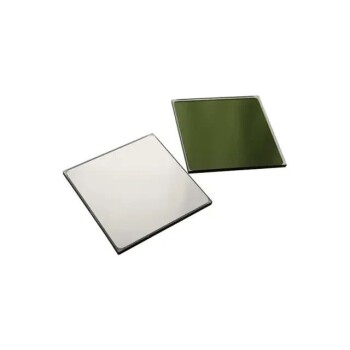
High-purity corundum and silicon substrates act as the essential foundation for Boron Nitride Nanotube (BNNT) synthesis by providing thermal stability and chemical neutrality. These materials ensure that the reaction environment remains uncontaminated while offering the precise surface characteristics necessary for catalyst nucleation and controlled nanotube growth.
High-purity substrates are critical because they remain chemically inert at the extreme temperatures required for BNNT synthesis, preventing side reactions that would otherwise compromise the purity and structural integrity of the nanotubes.
The Role of Stability in High-Temperature Synthesis
Resisting Thermal Degradation at Extreme Temperatures
BNNT synthesis typically occurs in a high-intensity atmosphere tube furnace at temperatures ranging from 1100°C to 1300°C. Corundum and silicon are selected because they can withstand these extreme thermal loads without melting or losing their structural form.
Ensuring Chemical Inertness
At high temperatures, many materials become reactive, but high-purity corundum and silicon do not engage in side reactions with precursors like $W_2B_5/Li$. This chemical neutrality is vital to ensure that the resulting BNNTs are of the highest possible purity and free from substrate-derived contaminants.
Maintaining a Stable Micro-Environment
These substrates provide a physical platform that supports the Chemical Vapor Deposition (CVD) process within a stable ammonia ($NH_3$) flow. This stability allows the self-catalytic ternary compound precursors to react predictably, leading to the growth of high-purity nanotubes with high aspect ratios.
Influencing Nanotube Growth and Morphology
Controlling Nucleation Density
The surface characteristics of the substrate directly dictate the distribution and nucleation density of catalytic particles. By providing a consistent surface, these substrates allow researchers to observe and control how nanotubes begin to form at various interfaces.
Optimizing Growth Behavior
Substrate selection influences how the BNNTs align and attach during the synthesis process. A high-purity surface ensures that the catalytic behavior remains focused on the precursor materials rather than being disrupted by surface impurities or structural defects in the support platform.
Preserving Surface Quality
Just as boron nitride powder is used as an embedding material to prevent adhesion in ceramics, high-purity substrates ensure the structural integrity of the sample. They prevent the synthesized nanotubes from fusing with the furnace hardware or the ceramic crucible.
Understanding the Trade-offs
Purity Requirements vs. Material Cost
While high-purity corundum and silicon offer the best performance, the cost of high-grade materials can be significant. Lower-purity alternatives may introduce trace elements that act as poisons to the catalyst, drastically reducing the yield of high-aspect-ratio nanotubes.
Substrate-Precursor Compatibility
While silicon is excellent for many CVD processes, its melting point (approx. 1414°C) is relatively close to the upper limits of BNNT synthesis. Corundum (alumina) offers a higher thermal ceiling but may have different surface energy levels that affect the initial wetting of the catalyst.
How to Apply This to Your Project
When selecting a substrate for BNNT synthesis, consider the specific thermal and chemical requirements of your precursor system.
- If your primary focus is Maximum Purity: Utilize high-purity corundum to ensure zero chemical interaction between the substrate and the $W_2B_5/Li$ precursors at temperatures exceeding 1200°C.
- If your primary focus is Precise Nucleation Control: Opt for silicon substrates, as their well-defined surface morphology allows for more predictable distribution of catalytic particles during the initial growth phase.
- If your primary focus is Scalability and Cost-Effectiveness: Evaluate the minimum purity levels required to prevent catalyst poisoning, balancing the cost of corundum against the desired aspect ratio of the BNNTs.
By prioritizing chemical inertness and thermal resilience, you ensure a stable environment that translates directly into superior nanotube quality.
Summary Table:
| Feature | High-Purity Corundum (Alumina) | Silicon Substrate |
|---|---|---|
| Thermal Stability | Excellent (up to 1800°C+) | Good (Melting point ~1414°C) |
| Chemical Inertness | Exceptionally high; prevents side reactions | High; remains stable in CVD environments |
| Surface Control | Optimal for preventing sample adhesion | Superior for precise catalyst nucleation |
| Best Used For | Maximum purity at temperatures >1200°C | Predictable morphology & nucleation control |
Elevate Your Nanomaterial Research with KINTEK
Achieving the perfect Boron Nitride Nanotube (BNNT) structure requires more than just high-purity substrates—it demands a controlled thermal environment. KINTEK specializes in high-performance laboratory equipment, offering state-of-the-art high-intensity atmosphere tube furnaces, CVD systems, and premium ceramic crucibles specifically designed for advanced synthesis.
Whether you are focusing on nucleation control or scaling up high-purity production, our expert-grade tools ensure your materials meet the highest standards of structural integrity. Contact us today to discover how KINTEK’s precision furnaces and laboratory consumables can optimize your synthesis workflow!
References
- Nanyang Wang, Yagang Yao. Self‐Catalytic Ternary Compounds for Efficient Synthesis of High‐Quality Boron Nitride Nanotubes. DOI: 10.1002/smll.202206933
This article is also based on technical information from Kintek Solution Knowledge Base .
Related Products
- Boron Nitride (BN) Ceramic Tube
- Hexagonal Boron Nitride HBN Thermocouple Protection Tube
- Boron Nitride (BN) Ceramic Plate
- Boron Nitride (BN) Ceramic Rod for High Temperature Applications
- Conductive Boron Nitride BN Ceramics Composite for Advanced Applications
People Also Ask
- Why are Boron Nitride Tubes selected as reaction vessels for Na3SbS4? Ensure Purity in High-Temp Synthesis
- What is the maximum temperature for a ceramic tube? Find the Right Material for Your High-Temp Needs
- What is the temperature resistance of a ceramic tube? It Depends on the Material—Find the Right Fit
- What is the temperature range of a ceramic tube? Select the Right Material for Your High-Temp Needs
- What are ceramic tubes used for? Essential Components for Extreme Heat & Electrical Insulation