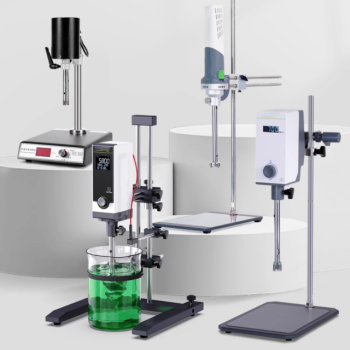
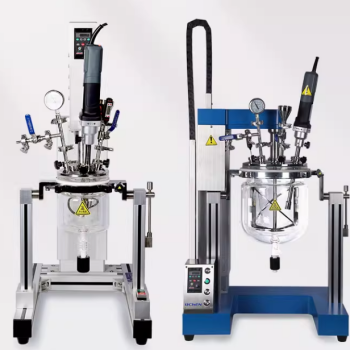
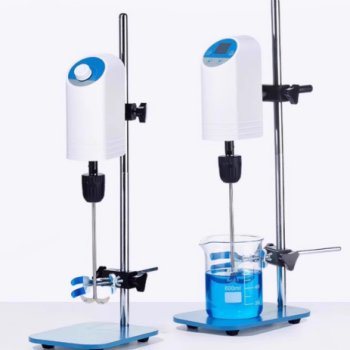
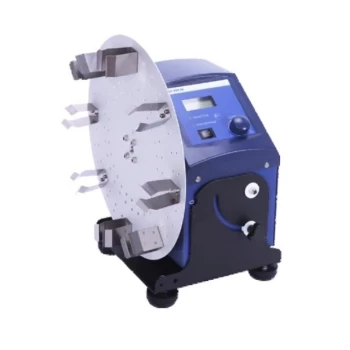
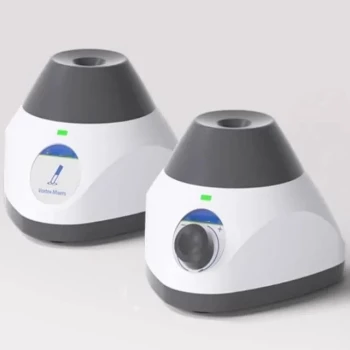
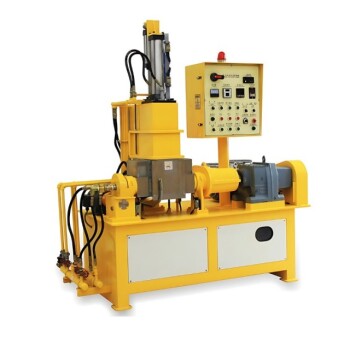
High-shear strong mixers are non-negotiable because nanoparticles possess immense surface area, causing them to naturally clump together into tight clusters. Standard mixing lacks the physical force to break these bonds; only high-shear energy can separate the particles to ensure they are evenly distributed throughout the concrete matrix.
Core Takeaway: Nanomaterials like nano-silica act as powerful reinforcing agents only when effectively separated. Without high-shear mixing to break down agglomerates, these particles remain clumped, failing to improve compressive strength or reduce permeability.
The Challenge of Nanoparticle Physics
High Specific Surface Area
Nanomaterials, such as nano-silica and carbon nanotubes, are defined by their extremely small size and massive specific surface area. This physical characteristic is what makes them chemically potent.
However, this vast surface area creates strong inter-particle attraction. The particles naturally gravitate toward one another immediately upon introduction to the mix.
The Formation of Agglomerates
Because of this attraction, nanoparticles do not flow freely like sand or cement. Instead, they form distinct clusters known as agglomerates.
In a standard mix, these agglomerates act essentially as large, porous grains. If they are not broken down, the material cannot interact with the cement paste on a microscopic level.
The Function of High-Shear Mixing
Overcoming Inter-Particle Forces
Standard concrete mixers rely on tumbling or low-speed rotation to blend ingredients. This motion provides insufficient energy to overcome the forces holding nanoparticle agglomerates together.
High-shear mixers apply intense, localized stress to the fluid. This mechanical energy is required to physically "shred" the agglomerates apart.
Ensuring Uniform Dispersion
Once the agglomerates are broken, the mixer must distribute the individual particles evenly.
Uniform dispersion is critical for the chemical reaction. It ensures that the nanoparticles are available throughout the entire cement paste to modify the microstructure.
Impact on Concrete Performance
Maximizing Compressive Strength
When nanoparticles are well-dispersed, they accelerate hydration and densify the cement matrix.
This results in a significant increase in compressive strength. If the particles remain agglomerated, this strength gain is lost, and the clumps may even introduce weak points.
Minimizing Permeability
Dispersed nanoparticles fill the microscopic voids between cement grains.
This "pore-filling" effect drastically reduces permeability. By blocking pathways for water and chemicals, the concrete becomes more durable and resistant to environmental attack.
Understanding the Trade-offs
Equipment Complexity and Cost
Implementing high-shear mixing requires specialized equipment. It adds a layer of complexity to the batching process that standard drum mixers cannot handle.
Heat Generation
The physics of shearing creates friction. High-shear mixing generates significantly more heat than standard mixing.
This heat can accelerate the chemical reaction of the cement. You must monitor the mix temperature closely to avoid issues with flash setting or reduced workability time.
Making the Right Choice for Your Goal
To effectively utilize nanotechnology in concrete, you must match your mixing energy to the material's requirements.
- If your primary focus is Structural Integrity: You must use high shear to fully disperse particles, as this is the only way to achieve maximum compressive strength.
- If your primary focus is Durability: You must prioritize uniform dispersion to ensure the permeability of the concrete is consistently lowered across the entire structure.
The potential of nanomaterials is unlocked not by their chemistry alone, but by the mechanical energy used to disperse them.
Summary Table:
| Feature | Standard Mixing | High-Shear Mixing |
|---|---|---|
| Mechanism | Low-speed tumbling/rotation | Intense, localized mechanical stress |
| Particle State | Large agglomerates/clumps | Uniformly dispersed individual particles |
| Hydration Effect | Limited chemical interaction | Accelerated and complete hydration |
| Concrete Strength | Negligible improvement | Significant increase in compressive strength |
| Permeability | High (voids remain) | Low (microscopic voids filled) |
| Heat Generation | Minimal | Significant (requires monitoring) |
Elevate Your Material Research with KINTEK Precision
Don't let nanoparticle agglomeration compromise your structural integrity. KINTEK specializes in advanced laboratory equipment designed to meet the rigorous demands of nanotechnology and concrete research. Whether you need high-shear crushing and milling systems, pellet presses, or specialized high-temperature furnaces, our solutions ensure your materials achieve maximum dispersion and performance.
Ready to optimize your mixing process? Contact our experts today to find the perfect equipment for your research and production needs!
References
- Noorullah Zahid, Fada Mohammad Mohammadi. Effect of nano-materials on mechanical properties of cement and concrete. DOI: 10.33545/27068919.2022.v4.i1c.706
This article is also based on technical information from Kintek Solution Knowledge Base .
Related Products
- High Shear Homogenizer for Pharmaceutical and Cosmetic Applications
- High Performance Lab Homogenizer for Pharma Cosmetics and Food R&D
- High Performance Laboratory Stirrers for Diverse Applications
- Laboratory Disc Rotary Mixer for Efficient Sample Mixing and Homogenization
- Laboratory Vortex Mixer Orbital Shaker Multifunctional Rotation Oscillation Mixer
People Also Ask
- Why Use a High Shear Homogenizer for Cathode Slurries? Optimize Double-Layer Solid-State Battery Production
- What is the function of high-shear dispersion equipment in corona-resistant nanocomposites? Elevate Your Insulation
- What is the necessity of using an industrial-grade high-shear homogenizer for biomass washing? Ensure Process Efficiency
- What are the advantages of using a high-shear homogenizer for BED/GMA coatings? Achieve Superior Nano-Dispersion
- What role does a high-shear homogenizer play in ODC catalyst suspensions? Unlock Superior Electrochemical Efficiency