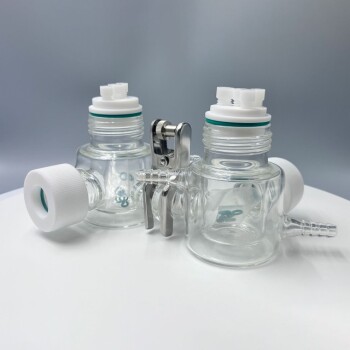
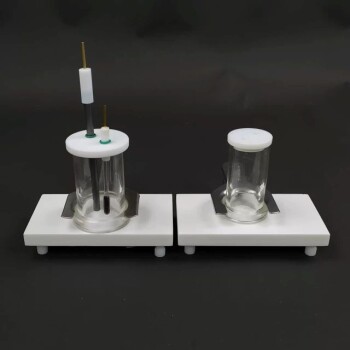
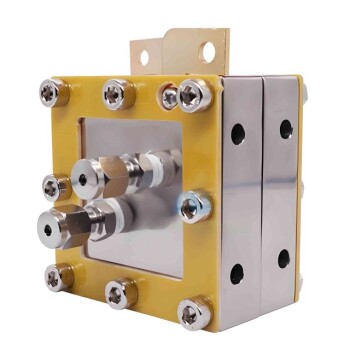
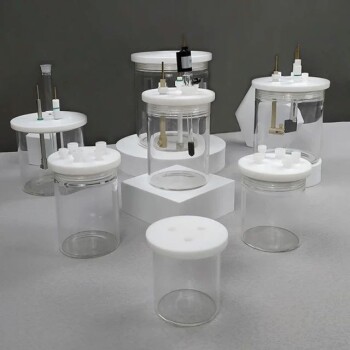
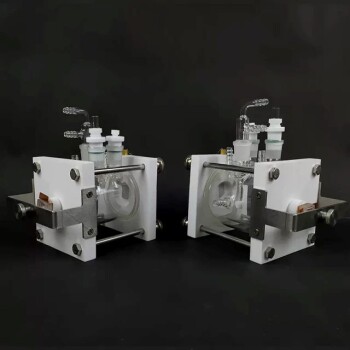
The primary utility of a double-chamber H-type glass electrolytic cell is to enforce physical isolation between the anode and cathode compartments during experimentation. This separation is strictly necessary to prevent oxidation products generated at the anode from migrating to the cathode, where they would be re-reduced and invalidate the results.
In glycerol electrolysis, accurate data relies on preventing cross-contamination between electrodes. The H-type cell acts as a physical barrier, ensuring that oxidation products remain stable and are not reversed by the cathode, allowing for precise evaluation of reaction pathways.
The Mechanics of Separation
Preventing Product Re-reduction
In a standard single-chamber setup, chemical species are free to circulate between electrodes. During glycerol electrolysis, the anode generates specific oxidation products, such as glyceraldehyde or dihydroxyacetone.
Without physical isolation, these products can diffuse toward the cathode. Upon contact, the cathode effectively reverses the reaction, re-reducing the products and altering the chemical composition of the electrolyte.
Ensuring Analytical Accuracy
This cycle of oxidation and re-reduction corrupts the data. It makes it impossible to distinguish between the actual rate of product formation and the rate of product loss at the counter electrode.
The H-type structure traps the target compounds in the anode chamber. This ensures that when you sample the solution, the concentration reflects the true yield of the reaction.
Evaluating Reaction Efficiency
Isolating Reaction Pathways
To optimize glycerol oxidation, researchers must evaluate the efficiency of the process. This involves analyzing both direct and indirect electrochemical oxidation pathways.
The double-chamber configuration allows for this precise evaluation. By removing cathodic interference, you can attribute changes in efficiency directly to the anodic mechanism being studied.
Operational Considerations and Trade-offs
Material Fragility
While the glass construction provides necessary chemical resistance and visibility, it introduces handling risks. The H-type cell is inherently fragile compared to industrial metallic setups.
You must exercise extreme caution during assembly, cleaning, and stirring. A minor fracture or chip can break the isolation between chambers, rendering the batch of data useless.
Batch Process Limitations
This specific cell structure is optimized for batch electrolysis. It is designed for fundamental studies and initial product analysis rather than high-volume production.
While it excels at accuracy, the data derived from an H-type cell may require adjustment before it can be extrapolated to continuous flow industrial systems.
Maximizing Experimental Success
To extract the most value from your H-type cell configuration, align your protocol with your analytical objectives:
- If your primary focus is quantifying yield: rigorous isolation is your priority; ensure the bridge or separator between chambers is functioning perfectly to prevent any product crossover.
- If your primary focus is mechanism discovery: utilize the separated chambers to test different electrolytes or mediators in the anode compartment without affecting the cathode's stability.
The H-type cell is not merely a vessel; it is a precision tool for isolating variables and validating the true efficiency of your electrochemical system.
Summary Table:
| Feature | Purpose in Glycerol Electrolysis | Key Benefit |
|---|---|---|
| Dual-Chamber Design | Separates anode and cathode reactions | Prevents oxidation products from re-reducing |
| H-Type Bridge | Provides physical barrier for ionic flow | Eliminates cross-contamination of chemical species |
| Glass Construction | Chemical resistance and visibility | Allows for precise observation of reaction pathways |
| Batch Optimization | Small-scale fundamental study | High accuracy for quantifying product yields |
Elevate Your Electrochemical Research with KINTEK
Precise results depend on superior equipment. KINTEK specializes in high-performance laboratory solutions, providing researchers with the exact tools needed for complex glycerol electrolysis and material science.
Our extensive portfolio includes:
- Electrolytic cells and electrodes (including H-type, double-chamber, and specialized glass cells)
- High-temperature high-pressure reactors and autoclaves
- Battery research tools and advanced consumables
- Muffle, tube, and vacuum furnaces for material synthesis
- Precision hydraulic presses and milling systems
Don't let cross-contamination or equipment failure compromise your data. Partner with KINTEK for durable, high-precision laboratory equipment and consumables tailored to your specific research goals.
Ready to optimize your lab setup? Contact us today to explore our full range of solutions!
References
- Michael Guschakowski, Uwe Schröder. Direct and Indirect Electrooxidation of Glycerol to Value‐Added Products. DOI: 10.1002/cssc.202100556
This article is also based on technical information from Kintek Solution Knowledge Base .
Related Products
- H-Type Double-Layer Optical Electrolytic Electrochemical Cell with Water Bath
- H Type Electrolytic Cell Triple Electrochemical Cell
- Side Window Optical Electrolytic Electrochemical Cell
- Thin-Layer Spectral Electrolysis Electrochemical Cell
- Optical Water Bath Electrolytic Electrochemical Cell
People Also Ask
- What is the overall structure of the H-type double-layer optical water bath electrolytic cell? Precision Design for Controlled Experiments
- How is the electrolyte managed in H-type electrolytic cells for specific reactions? Achieve Precise Control and High Purity
- What checks should be performed on the H-type electrolytic cell before use? Ensure Accurate Electrochemical Data
- What is important regarding temperature control for the H-type electrolytic cell? Ensure Precision and Data Integrity
- What is the overall structure of the H-type electrolytic cell? Understanding Dual-Chamber Electrochemical Designs