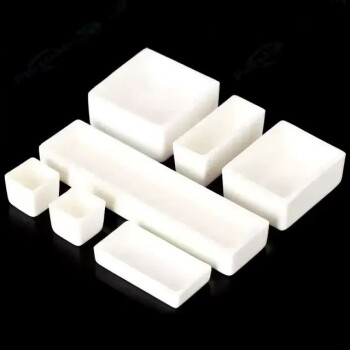
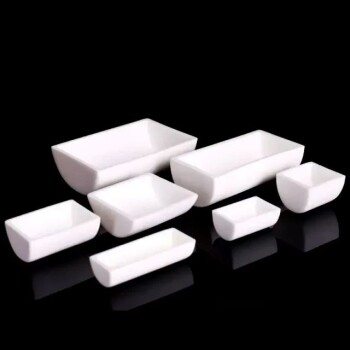
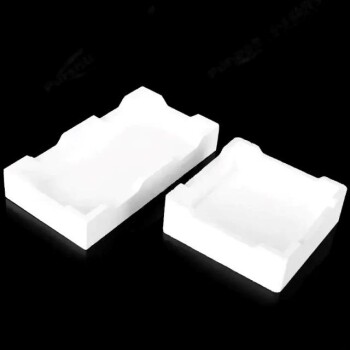
A flat-bottom alumina ceramic boat is the preferred vessel for high-temperature synthesis because it provides a chemically inert environment that prevents sample contamination. It is specifically engineered to withstand extreme thermal conditions—often exceeding 1200°C—without reacting with source materials like Zinc Oxide, graphite, or corrosive fluxes. Furthermore, its flat geometry is essential for ensuring uniform heat distribution and a stable vapor concentration gradient, both of which are critical for the formation of precise nanostructures and high-purity crystals.
The choice of a flat-bottom alumina boat balances chemical purity with thermal precision. It acts as a stable, non-reactive platform that optimizes the physical environment to ensure consistent and reproducible material synthesis.
The Role of Chemical Inertness and Purity
Eliminating Material Cross-Contamination
Alumina ($\text{Al}_2\text{O}_3$) is highly stable and does not react with common reagents like Zinc Oxide (ZnO) or graphite at high temperatures (e.g., 860°C to 1020°C). This ensures that no unwanted elements are leached into the synthesis process, maintaining the high purity of the generated vapor.
Resistance to Corrosive Atmospheres
High-purity alumina boats effectively resist chemical corrosion even in aggressive environments, such as strongly reducing ammonia atmospheres or alkaline activation conditions. This makes them ideal for specialized processes like nitridation or the production of activated carbon.
Protection of the Equipment
By acting as a refractory container, the boat prevents direct contact between the reactants and the furnace tube. This protects expensive equipment from chemical damage and prevents the furnace tube itself from introducing impurities into the sample.
Thermal Stability and Structural Integrity
High Refractory Performance
Alumina possesses an extremely high melting point and superior heat resistance, allowing it to remain structurally sound at temperatures exceeding 1200°C. It will not sag, melt, or collapse even when holding heavy powders or molten fluxes like KCl.
Superior Thermal Shock Resistance
These boats are designed to endure rapid temperature fluctuations without cracking or shattering. This durability is vital for experimental setups that require quick heating or cooling cycles to achieve specific material phases.
Strategic Benefits of the Flat-Bottom Design
Promoting Uniform Heating
The flat-bottom geometry ensures that the source material is spread in a thin, even layer with maximum contact against the base. This promotes consistent heat transfer throughout the sample, preventing localized hot spots that could ruin the reaction.
Maintaining Stable Vapor Gradients
In vapor-phase synthesis, a flat boat helps maintain a stable vapor concentration gradient within the tube furnace. This stability is a prerequisite for the growth of morphologically complete nanorod arrays and other complex 2D crystals.
Enhancing Gas-Phase Interaction
The wide, open geometry of a flat boat increases the surface area contact between raw materials and reaction gases (such as phosphine or ammonia). This surface exposure is conducive to thorough reactions, ensuring that the entire sample is processed completely.
Understanding the Trade-offs
Brittleness and Handling
While alumina is thermally robust, it is a ceramic and remains highly brittle. It is susceptible to mechanical failure if dropped or handled with metal tools that can cause micro-fractures.
Porosity vs. Purity
Lower-grade alumina boats may have higher porosity, which can trap residual chemicals from previous experiments. To avoid cross-contamination between different projects, researchers must use high-density, non-porous alumina or dedicated boats for specific materials.
Limits of Chemical Inertness
Although alumina is generally inert, it can react with certain highly aggressive molten salts or strong acids at extremely high temperatures. In these specialized cases, alternative materials like platinum or graphite may be required.
How to Apply This to Your Project
Selecting the Right Vessel
- If your primary focus is nanostructure morphology: Use a flat-bottom boat to ensure the stable vapor gradient required for uniform nanorod or nanowire growth.
- If your primary focus is chemical purity: Select the highest possible purity alumina (99%+) to prevent trace elements from interfering with VLS or VS growth mechanisms.
- If your primary focus is high-volume gas interaction: Utilize the flat geometry to spread your sample thinly, maximizing the contact area between the solid powder and the reaction gas.
The flat-bottom alumina boat remains the definitive choice for researchers who require a balance of extreme thermal endurance and absolute chemical isolation.
Summary Table:
| Feature | Key Benefit | Practical Application |
|---|---|---|
| Chemical Inertness | Prevents sample contamination & corrosion | Synthesis of ZnO, graphite, & nitrides |
| Flat-Bottom Geometry | Ensures uniform heat & stable vapor gradient | Growth of nanorod arrays & 2D crystals |
| Thermal Resistance | Withstands temperatures exceeding 1200°C | High-temp sintering & molten flux handling |
| High Surface Area | Maximizes gas-solid interaction | Efficient gas-phase reactions & activations |
Optimize Your High-Temperature Synthesis with KINTEK
Precision in material research begins with the right environment. KINTEK provides high-purity alumina ceramic boats, crucibles, and PTFE products specifically engineered to withstand extreme thermal conditions while ensuring zero cross-contamination.
Whether you are conducting CVD experiments, battery research, or complex crystal growth, our comprehensive range of laboratory equipment—including high-temperature tube furnaces, vacuum systems, and crushing equipment—is designed to meet the rigorous standards of modern science.
Why choose KINTEK?
- Superior Materials: 99%+ purity alumina for absolute chemical isolation.
- Thermal Excellence: Robust solutions for muffle, rotary, and dental furnaces.
- Complete Solutions: From hydraulic pellet presses to cooling solutions and shakers.
Ready to elevate your lab's efficiency and reproducibility? Contact our specialists today to find the perfect high-performance consumables and equipment for your project!
References
- Dhruva Jindal. Fabrication & Test of Semiconductor Nanorods based Field Emitters for Applications in Advanced Sensors. DOI: 10.21275/sr23920153829
This article is also based on technical information from Kintek Solution Knowledge Base .
Related Products
- Engineering Advanced Fine Alumina Al2O3 Ceramic Crucible for Laboratory Muffle Furnace
- Aluminized Ceramic Evaporation Boat for Thin Film Deposition
- Alumina Al2O3 Ceramic Crucible Semicircle Boat with Lid for Engineering Advanced Fine Ceramics
- Ceramic Evaporation Boat Set Alumina Crucible for Laboratory Use
- Hemispherical Bottom Tungsten Molybdenum Evaporation Boat
People Also Ask
- What crucible is used in muffle furnace? Select the Right Material for Your Application
- Why are alumina crucibles and mother powder essential for LATP sintering? Optimize Your Solid Electrolyte Performance
- Why are high-purity alumina crucibles used for liquid lead corrosion experiments? Ensure Data Accuracy at 550°C
- Why Use Alumina Crucibles & Powder Burial for NaSICON? Ensure Phase Purity and Prevent Elemental Volatilization
- What is the primary purpose of using alumina crucibles for LLTO ceramics? Optimize Your High-Temperature Sintering