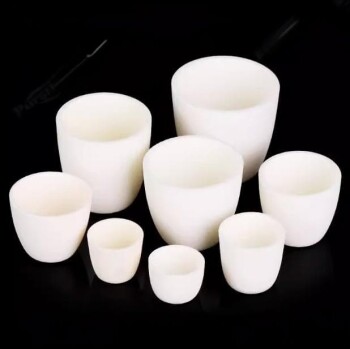
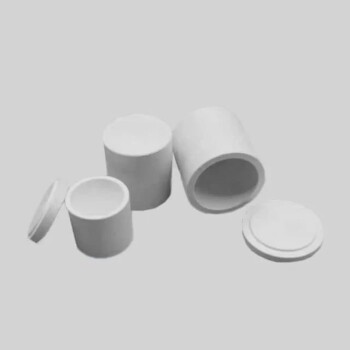
The selection of an alumina crucible is critical for the synthesis of LATP glass due to its dual capability of withstanding extreme thermal environments and resisting chemical attack. These crucibles maintain their structural integrity at temperatures up to 1500°C, ensuring the vessel does not fail during the melting process. Furthermore, the chemical stability of alumina prevents the molten glass from reacting with the crucible walls, thereby preserving the purity and homogeneity of the final material.
Core Takeaway: The crucible is not merely a container; it is a process variable. Alumina is chosen to isolate the LATP melt from physical contamination (via structural failure) and chemical contamination (via reaction with the vessel walls), ensuring the final glass composition is exact.
Thermal Stability and Structural Integrity
Withstanding Extreme Heat
The synthesis of LATP glass requires a melting process involving significant thermal energy. An alumina crucible is specifically employed because it offers superior high-temperature resistance.
Reliable Containment
The material is capable of maintaining structural integrity at temperatures as high as 1500°C. This robustness ensures that the vessel remains stable and does not deform or collapse, providing a secure environment for the raw materials throughout the heating cycle.
Chemical Inertness and Material Quality
Preventing Chemical Reactions
Molten glass can be highly reactive, often attempting to dissolve or interact with the material holding it. Alumina is chemically stable, acting as an inert barrier between the heat source and the raw materials.
Ensuring Homogeneity
Because alumina prevents chemical reactions between the melt and the crucible walls, the resulting LATP glass maintains a uniform composition. This stability ensures that no foreign elements alter the intended formulation of the glass.
The Trade-off: Compatibility vs. Contamination
Understanding Material Leaching
In high-temperature synthesis, the wrong vessel choice leads to "leaching," where crucible components bleed into the glass melt. While other materials like platinum are used for different glass types (such as medieval model glass) to prevent this, they are specific to those chemical ratios.
The Consequence of Interaction
If a crucible is not sufficiently inert relative to the specific glass being melted, the precise ratio of oxides will be compromised. In the context of LATP, relying on alumina minimizes this risk, whereas a less stable material would almost certainly degrade the purity of the final product.
Making the Right Choice for Your Goal
To ensure the success of your LATP glass synthesis, consider your specific processing requirements:
- If your primary focus is Thermal Safety: Utilize alumina to ensure the melting vessel retains its shape and strength at temperatures up to 1500°C.
- If your primary focus is Material Purity: Rely on alumina’s chemical inertness to prevent wall reactions that would contaminate the melt and alter the glass homogeneity.
By selecting the correct crucible material, you transform the vessel from a potential contaminant into a guarantor of quality.
Summary Table:
| Feature | Benefit for LATP Synthesis |
|---|---|
| Max Temperature | Up to 1500°C; ensures structural integrity during extreme heating. |
| Chemical Stability | Prevents reactions between molten glass and vessel walls; maintains purity. |
| Material Purity | Minimizes leaching of foreign elements to ensure exact oxide ratios. |
| Thermal Resilience | Resists deformation or collapse during rigorous heating cycles. |
Elevate Your Materials Research with KINTEK
Precision in LATP glass synthesis starts with the right equipment. KINTEK specializes in high-performance laboratory solutions designed for the most demanding thermal processes. Whether you require high-temperature muffle or tube furnaces, specialized cruibles and ceramics, or advanced high-pressure reactors, we provide the tools necessary to prevent contamination and ensure material homogeneity.
Don't let inferior vessels compromise your research results. Our comprehensive portfolio—including crushing systems, hydraulic presses, and battery research consumables—is engineered to meet the exact standards of modern science.
Ready to optimize your high-temperature workflows? Contact us today to find the perfect solution for your lab!
Related Products
- Arc-Shaped Alumina Ceramic Crucible High Temperature Resistant for Engineering Advanced Fine Ceramics
- Alumina Al2O3 Ceramic Crucible Semicircle Boat with Lid for Engineering Advanced Fine Ceramics
- Engineering Advanced Fine Ceramics Alumina Al2O3 Crucible With Lid Cylindrical Laboratory Crucible
- Engineering Advanced Fine Ceramics Alumina Crucibles (Al2O3) for Thermal Analysis TGA DTA
- Engineering Advanced Fine Alumina Al2O3 Ceramic Crucible for Laboratory Muffle Furnace
People Also Ask
- Why Use Alumina Crucibles & Powder Burial for NaSICON? Ensure Phase Purity and Prevent Elemental Volatilization
- What is the primary purpose of using alumina crucibles for LLTO ceramics? Optimize Your High-Temperature Sintering
- Why are alumina crucibles and mother powder essential for LATP sintering? Optimize Your Solid Electrolyte Performance
- Why are high-purity alumina crucibles used for liquid lead corrosion experiments? Ensure Data Accuracy at 550°C
- Primary considerations for choosing alumina crucibles and quartz tubes in indium intercalation: Ensure Material Purity