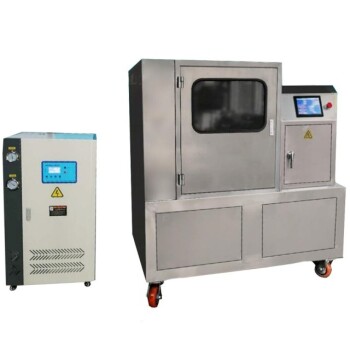
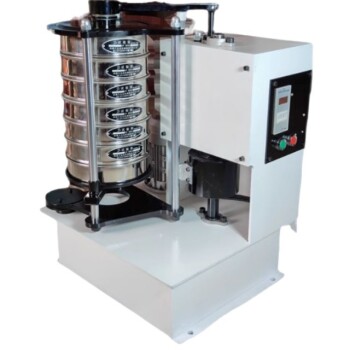
High-energy vibrating mills are essential because standard mixing methods cannot achieve the extreme homogeneity required for precise analytical calibration. When preparing LiF–NaF–KF (FLiNaK) mechanical mixtures, simple blending often fails to prevent component segregation between the salt matrix and trace lithium oxide. The vibrating mill utilizes high-energy collisions and shearing forces to enforce deep mixing, ensuring the additives are uniformly distributed throughout the powder.
To generate a reliable reductive fusion analysis curve, you must eliminate segregation between the matrix and trace additives. The vibrating mill achieves this through deep mixing, allowing for the creation of calibration standards with precise concentration gradients.
The Physics of High-Performance Mixing
Overcoming Particle Segregation
In mechanical mixtures, particles of different densities and sizes naturally separate. Segregation destroys the validity of a calibration standard because a sample taken from one part of the mixture will differ from another. A high-energy vibrating mill prevents this settling by subjecting the powder to constant, chaotic motion.
The Role of Shearing Forces
Standard mixers often just tumble ingredients, but vibrating mills introduce high-energy collisions. These collisions generate significant shearing forces within the jar. This physical stress breaks down agglomerates (clumps) of lithium oxide powder that would otherwise distort analysis.
Achieving Deep Homogenization
The primary reference emphasizes the need for "deep, prolonged mixing." This ensures that the purified fluoride salt matrix and the known quantities of lithium oxide become indistinguishable as separate phases at a macroscopic level. The result is a unified mixture where the trace additive is locked into the matrix structure.
The Impact on Analytical Calibration
Establishing Precise Gradients
Calibration requires standards with known, specific concentrations to act as a reference "ruler." The high-energy mill allows you to prepare these standards with precise concentration gradients. Without this precision, you cannot correlate the signal from the instrument to a specific quantity of oxygen.
Ensuring Curve Reliability
The ultimate goal is generating a reductive fusion analysis curve. If the calibration standards are not homogeneous, the resulting curve will be non-linear or erratic. Using a vibrating mill eliminates the variable of mixing quality, ensuring the curve reflects true chemical composition.
Understanding the Trade-offs
Potential for Contamination
High-energy collisions involve significant impact between the grinding media (balls) and the jar walls. There is a risk of abrasive contamination entering the sample if the milling hardware is not made of compatible, high-hardness materials. You must ensure the jar and media materials do not introduce elements that interfere with oxygen analysis.
Heat Generation
The kinetic energy from prolonged, high-energy milling translates into heat. Excessive heat can potentially alter the hydration state of hygroscopic salts like LiF, NaF, and KF. Users must monitor the process to ensure the temperature does not degrade the sample before analysis.
Making the Right Choice for Your Goal
Reliable oxygen analysis depends entirely on the quality of your reference materials. When preparing your calibration workflow, consider these factors:
- If your primary focus is calibration accuracy: Prioritize high-energy milling to guarantee the elimination of segregation and the creation of a linear, reliable standard curve.
- If your primary focus is sample integrity: Monitor the milling duration to balance the need for deep homogenization against the risks of heat generation or media contamination.
By using high-energy forces to lock trace additives into the matrix, you transform a simple mixture into a trusted analytical standard.
Summary Table:
| Feature | High-Energy Vibrating Mill | Standard Mixing Methods |
|---|---|---|
| Mixing Mechanism | High-energy collisions & shearing forces | Basic tumbling & gravity |
| Homogeneity | Deep homogenization (molecular level) | Low (prone to segregation) |
| Agglomerate Removal | Breaks down Li2O clumps effectively | Inefficient; clumps remain |
| Calibration Goal | Linear, reliable standard curves | Non-linear or erratic curves |
| Risk Factor | Heat generation & contamination control | Poor concentration gradient accuracy |
Elevate Your Analytical Precision with KINTEK
Achieving perfect homogeneity in LiF–NaF–KF mixtures is critical for reliable calibration. KINTEK specializes in advanced laboratory solutions designed to meet the most demanding sample preparation needs. From high-performance crushing and milling systems to precision high-temperature furnaces and pellet presses, we provide the tools necessary to eliminate segregation and ensure deep mixing for your oxygen analysis standards.
Don't let sample inconsistency compromise your research. Partner with KINTEK to access a comprehensive range of laboratory equipment, including specialized high-temperature high-pressure reactors, crucibles, and vacuum furnaces. Our experts are ready to help you optimize your workflow and achieve superior analytical results.
Contact KINTEK Today to Find Your Perfect Lab Solution
References
- Anna A. Maslennikova, Wei‐Qun Shi. Determination of the Oxygen Content in the LiF–NaF–KF Melt. DOI: 10.3390/ma16114197
This article is also based on technical information from Kintek Solution Knowledge Base .
Related Products
- High Energy Vibratory Ball Mill for Lab Use
- High Energy Vibratory Laboratory Ball Mill Grinding Mill Single Tank Type
- High Energy Vibratory Laboratory Ball Mill Double Tank Type
- Hybrid High Energy Vibratory Ball Mill for Lab Use
- High-Energy Omnidirectional Planetary Ball Mill Milling Machine for Laboratory
People Also Ask
- What is the role of a high-energy ball mill in Al/Si/Al2O3/SiO2/MWCNTs nanocomposites? Master Powder Pretreatment
- How is a high-energy ball mill utilized in the dry-process preparation of composite electrolytes? | KINTEK
- What is the function of a high-energy ball mill in the preparation of nanoparticle-reinforced steel? | KINTEK
- Why is a high-energy ball mill used in the preparation of NTP electrode slurries? Maximize Conductivity & Performance
- What is the role of a high-energy ball mill in battery material prep? Optimize Nanostructuring for Li-ion Performance