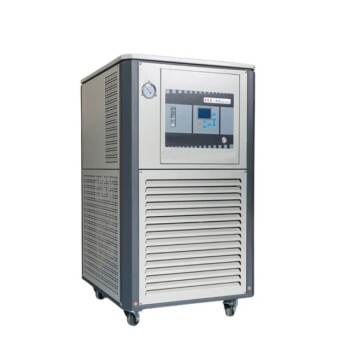
Accurate performance evaluation of SAPO-34 mixed matrix membranes relies fundamentally on high-precision temperature control because gas permeation is an inherently temperature-sensitive process. A specialized control system maintains a stable thermodynamic environment, typically ranging from 267 K to 394 K, effectively eliminating data deviations caused by thermal fluctuations.
Core Takeaway: Gas permeation depends on specific solubility and diffusion coefficients, both of which change significantly with temperature. A high-precision control system isolates these variables, ensuring that experimental data reflects the true material properties rather than environmental thermal noise.
The Physics of Permeation and Temperature
Sensitivity of Gas Permeation
Gas permeation processes are not static; they are highly sensitive to temperature variations. Even minor fluctuations in the thermal environment can alter how gas molecules interact with the membrane matrix.
Without precise control, it becomes impossible to distinguish between the membrane's actual performance and artifacts created by temperature shifts.
Impact on Solubility and Diffusion Coefficients
The core mechanisms governing separation are solubility (how much gas dissolves) and diffusion (how fast it moves).
Temperature fluctuations cause immediate deviations in the coefficients for both solubility and diffusion. To accurately characterize SAPO-34 membranes, these coefficients must remain stable during measurement.
Ensuring Data Integrity for Modeling
Creating a Stable Thermodynamic Environment
Reliable testing requires a stable thermodynamic environment across a wide operational range, specifically cited as 267 K to 394 K.
This stability allows researchers to isolate specific thermal conditions to observe how the membrane behaves at distinct operating points.
The Requirement for Repeatability
Performance modeling relies on data that is both accurate and repeatable.
If the temperature control system permits drift, the resulting data will lack the consistency required to build predictive models for membrane behavior.
Understanding the Risks of Inprecision
The Cost of Thermal Deviations
The primary trade-off in skipping high-precision control is the introduction of experimental error.
When temperature varies uncontrolled, it introduces "noise" into the data that can result in false positive or false negative readings regarding the membrane's flux and selectivity.
Complexity vs. Data Validity
Implementing high-precision thermal systems increases the complexity of the experimental setup compared to standard ambient tests.
However, this complexity is a necessary investment to prevent gas leakage and experimental errors that would otherwise invalidate the study of the membrane's tolerance.
Making the Right Choice for Your Goal
To ensure your evaluation of SAPO-34 mixed matrix membranes is successful, align your testing strategy with your specific objectives:
- If your primary focus is fundamental modeling: Prioritize a system that minimizes deviations in solubility and diffusion coefficients to ensure mathematical accuracy.
- If your primary focus is industrial simulation: Ensure your system can hold a stable thermodynamic environment across the full 267 K to 394 K range to mimic real-world processing conditions.
Precision in temperature control is not merely a feature; it is the prerequisite for obtaining valid, scientific data on membrane performance.
Summary Table:
| Factor | Impact on Membrane Evaluation | Benefit of High-Precision Control |
|---|---|---|
| Temperature Stability | Fluctuations (267 K - 394 K) cause data noise | Eliminates thermal deviations for repeatable results |
| Gas Permeability | Highly sensitive to minor thermal shifts | Isolates material properties from environmental noise |
| Solubility/Diffusion | Coefficients change with temperature | Maintains stable coefficients for accurate modeling |
| Data Integrity | Inaccurate readings lead to false performance data | Ensures scientific validity for industrial simulation |
Elevate Your Material Research with KINTEK Precision
Precise temperature control is the backbone of reliable membrane performance evaluation. At KINTEK, we specialize in providing high-performance laboratory equipment designed to meet the rigorous demands of advanced material science. Whether you are researching SAPO-34 mixed matrix membranes or developing next-generation gas separation technologies, our comprehensive range of high-temperature furnaces, vacuum systems, and precise thermal control solutions ensures your data remains accurate and repeatable.
Our value to you:
- Unmatched Precision: Maintain stable thermodynamic environments from 267 K to 394 K and beyond.
- Comprehensive Portfolio: From CVD/PECVD systems for membrane synthesis to high-pressure reactors for performance testing.
- Reliable Results: Minimize experimental error with equipment engineered for consistency.
Contact our technical experts today to find the perfect thermal solution for your laboratory and ensure your research reaches its full potential.
References
- Ali Hosin Alibak, Babak Aghel. Developing a Hybrid Neuro-Fuzzy Method to Predict Carbon Dioxide (CO2) Permeability in Mixed Matrix Membranes Containing SAPO-34 Zeolite. DOI: 10.3390/membranes12111147
This article is also based on technical information from Kintek Solution Knowledge Base .
Related Products
- Customizable Laboratory High Temperature High Pressure Reactors for Diverse Scientific Applications
- High Pressure Laboratory Autoclave Reactor for Hydrothermal Synthesis
- Customizable High Pressure Reactors for Advanced Scientific and Industrial Applications
- Stainless High Pressure Autoclave Reactor Laboratory Pressure Reactor
- Mini SS High Pressure Autoclave Reactor for Laboratory Use
People Also Ask
- How do high-pressure and high-temperature reactors ensure the effective treatment of lignocellulosic wastewater in WAO?
- What equipment is required for high-pressure high-temperature reactions? Master Extreme Chemistry Safely
- How do you control high pressure in a reactor? A Guide to Safe & Stable Operation
- How does initial oxygen pressure affect the wet oxidation of pharmaceutical sludge? Master Your Oxidation Depth
- Why is argon better than nitrogen for inert atmosphere? Ensure Absolute Reactivity & Stability