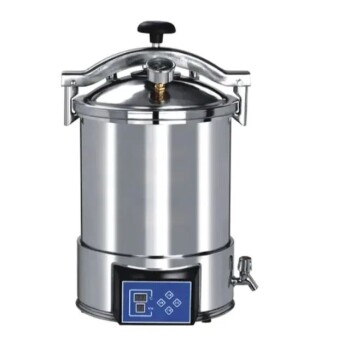
The high-pressure reactor is the non-negotiable engine for supercritical synthesis. It creates the sealed, extreme-temperature environment—typically reaching 400°C—required for the "one-pot" chemical conversion of nickel, molybdenum, and sulfur precursors. Without this contained pressure, the solvent would evaporate before reaching the supercritical state necessary to produce the high-surface-area, layered structures required for high methanol selectivity.
A high-pressure autoclave enables catalysts to bypass atmospheric kinetic limits by maintaining solvents in a supercritical state. This environment facilitates total precursor conversion and precise morphological control, which are essential for the performance of Ni-MoS2/MgO catalysts.
Establishing the Supercritical Environment
Maintaining Phase Stability at 400°C
A high-pressure reactor provides the essential high-temperature and high-pressure sealed environment required for the "one-pot" synthesis of catalysts. Under these conditions, the reactor ensures that the solvent reaches a supercritical state, where the distinction between liquid and gas phases disappears.
This state is critical because it allows molybdenum, sulfur, and nickel precursors to undergo complete chemical conversion within the solvent. If the reaction were attempted in an open system, the solvent would boil away long before the necessary 400°C threshold was reached.
Accelerating Reaction Kinetics
The extreme environment within an autoclave significantly enhances molecular collision frequency and diffusion capabilities. This allows the reaction to overcome kinetic barriers that exist at standard atmospheric pressure.
By increasing the energy and movement of the molecules, the reactor enables chemical transformations that are otherwise impossible. This results in a more efficient and thorough synthesis of the Ni-MoS2/MgO composite.
Shaping the Catalyst Microstructure
Developing High Specific Surface Areas
One of the primary goals of using the supercritical method is to produce catalysts with high specific surface areas. The high-pressure environment prevents the collapse of the material's pores during the formation process.
This large surface area is vital for achieving high methanol selectivity, as it provides more active sites for the chemical reaction to occur. The reactor’s ability to maintain a stable, high-pressure environment is what ensures this structural integrity.
Promoting Directional Crystal Growth
The reactor allows for the precise control of nucleation and growth kinetics, leading to well-defined layered structures. In the case of Ni-MoS2/MgO, this ensures that the molybdenum disulfide forms the specific crystalline phases required for high performance.
This controlled environment also facilitates the uniform loading of precursors onto the MgO support. The result is a tight integration of components at the molecular scale, which is essential for catalyst stability and activity.
Understanding the Trade-offs
Material Limitations and Safety
Operating at 400°C and high pressure requires specialized materials, as standard PTFE liners may fail or degrade at temperatures exceeding 250°C. High-strength stainless steel or specialized corrosion-resistant alloys are often required to maintain safety and prevent reactor failure.
The complexity of these systems also introduces a higher operational cost and requires rigorous safety protocols to manage the stored energy within the vessel. Failure to precisely control the cooling and heating rates can lead to inconsistencies in the catalyst's crystalline structure.
Complexity of Scalability
While the "one-pot" supercritical method is efficient in a laboratory setting, scaling this process to industrial levels presents significant engineering challenges. Maintaining uniform temperature distribution throughout a large-scale high-pressure vessel is difficult and can lead to batch-to-batch variability.
Making the Right Choice for Your Goal
When deciding on the parameters for your high-pressure synthesis, consider your primary objective for the catalyst:
- If your primary focus is maximum methanol selectivity: Use a high-pressure reactor to maintain supercritical conditions at 400°C to ensure the development of well-defined layered MoS2 structures.
- If your primary focus is catalyst stability and longevity: Prioritize the use of a reactor that allows for the precise control of the MgO hydrolysis and its integration with the Ni-MoS2 components.
- If your primary focus is high-throughput production: Evaluate the trade-offs between the "one-pot" supercritical method and traditional hydrothermal methods, which may operate at lower temperatures but yield lower surface areas.
The high-pressure reactor is the fundamental tool that transforms simple precursors into highly engineered, high-performance catalytic materials.
Summary Table:
| Feature of Reactor | Function in Synthesis | Impact on Ni-MoS2/MgO Catalyst |
|---|---|---|
| High-Temp Seal (400°C) | Reaches solvent's supercritical point | Ensures complete precursor conversion |
| Pressure Containment | Prevents solvent evaporation | Preserves pore structure and high surface area |
| Supercritical State | Eliminates liquid-gas phase boundaries | Facilitates uniform loading and high selectivity |
| Kinetic Control | Enhances molecular collision frequency | Promotes directional crystal growth of MoS2 |
Elevate Your Catalyst Synthesis with KINTEK Precision
Achieving the perfect supercritical state for Ni-MoS2/MgO catalysts requires equipment that can withstand extreme 400°C environments without compromise. KINTEK specializes in high-performance high-temperature high-pressure reactors and autoclaves, engineered with advanced corrosion-resistant alloys to ensure safety and precision in your "one-pot" synthesis.
Beyond reactors, our comprehensive lab portfolio includes:
- Material Processing: Crushing, milling systems, and hydraulic presses.
- Thermal Solutions: Muffle, vacuum, and CVD furnaces.
- Lab Essentials: Electrolytic cells, cooling solutions, and high-quality ceramic crucibles.
Ready to optimize your reactor's performance and ensure high methanol selectivity? Contact our technical experts today to find the ideal high-pressure solution for your laboratory’s research goals!
References
- Siyi Jiang, Qi Sun. Conversion of CO2 Hydrogenation to Methanol over K/Ni Promoted MoS2/MgO Catalyst. DOI: 10.3390/catal13071030
This article is also based on technical information from Kintek Solution Knowledge Base .
Related Products
- High Pressure Laboratory Autoclave Reactor for Hydrothermal Synthesis
- Stainless High Pressure Autoclave Reactor Laboratory Pressure Reactor
- Mini SS High Pressure Autoclave Reactor for Laboratory Use
- Customizable High Pressure Reactors for Advanced Scientific and Industrial Applications
- Customizable Laboratory High Temperature High Pressure Reactors for Diverse Scientific Applications
People Also Ask
- What role does a high-pressure reactor (autoclave) play in the synthesis of NiCuFe-LDH? Master Hydrothermal Growth
- What Role Does a High-Pressure Reactor or Autoclave Play in HA Catalyst Synthesis? Achieve High Surface Area Materials
- What equipment is required for hydrothermal synthesis of Ga0.25Zn4.67S5.08? Optimize Your Semiconductor Production
- What is the function of a high-pressure reactor in the hydrothermal synthesis of boehmite? Expert Process Insights
- What role does an autoclave play in the synthesis of MnO2 nanofibers? Mastering Hydrothermal Growth