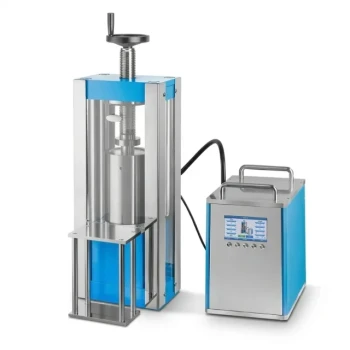
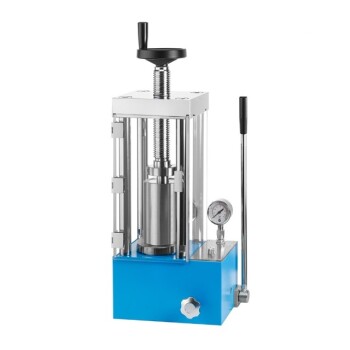
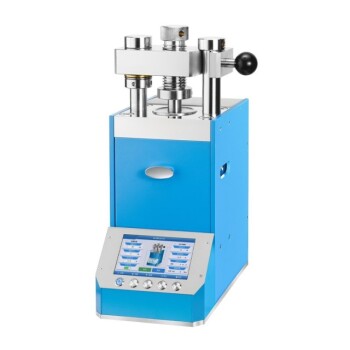
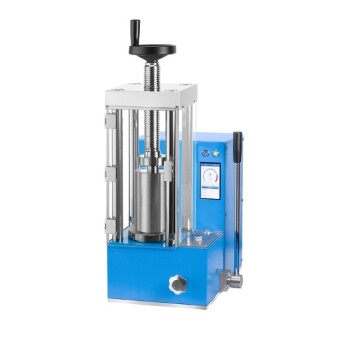
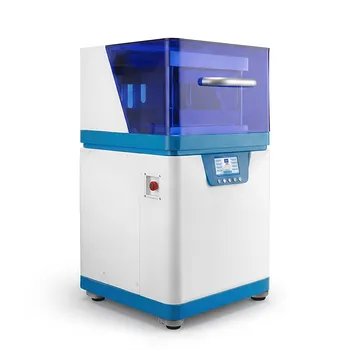
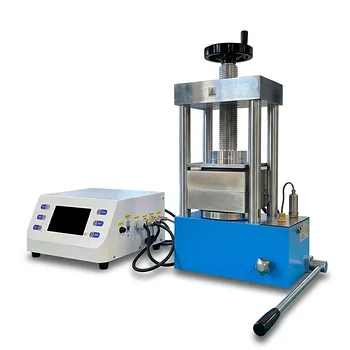
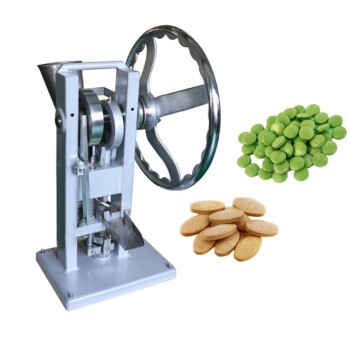
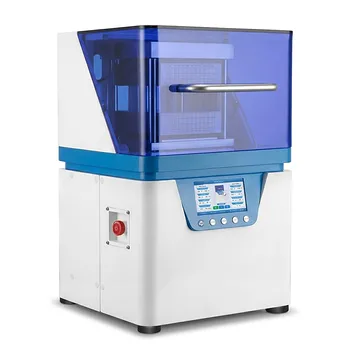
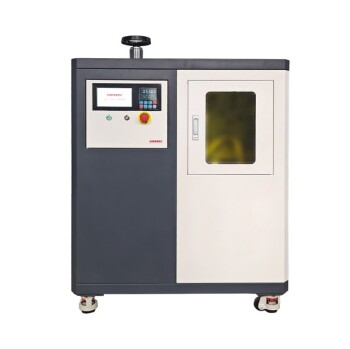
High-tonnage hydraulic presses are essential for 316L stainless steel powder metallurgy because they generate the massive uniaxial force—typically between 750 MPa and 840 MPa—required to overcome the material's resistance to deformation. This intense pressure forces individual metallic particles to undergo plastic deformation, physically interlocking them into a "green compact." Without this high-tonnage application, the powder remains too porous and lacks the structural integrity required for handling and successful high-temperature sintering.
High-pressure compaction is the critical bridge between loose powder and a solid component; it maximizes green density and reduces internal voids to create the necessary conditions for atomic diffusion during sintering.
Overcoming Material Strength through Plastic Deformation
Inducing Necessary Mechanical Interlocking
316L stainless steel is a robust alloy that requires significant energy to reshape at room temperature. High-tonnage presses apply uniaxial force that exceeds the yield strength of the powder particles, forcing them to flatten and mesh together. This mechanical interlocking provides the "green strength" necessary for the part to maintain its shape before it enters the furnace.
Maximizing Green Density
The goal of cold pressing is to achieve the highest possible relative density before any heat is applied. By applying pressures up to 750 MPa, the press minimizes the gaps between particles, which is vital for the mechanical properties of the finished part. High green density ensures that the final sintered product will have the required corrosion resistance and tensile strength.
Expelling Entrapped Air
Loose powder contains a significant amount of air that can cause internal defects if trapped during the heating process. High-pressure compaction effectively expels this air and increases the loading density of the mold. This creates a stable preform that can be safely moved or staged for the next phase of production.
Setting the Foundation for High-Temperature Sintering
Facilitating Atomic Diffusion
Sintering relies on the movement of atoms across particle boundaries, a process called atomic diffusion. By forcing particles into intimate contact through high-tonnage pressing, you create more "bridge points" for this diffusion to occur. This leads to faster densification and a more homogenous metallurgical bond during the sintering stage.
Eliminating Macroscopic Voids
Even minor voids in a green compact can lead to structural failure or localized corrosion in the final stainless steel part. The precise pressure control of an industrial hydraulic press ensures that these macroscopic voids are eliminated across the entire cross-section of the component. This uniformity is what allows powder metallurgy to compete with traditional casting or forging.
Enabling Cold Sintering Mechanisms
In specialized applications, high pressure drives specific mechanisms like pressure-solution-precipitation. This allows for particle rearrangement and mass transport even at relatively low temperatures. High tonnage provides the driving force needed for these complex physical transformations to occur efficiently.
Understanding the Trade-offs and Constraints
Tooling Wear and Maintenance
The extreme pressures required for 316L stainless steel put immense stress on the molds and punches. Operating at the high end of the pressure scale (e.g., 840 MPa) accelerates tool wear and requires high-quality, hardened tool steels to avoid frequent replacements. This increases the total cost per part but is necessary for maintaining dimensional accuracy.
The Risk of Laminations and Springback
If the pressure is applied or released too quickly, the compact may experience elastic recovery, or "springback," where the metal tries to return to its original shape. This can lead to laminations—internal cracks that weaken the part. Industrial hydraulic presses mitigate this through controlled decompression cycles, which are only possible with advanced hydraulic management systems.
Making the Right Choice for Your Production
To achieve the best results with 316L stainless steel powder, your equipment strategy should align with your specific performance requirements.
- If your primary focus is Maximum Mechanical Strength: Utilize a press capable of sustained 800+ MPa to maximize green density and minimize final porosity.
- If your primary focus is High-Volume Dimensional Consistency: Prioritize a press with advanced hydraulic control and slow decompression to prevent springback cracks.
- If your primary focus is Complex Geometry: Ensure your high-tonnage press supports multi-action tooling to maintain uniform density across varying thicknesses.
Precise, high-pressure compaction is the non-negotiable foundation for transforming 316L powder into high-performance industrial components.
Summary Table:
| Key Factor | Requirement for 316L Stainless Steel |
|---|---|
| Compaction Pressure | 750 MPa – 840 MPa |
| Primary Mechanism | Plastic deformation & mechanical interlocking |
| Critical Benefit | High green density & reduced internal voids |
| Sintering Impact | Facilitates atomic diffusion & metallurgical bonding |
| Process Safety | Controlled decompression to prevent springback/cracks |
Achieve superior material density with KINTEK’s high-tonnage hydraulic presses, specifically engineered to handle the extreme 800+ MPa pressures required for 316L stainless steel powder metallurgy.
Beyond our precision pellet, hot, and isostatic hydraulic presses, KINTEK provides a complete ecosystem for material science—including high-temperature muffle, vacuum, and atmosphere furnaces for sintering, as well as crushing systems and specialized ceramics. Whether you are aiming for maximum mechanical strength or high-volume consistency, our expert solutions ensure flawless component integrity and reliable performance. Contact KINTEK today to optimize your production workflow with our industry-leading laboratory equipment.
References
- Mustafa Türkmen, Mehmet Akif Erden. The Effect of Mn and Ti Ratio on Microstructure and Mechanical and Machinability Properties of 316 L Stainless Steel Used in Biomedical Applications. DOI: 10.3390/met13111804
This article is also based on technical information from Kintek Solution Knowledge Base .
Related Products
- Electric Split Lab Cold Isostatic Press CIP Machine for Cold Isostatic Pressing
- Manual Cold Isostatic Pressing Machine CIP Pellet Press
- Automatic Lab Cold Isostatic Press CIP Machine Cold Isostatic Pressing
- Electric Lab Cold Isostatic Press CIP Machine for Cold Isostatic Pressing
- Round Bidirectional Press Mold for Lab
People Also Ask
- How is isostatic pressing equipment utilized to integrate lithium metal anodes during solid-state battery assembly?
- How does isostatic pressing equipment enhance lithium metal anode contact? Optimize Your Solid-State Battery Assembly
- What is the meaning of isostatic pressing? Achieve Uniform Density in Complex Parts
- What is isostatic pressing method for ceramics? Achieve Uniform Density for Complex Parts
- What role does cold isostatic pressing play in the formation of feed rods for single crystal growth? Ensure Stability.