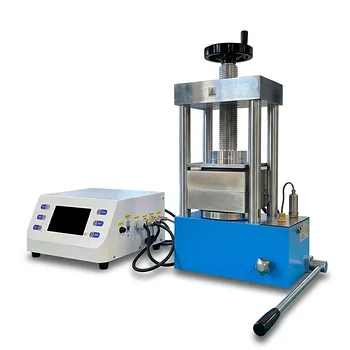
Precision is the critical variable in solid-state battery assembly. A hydraulic sealer with a pressure display is used to strictly control the force applied to the coin cell case—typically around 30 MPa—to ensure an airtight seal without crushing the internal components. This visual feedback allows operators to find the exact balance between protecting the cell from the environment and preserving the structural integrity of fragile ceramic materials.
Core Takeaway
In solid-state assembly, pressure is a functional parameter, not just a mechanical step. The pressure display is essential for applying enough force to minimize interfacial resistance and seal the case, while strictly capping that force to prevent catastrophic fracture of the brittle ceramic electrolyte.
The Mechanical Challenges of Solid-State Cells
Protecting Brittle Ceramic Electrolytes
Unlike traditional liquid electrolyte batteries, solid-state cells often rely on ceramic electrolyte pellets. These materials are hard but extremely brittle.
If the sealing pressure exceeds the material's tolerance, the electrolyte layer will crack. A pressure display allows the operator to stop exactly at the safe threshold (e.g., 30 MPa), preventing immediate structural failure.
Ensuring an Airtight Seal
The primary mechanical function of the sealer is to crimp the coin cell case. This deformation creates a barrier against the external environment.
Solid-state chemistries are highly sensitive to air and moisture. A monitored pressure ensures the crimp is tight enough to hermetically seal the active materials inside, preventing degradation caused by atmospheric exposure.
Optimizing Electrochemical Performance
Reducing Interfacial Contact Resistance
In a solid-state battery, ions must move between solid electrodes and solid electrolytes. This requires "intimate" physical contact.
Microscopic voids between these rigid layers act as barriers to ion transport. The hydraulic sealer applies the necessary compressive force to minimize these voids, significantly reducing interfacial contact resistance.
Ensuring Consistency and Reproducibility
Experimental data is useless if the assembly process varies from cell to cell. Relying on manual feel or unmonitored hydraulic jacks introduces massive variables.
A pressure display quantifies the assembly standard. This ensures that every coin cell is sealed under identical conditions, making cycle life and performance data reliable and reproducible.
Understanding the Trade-offs
The Danger of Excessive Force
While high pressure improves contact between layers, applying too much force during the sealing stage is the most common cause of failure.
Over-pressurization does not just deform the case; it fractures the internal ceramic pellet. This creates immediate short circuits or severs the ionic pathways, rendering the cell useless before testing begins.
The Risk of Insufficient Pressure
Conversely, under-pressurizing the cell to "play it safe" creates two distinct problems.
First, the case may not seal completely, allowing moisture ingress. Second, without sufficient stack pressure, the solid components may lose physical contact, resulting in extremely high impedance and poor cycle life.
Making the Right Choice for Your Goal
To maximize the yield of your solid-state coin cell assembly, align your pressure settings with your specific objectives:
- If your primary focus is Electrolyte Integrity: Keep sealing pressure strictly within the lower bounds (e.g., roughly 30 MPa) to prevent micro-cracking in ceramic pellets.
- If your primary focus is Electrochemical Performance: Ensure the pressure is high enough to eliminate microscopic voids, thereby minimizing interfacial resistance.
- If your primary focus is Data Quality: Record the specific pressure value for every cell to ensure experimental consistency across the entire batch.
The pressure display transforms the sealer from a blunt tool into a precision instrument, ensuring the delicate balance between connection and destruction.
Summary Table:
| Feature | Impact on Solid-State Coin Cells |
|---|---|
| Pressure Monitoring | Prevents brittle ceramic electrolyte cracking by avoiding over-pressurization. |
| Consistent Force | Ensures an airtight, hermetic seal against air and moisture ingress. |
| Interfacial Contact | Minimizes microscopic voids to reduce ionic transport resistance. |
| Quantifiable Data | Guarantees reproducibility and reliability across experimental batches. |
Elevate Your Battery Research with KINTEK Precision
Consistency is the backbone of breakthrough battery research. KINTEK specializes in high-performance laboratory equipment designed for the rigorous demands of solid-state assembly. From our precision hydraulic pellet presses and coin cell sealers with digital pressure displays to our comprehensive range of battery research tools, consumables, and high-temperature vacuum furnaces, we provide the tools you need to minimize interfacial resistance and maximize cell longevity.
Don't let inconsistent assembly ruin your experimental data. Contact KINTEK today to discover how our specialized equipment can bring unmatched accuracy and reproducibility to your laboratory.
Related Products
- Manual button battery sealing machine (digital display)
- Ball Press Mold for Lab
- Automatic High Temperature Heated Hydraulic Press Machine with Heated Plates for Lab
- Heated Hydraulic Press Machine with Heated Plates for Vacuum Box Laboratory Hot Press
- Heated Hydraulic Press Machine with Integrated Manual Heated Plates for Lab Use
People Also Ask
- What is a manual press? Amplify Your Force for Precision Assembly and Stamping
- What is the function of a press machine? Harness Immense Force for Shaping and Assembly
- What is the difference between hydraulic and mechanical press machine? Choose the Right Press for Your Application
- What are the different types of manual press machines? Choose the Right Tool for Your Task
- What is a manual press? A Guide to Human-Powered Force and Precision