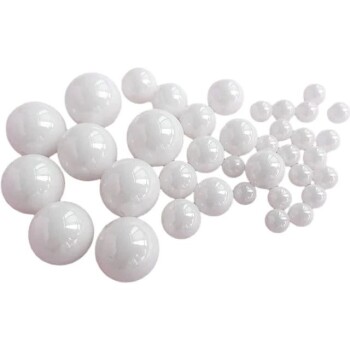
The primary function of a planetary ball mill using zirconia grinding balls is to mechanically dismantle the rigid crystalline structure of cellulose through high-energy impact and shear forces. By disrupting the material's stable hydrogen-bond network, this pretreatment significantly increases the amorphous surface area, making the cellulose far more reactive and accessible to catalysts during hydrolysis.
The core value of this process is the conversion of physical structure to chemical potential. By reducing crystallinity, you essentially "unlock" the cellulose, allowing solid acid catalysts to make effective contact and drive higher glucose yields.
Breaking Down the Crystalline Barrier
Disruption of Hydrogen Bonds
Cellulose is naturally resistant to chemical breakdown due to a dense, stable network of hydrogen bonds.
The planetary ball mill generates intense mechanical forces that physically rupture these bonds.
This is the first necessary step to altering the material's properties, as it destabilizes the rigid lattice structure that protects the cellulose polymer.
Increasing Amorphous Content
The impact from the zirconia balls effectively converts the cellulose from a crystalline state to an amorphous one.
Crystalline regions are highly ordered and difficult for chemicals to penetrate.
By increasing the proportion of amorphous regions, the milling process creates a disordered structure that is chemically vulnerable and ready for reaction.
Reduction of Particle Size
Beyond internal structural changes, the milling process reduces the overall degree of polymerization.
This results in a significant increase in the specific surface area of the material.
Greater surface area exposes more of the cellulose to the reaction environment, further enhancing its reactivity.
Optimizing for Catalytic Hydrolysis
Enhancing Catalyst Contact
The efficiency of solid acid catalysts relies heavily on direct contact with the substrate.
Untreated microcrystalline cellulose restricts this contact due to its tight structure.
The structural changes induced by milling significantly improve the contact efficiency between the cellulose and the catalyst's acidic sites.
Facilitating Milder Reaction Conditions
Because the pre-treated cellulose is more accessible, the hydrolysis barrier is lowered.
Large molecules that are typically difficult to hydrolyze can be broken down more easily.
This allows the subsequent hydrolysis process to proceed effectively at lower temperatures, improving overall conversion efficiency without requiring extreme heat.
Understanding the Trade-offs
Mechanical Energy vs. Thermal Energy
While this method increases yield, it shifts the energy burden from the chemical reactor to the mechanical pretreatment phase.
You are essentially investing mechanical energy (milling) upfront to save on thermal energy (lower hydrolysis temperatures) later.
Media Selection Implications
The use of zirconia balls is specific; they provide the high density required for sufficient impact force.
Using lighter or softer grinding media may fail to generate the shear force necessary to disrupt the hydrogen-bond network effectively.
Making the Right Choice for Your Goal
To maximize the benefits of planetary ball milling for cellulose hydrolysis, consider your specific objectives:
- If your primary focus is maximizing glucose yield: Ensure the milling intensity is sufficient to maximize the ratio of amorphous to crystalline regions, as this directly correlates to reaction rates.
- If your primary focus is reducing reactor energy costs: Utilize the milled cellulose to lower the operating temperature of your hydrolysis phase, taking advantage of the material's increased reactivity.
By mechanically unlocking the cellulose structure, you transform a recalcitrant material into a highly reactive feedstock for efficient hydrolysis.
Summary Table:
| Feature | Impact on Cellulose Pretreatment | Benefit for Hydrolysis |
|---|---|---|
| Zirconia Media | High-density impact and intense shear forces | Efficient disruption of hydrogen-bond networks |
| Structural Shift | Crystalline structure converted to amorphous state | Increased accessibility for solid acid catalysts |
| Surface Area | Significant reduction in particle size | Maximized contact between substrate and catalyst |
| Energy Profile | High mechanical energy input | Lower thermal energy requirements for reaction |
Elevate Your Biomass Research with KINTEK Precision
Maximize your glucose yields and optimize catalytic efficiency with KINTEK’s industry-leading laboratory solutions. Whether you need high-energy planetary ball mills and durable zirconia grinding media for cellulose disruption, or high-temperature high-pressure reactors for subsequent hydrolysis, we provide the tools necessary for breakthrough results.
From crushing and milling systems to catalytic reactors and autoclaves, KINTEK specializes in supporting advanced material science and green energy research. Contact us today to find the perfect equipment for your laboratory workflow!
References
- Ayumu Onda. Selective Hydrolysis of Cellulose and Polysaccharides into Sugars by Catalytic Hydrothermal Method Using Sulfonated Activated-carbon. DOI: 10.1627/jpi.55.73
This article is also based on technical information from Kintek Solution Knowledge Base .
Related Products
- Laboratory Jar Ball Mill with Alumina Zirconia Grinding Jar and Balls
- High Energy Planetary Ball Mill Milling Machine for Laboratory
- High Energy Planetary Ball Mill Milling Machine for Laboratory
- Laboratory Jar Mill with Agate Grinding Jar and Balls
- Laboratory Horizontal Planetary Ball Mill Milling Machine
People Also Ask
- What are the primary functions of using a ball mill for BZCY72 powder? Achieve High Purity and Enhanced Sintering
- In what way does a laboratory ball mill affect material properties when modifying PHBV/pulp fiber composites?
- Why is a laboratory ball mill required for ultra-fine fly ash? Unlock Nano-Scale Adsorption Power
- What is the function of a laboratory ball mill in the preparation of AMMCs? Optimize Dispersion & Grain Refinement
- What is the function of a laboratory ball mill in the pretreatment of waste tire char (WTC)? Optimize Material Reactivity