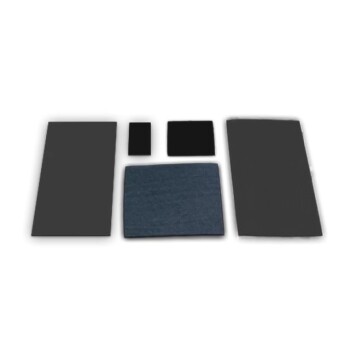
A polished glassy carbon disk is the standard choice for the working electrode substrate because it combines exceptional chemical stability with high electrical conductivity. Its smooth surface allows for the robust and uniform attachment of sample powders, while its electrochemical inertness—particularly in acidic environments—ensures that the applied voltage acts solely on your sample material rather than reacting with the electrode itself.
Glassy carbon functions as a conductive "blank canvas" for your experiment. By remaining electrochemically neutral, it guarantees that any measured activity or structural change is driven exclusively by the material you are testing, eliminating false positives from the substrate.
Ensuring Data Integrity through Chemical Inertness
Eliminating Background Interference
The primary reason for selecting glassy carbon is its electrochemical inertness, specifically in acidic electrolytes.
In an etching experiment, you need to be certain that the current you measure is derived from your sample. Glassy carbon has a wide electrochemical window, meaning it does not participate in reactions within typical voltage ranges.
Directing Energy to the Sample
Because the substrate resists reacting with the electrolyte, the applied voltage is directed solely toward the sample powder.
This isolation is critical for efficient electrochemical exfoliation. It forces the energy to drive the intended etching process in the silicon carbide-derived carbon powders rather than being wasted on side reactions with the electrode disk.
Physical and Electrical Advantages
Ideally Smooth Surface
The "polished" aspect of the disk is not merely aesthetic; it is a functional requirement.
A mirror-like finish provides a uniform surface area. This smoothness ensures that sample powders attach securely and evenly, preventing agglomeration or loose contact that could lead to inconsistent data.
High Electrical Conductivity
Despite being chemically resistant, glassy carbon maintains high electrical conductivity.
This property minimizes internal resistance (IR drop) across the electrode. Efficient charge transfer ensures that the potential you apply at the instrument level is effectively the potential experienced by the sample at the microscopic level.
Understanding the Trade-offs
Vulnerability in Alkaline Conditions
While glassy carbon is robust in acids, it is not universally indestructible.
You must exercise caution when working with high oxidizing potentials in alkaline solutions. Under these specific conditions, glassy carbon is prone to dissolution, which can degrade the electrode surface and contaminate your electrolyte, effectively ruining the experiment.
Making the Right Choice for Your Goal
To ensure your experimental setup yields valid results, consider how your specific conditions align with the properties of glassy carbon.
- If your primary focus is acidic etching: Rely on glassy carbon for its exceptional stability, as it will remain inert and direct all energy to your sample.
- If your primary focus is powder characterization: Utilize the polished surface to achieve a thin, uniform film of material, which is essential for reproducible voltammetry.
- If your primary focus is high-voltage alkaline oxidation: Monitor your electrode carefully, as glassy carbon may degrade or dissolve under these harsh conditions.
By treating the glassy carbon disk as a precision instrument rather than just a holder, you ensure the fidelity of your electrochemical data.
Summary Table:
| Feature | Advantage for Electrochemical Etching | Impact on Results |
|---|---|---|
| Chemical Inertness | Resists reaction in acidic electrolytes | Eliminates background noise and false positives |
| High Conductivity | Minimizes internal resistance (IR drop) | Ensures precise potential control at the sample |
| Polished Surface | Provides a mirror-like, uniform area | Enables robust and even attachment of sample powders |
| Wide Voltage Window | Remains neutral across typical ranges | Directs total applied energy toward the sample material |
Elevate Your Electrochemical Research with KINTEK
Precision in the lab starts with the right materials. KINTEK specializes in high-performance laboratory equipment, offering everything from electrolytic cells and electrodes to high-temperature furnaces and hydraulic presses.
Whether you are performing electrochemical etching, battery research, or material synthesis, our glassy carbon solutions provide the 'blank canvas' your data deserves. Contact us today to discover how our comprehensive range of lab consumables and precision instruments can enhance your experimental accuracy and research efficiency.
References
- Tao Peng, Shichun Mu. Direct Transformation of Amorphous Silicon Carbide into Graphene under Low Temperature and Ambient Pressure. DOI: 10.1038/srep01148
This article is also based on technical information from Kintek Solution Knowledge Base .
Related Products
- Glassy Carbon Electrochemical Electrode
- RRDE rotating disk (ring disk) electrode / compatible with PINE, Japanese ALS, Swiss Metrohm glassy carbon platinum
- Glassy Carbon Sheet RVC for Electrochemical Experiments
- Gold Disc Electrode
- Metal Disc Electrode Electrochemical Electrode
People Also Ask
- How do the glassy carbon electrode, SCE, and graphite rod work together in an enzymatic fuel cell? Optimize EFC Testing
- Why is glassy carbon selected for mediator-assisted indirect oxidation of glycerol? The Key to Unbiased Research
- What are the functions of a glassy carbon electrode in CV testing of antioxidants? Enhance Your Redox Analysis Accuracy
- What characteristics make glassy carbon electrodes suitable as anodes? Ideal for Pure Molten Salt Electrolysis
- What are the primary physicochemical reasons for selecting a carbon electrode as the anode in aluminum recovery? 5 Keys