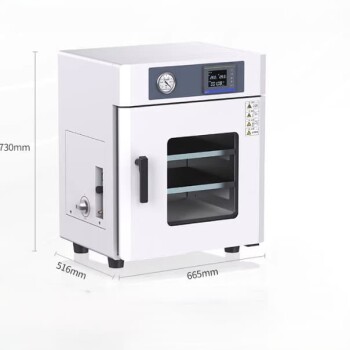
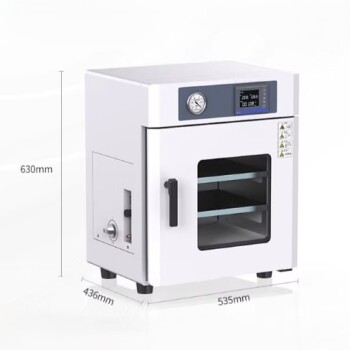
Precision laboratory vacuum ovens are indispensable for lithium-ion battery electrode preparation because they facilitate the complete removal of residual solvents and trace moisture without damaging the electrode’s delicate chemical structure. By lowering the boiling point of liquids through a vacuum environment, these ovens allow for deep drying at temperatures—typically between 100°C and 120°C—that are low enough to prevent the oxidation or degradation of active materials and metallic current collectors.
Core Takeaway: A vacuum oven is the only reliable method to achieve the "deep drying" state required for battery stability, as it eliminates moisture that would otherwise react with electrolytes to form corrosive acids, ultimately saving the battery from premature failure and safety risks.
Preserving Chemical Integrity at Lower Temperatures
The Risk of High-Temperature Degradation
Active materials and binders used in electrodes are sensitive to extreme heat, which can trigger physical or chemical breakdown. Standard atmospheric ovens would require much higher temperatures to evaporate solvents like NMP (N-methylpyrrolidone), risking the integrity of the electrode.
Leveraging Vacuum for Efficient Evaporation
A vacuum environment significantly lowers the boiling point of residual solvents and water. This allows the oven to achieve thorough volatilization at moderate temperatures, ensuring the active materials remain chemically stable throughout the drying cycle.
Preventing Oxidation of Current Collectors
Metallic foils, such as copper and aluminum, are prone to oxidation when exposed to high heat in the presence of oxygen. By removing air and moisture, the vacuum oven protects these foils, ensuring tight contact and high conductivity between the active material and the current collector.
Eliminating the Catalyst for Electrolyte Decay
The Danger of Residual Moisture
Trace moisture is the primary enemy of lithium-ion battery longevity. Even microscopic amounts of water can react with the electrolyte salt, LiPF6 (Lithium Hexafluorophosphate), during the battery's operation.
Preventing Hydrofluoric Acid (HF) Formation
When moisture meets the electrolyte, it triggers a hydrolysis reaction that produces hydrofluoric acid (HF). This highly corrosive byproduct attacks the electrode materials and the internal structure of the cell, leading to rapid performance loss.
Enhancing Electrochemical Stability
By ensuring a "deep dry" state, the vacuum oven eliminates the possibility of these secondary reactions. This process is essential for maintaining the cycling stability and safety of the battery over hundreds or thousands of charge cycles.
Ensuring Mechanical and Structural Reliability
Optimizing Binder Performance
The electrode slurry contains binders, such as PVDF, which must set perfectly to hold the active material to the foil. Precision drying ensures the solvent is removed evenly, preventing cracks or "skinning" that can occur with uneven atmospheric heating.
Strengthening Bonding Strength
Proper vacuum drying enhances the bonding strength between the electrode material and the current collector. This mechanical bond is critical because it prevents the material from delaminating during the physical expansion and contraction that occurs during charging.
Understanding the Trade-offs and Pitfalls
The Challenge of Drying Time
Deep drying in a vacuum is a slow process, often requiring 12 hours or more to ensure all trace elements are removed. Attempting to rush this process by increasing heat can lead to the very degradation the vacuum was meant to prevent.
Vacuum Consistency and Leakage
If a vacuum oven does not maintain a consistent negative pressure, "pockets" of moisture may remain trapped within the porous electrode structure. Precision equipment is required to ensure a uniform vacuum level, as any variation can result in inconsistent battery performance across a production batch.
How to Apply This to Your Battery Research
The necessity of a vacuum oven depends on your specific material chemistry and performance targets.
- If your primary focus is high-cycle life and safety: You must prioritize a vacuum oven capable of reaching high vacuum levels and maintaining a steady 120°C to ensure the total elimination of moisture and HF-forming precursors.
- If your primary focus is testing new binder materials: Use a vacuum oven with precise temperature ramping to determine the exact point where solvent removal is complete without compromising the binder’s adhesive properties.
- If your primary focus is rapid prototyping: Utilize a vacuum oven with high thermal uniformity to dry multiple electrode sheets simultaneously, ensuring consistent results across your entire test group.
Ultimately, the precision laboratory vacuum oven is not just a drying tool, but a critical gatekeeper that determines the electrochemical viability and safety of the final battery cell.
Summary Table:
| Feature | Benefit for Electrodes | Impact on Battery Performance |
|---|---|---|
| Vacuum Environment | Lowers solvent boiling points (e.g., NMP) | Complete drying at safer, lower temperatures |
| Low-Temp Drying | Prevents degradation of active materials | Maintains chemical integrity and capacity |
| Oxygen Removal | Protects copper/aluminum foils from oxidation | Ensures high conductivity and bonding strength |
| Moisture Elimination | Prevents Hydrofluoric Acid (HF) formation | Extends cycle life and improves safety profile |
Optimize Your Battery Research with KINTEK Precision
Don’t let trace moisture compromise your energy storage innovations. KINTEK specializes in high-performance laboratory equipment designed specifically for the rigorous demands of battery research. From our high-precision vacuum ovens that ensure perfect electrode drying to our specialized battery research tools, consumables, and electrolytic cells, we provide the accuracy your data depends on.
Our comprehensive portfolio also includes:
- High-Temperature Furnaces: Muffle, tube, and vacuum systems for material synthesis.
- Processing Equipment: Crushing, milling, and hydraulic pellet presses for sample prep.
- Thermal Solutions: ULT freezers and recirculating chillers for stable testing environments.
Ready to enhance your lab's efficiency and cell safety? Contact our technical team today to discover how KINTEK’s tailored solutions can support your next breakthrough!
References
- Yi-Xuan Guo, Wei‐Ren Liu. Synthesis and Electrochemical Properties of Co3O4@Reduced Graphene Oxides Derived from MOF as Anodes for Lithium-Ion Battery Applications. DOI: 10.3390/su15064988
This article is also based on technical information from Kintek Solution Knowledge Base .
Related Products
- 56L Vertical Laboratory Vacuum Drying Oven
- 23L Laboratory Vacuum Drying Oven
- Laboratory Scientific Electric Heating Blast Drying Oven
- High Temperature Muffle Oven Furnace for Laboratory Debinding and Pre Sintering
- Laboratory Sterilizer Lab Autoclave Pulse Vacuum Lifting Sterilizer
People Also Ask
- Why is a laboratory vacuum drying oven recommended for rice straw residues? Protect Your Biomass Integrity
- What role does a laboratory vacuum drying oven play in the preparation of modified multi-walled carbon nanotubes?
- What is the importance of using a laboratory vacuum drying oven? Preserving Slow-Release Microcapsule Integrity
- Why is a Laboratory Vacuum Drying Oven recommended for PBAT microspheres? Protect Sensitive Polymer Integrity
- What role does a laboratory vacuum drying oven play in processing nanoparticle powder samples? Protect Sample Integrity