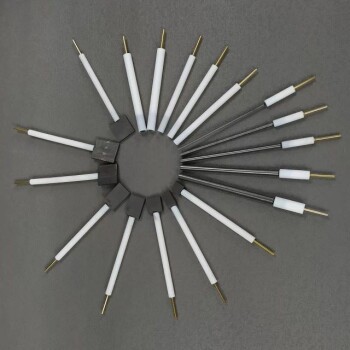
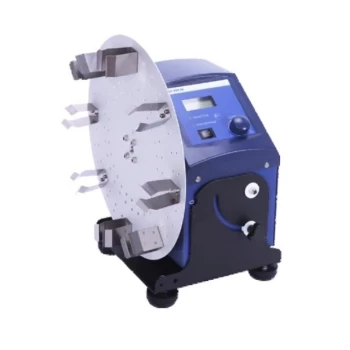
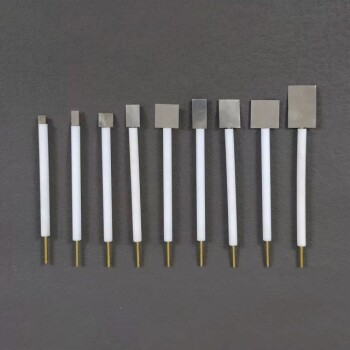
The Rotating Disk Electrode (RDE) system is essential for testing IrO2/ATO catalysts because it actively manages the physical byproducts of the Oxygen Evolution Reaction (OER). Specifically, it uses high-speed rotation to generate hydrodynamic forces that strip oxygen bubbles from the electrode surface, preventing them from blocking active sites and distorting measurement data.
In short: Static testing allows oxygen bubbles to mask the true performance of your catalyst. RDE creates a controlled environment that eliminates these physical interferences, allowing you to measure the intrinsic chemical activity of the material.
The Critical Challenge of OER Testing
The Bubble Problem
The Oxygen Evolution Reaction (OER) inherently generates oxygen gas at the electrode surface. In a static (non-rotating) setup, these bubbles accumulate rapidly.
Blocking Active Sites
If these bubbles are not removed, they adhere to the surface of your IrO2/ATO catalyst. This physically blocks the active sites, preventing the electrolyte from reacting with the material.
Data Distortion
Blocked sites lead to significant measurement distortion. The accumulation causes unstable readings and makes the catalyst appear less active than it actually is.
How RDE Solves the Problem
Controlled Hydrodynamics
The RDE system addresses this by rotating the electrode at precise, high speeds. This generates stable, forced convection within the electrolyte solution.
Active Bubble Stripping
The hydrodynamic force created by the rotation continuously strips oxygen microbubbles away from the catalyst layer. This ensures the surface remains accessible to the electrolyte throughout the test.
Eliminating Mass Transfer Limitations
By constantly refreshing the solution at the surface, RDE eliminates liquid-phase mass transfer limitations. This ensures that the reaction is limited only by the catalyst's speed, not by how fast reactants can reach the surface.
Obtaining Accurate Kinetic Data
Measuring Intrinsic Activity
Because diffusion interference is removed, the data reflects the intrinsic electrocatalytic activity of the IrO2/ATO. You are measuring the reaction kinetics, not the diffusion rate.
Calculating Key Indicators
This "clean" kinetic current data is required to accurately determine critical performance metrics. Without RDE, it is difficult to calculate precise overpotentials and Tafel slopes.
Rapid Screening Capabilities
The RDE system typically utilizes low catalyst loading and thin-layer coatings. This setup allows for rapid, consistent performance comparisons between different catalyst components at a laboratory scale.
Understanding the Trade-offs
Half-Cell vs. Full-Cell
RDE is a half-cell testing tool designed for initial screening and scientific assessment. While it is excellent for determining intrinsic activity, it does not perfectly replicate the complex conditions of a full industrial electrolyzer.
Importance of Coating Quality
The system relies on "thin-layer coating characteristics" to function correctly. If the catalyst layer is too thick or uneven, internal diffusion issues may arise that even rotation cannot eliminate, leading to erroneous results.
Making the Right Choice for Your Goal
To maximize the value of your IrO2/ATO testing:
- If your primary focus is fundamental kinetics: Use RDE to eliminate diffusion noise so you can calculate accurate Tafel slopes and overpotentials.
- If your primary focus is material comparison: Use RDE to ensure that differences in performance are due to catalyst chemistry, not random bubble accumulation.
RDE transforms OER testing from a chaotic physical process into a controlled measurement of chemical reality.
Summary Table:
| Feature | Static Electrode Testing | RDE System Testing |
|---|---|---|
| Oxygen Management | Bubbles accumulate and block active sites | Hydrodynamic forces strip bubbles away |
| Data Accuracy | Distorted by mass transfer limitations | Reflects intrinsic chemical kinetics |
| Flow Dynamics | Natural convection (unstable) | Forced convection (controlled) |
| Key Metrics | Inaccurate Tafel slopes/overpotential | Precise calculation of kinetic indicators |
| Ideal Use Case | Basic screening/General observation | Fundamental kinetic research & comparison |
Elevate Your Electrocatalysis Research with KINTEK
Precision in Oxygen Evolution Reaction (OER) testing requires more than just high-quality catalysts; it demands a controlled hydrodynamic environment. KINTEK specializes in high-performance laboratory equipment, including specialized electrolytic cells and electrodes designed to deliver the stability your research deserves.
From high-temperature high-pressure reactors to precision battery research tools and cooling solutions like ULT freezers, we provide the comprehensive infrastructure needed for advanced material science. Our portfolio also features high-purity ceramics, crucibles, and PTFE consumables to ensure zero contamination in your electrochemical setups.
Ready to eliminate measurement distortion and unlock the true potential of your IrO2/ATO catalysts?
Contact KINTEK Today for Expert Equipment Solutions
References
- Ziba S. H. S. Rajan, Rhiyaad Mohamed. Organometallic chemical deposition of crystalline iridium oxide nanoparticles on antimony-doped tin oxide support with high-performance for the oxygen evolution reaction. DOI: 10.1039/d0cy00470g
This article is also based on technical information from Kintek Solution Knowledge Base .
Related Products
- RRDE rotating disk (ring disk) electrode / compatible with PINE, Japanese ALS, Swiss Metrohm glassy carbon platinum
- Rotating Platinum Disk Electrode for Electrochemical Applications
- Metal Disc Electrode Electrochemical Electrode
- Gold Disc Electrode
- Graphite Disc Rod and Sheet Electrode Electrochemical Graphite Electrode
People Also Ask
- What is the rotating ring disk electrode method? Unlock Real-Time Reaction Analysis
- Role of RRDE & Workstations in Aerogel Catalysis: Master Precise Kinetic Analysis & Electron Transfer Pathways
- What role does the RRDE play in catalyst evaluation for H2O2 synthesis? Enhance Selectivity and Kinetic Precision
- What is the RRDE in electrochemistry? Unlock Detailed Reaction Pathways with Dual-Electrode Analysis
- What is the application of RRDE? Unlock Quantitative Catalyst and Reaction Insights