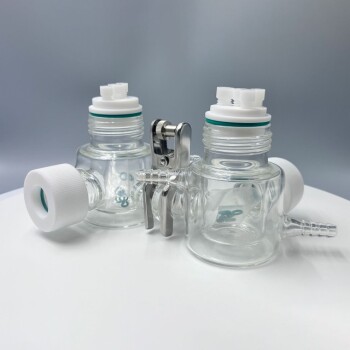
A single-chamber electrolytic cell with a cooling jacket is required because (non-)Kolbe electrolysis is a strongly exothermic process driven by high current densities. Without this active cooling mechanism, the significant heat generated during operation would destabilize the reaction. The cooling jacket enables precise temperature regulation, which is the deciding factor in chemical selectivity and product yield.
The primary function of the cooling jacket is to maintain reaction temperatures generally below 65°C. This specific thermal environment is critical for favoring radical dimerization (creating long-chain alkanes) while suppressing unwanted side reactions like radical disproportionation.
Managing Thermal Challenges
The nature of (non-)Kolbe electrolysis presents distinct thermal hurdles that a standard electrolytic cell cannot handle.
Counteracting High Heat Generation
(Non-)Kolbe electrolysis is not a passive process; it is strongly exothermic.
To drive the reaction efficiently, researchers typically employ high current densities. This electrical input generates substantial resistive heating within the electrolyte, which would cause a rapid temperature spike in an uncooled vessel.
The Necessity of Active Cooling
Passive heat dissipation is insufficient for these conditions.
A cooling jacket provides a continuous heat exchange interface surrounding the single chamber. This allows for the immediate removal of excess thermal energy, keeping the internal environment stable despite the high energy input.
Controlling Chemical Selectivity
The ultimate reason for using a cooling jacket goes beyond safety; it dictates the chemical identity of the final product.
Promoting Radical Dimerization
The goal of most (non-)Kolbe experiments is to produce long-chain alkanes.
This synthesis requires a specific pathway known as radical dimerization. The primary reference indicates that maintaining a lower temperature is essential to favor this pathway over others.
Suppressing Side Reactions
Heat is detrimental to product purity in this context.
If the temperature rises uncontrolled (typically above 65°C), the reaction kinetics shift. High temperatures encourage radical disproportionation, a side reaction that consumes the radical intermediates without forming the desired long chains.
Understanding the Trade-offs
While the cooling jacket enables the reaction, it also imposes operational limits that must be respected.
Cooling Capacity vs. Current Density
There is a physical limit to how much heat a jacket can remove.
You cannot increase the current density indefinitely to speed up the reaction. If the electrical heating exceeds the cooling jacket's thermal transfer rate, the temperature will breach the 65°C threshold, and product selectivity will degrade regardless of the apparatus used.
Making the Right Choice for Your Goal
To maximize the effectiveness of a single-chamber cell with a cooling jacket, align your operational parameters with your chemical objectives.
- If your primary focus is maximizing product yield (Long-Chain Alkanes): Ensure your cooling medium is sufficient to keep the electrolyte temperature strictly below 65°C to prioritize radical dimerization.
- If your primary focus is process speed (High Current): Monitor the temperature differential closely; if the cell temperature begins to climb, you must lower the current density to match the cooling jacket's capacity.
Precision in temperature control is the single most important factor in converting high current density into high-quality chemical output.
Summary Table:
| Feature | Requirement in (Non-)Kolbe Electrolysis | Impact of Cooling Jacket |
|---|---|---|
| Thermal State | Strongly Exothermic | Rapidly removes excess resistive heat |
| Temperature Limit | Generally < 65°C | Prevents thermal degradation of selectivity |
| Reaction Pathway | Radical Dimerization | Favors alkane formation over disproportionation |
| Current Density | High Current Inputs | Enables higher power without boiling electrolyte |
| Product Goal | Long-chain Alkanes | Ensures high purity and consistent chemical yield |
Maximize Your Electrochemical Precision with KINTEK
Precise temperature control is the difference between high-quality yields and failed synthesis. KINTEK specializes in advanced laboratory equipment, providing high-performance electrolytic cells and electrodes specifically designed to handle the thermal demands of (non-)Kolbe electrolysis.
Whether you are scaling up battery research or exploring organic synthesis, our comprehensive portfolio—including cooling solutions, high-temperature reactors, and precision furnaces—ensures your lab operates at peak efficiency.
Ready to upgrade your research capabilities? Contact our technical experts today to find the perfect electrolytic setup for your specific application.
References
- F. Joschka Holzhäuser, Regina Palkovits. (Non-)Kolbe electrolysis in biomass valorization – a discussion of potential applications. DOI: 10.1039/c9gc03264a
This article is also based on technical information from Kintek Solution Knowledge Base .
Related Products
- Double-Layer Water Bath Electrolytic Electrochemical Cell
- Multifunctional Electrolytic Electrochemical Cell Water Bath Single Layer Double Layer
- Electrolytic Electrochemical Cell for Coating Evaluation
- Customizable PEM Electrolysis Cells for Diverse Research Applications
- Thin-Layer Spectral Electrolysis Electrochemical Cell
People Also Ask
- What does the routine maintenance of a double-layer water-bath electrolytic cell involve? A Guide to Ensuring Precision and Longevity
- What is the typical experimental system used with a double-layer water-bath electrolytic cell? Achieve Precise Electrochemical Control
- What are the procedures for after using a double-layer water-bath electrolytic cell? Ensure Equipment Longevity and Data Accuracy
- When is professional repair required for a double-layer water-bath electrolytic cell? Protect Your Lab's Precision and Safety
- What are the key features of a double-layer water-bath electrolytic cell? Achieve Precise Temperature Control for Your Experiments