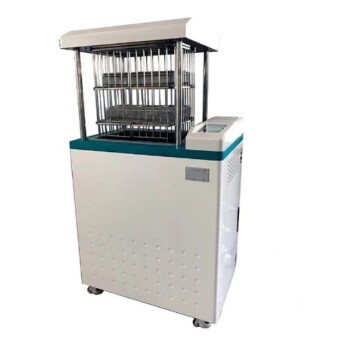
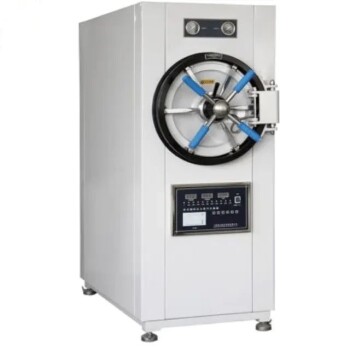
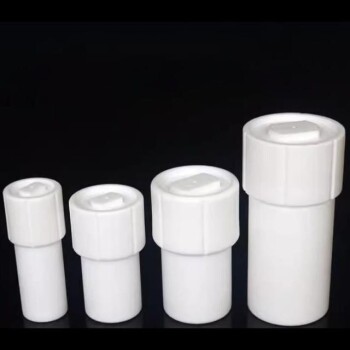
A Teflon-lined stainless steel high-pressure autoclave is the critical enabler for solvothermal synthesis because it allows solvents to be heated significantly beyond their atmospheric boiling points. This creates a unique high-pressure environment that enhances the solubility of nickel precursors, while the inner lining provides a non-reactive barrier to prevent contamination.
The autoclave serves a dual function: it generates the high-pressure conditions necessary for uniform particle nucleation and provides the chemical inertness required to maintain high purity during the reduction process.
The Physics of the Reaction Environment
Exceeding Atmospheric Boiling Points
In a standard open beaker, a solvent cannot exceed its boiling point; it simply evaporates.
The sealed environment of the autoclave traps the solvent. This allows the temperature to rise well above the solvent’s normal boiling point, creating a high-pressure system often referred to as subcritical or supercritical conditions.
Enhancing Solubility and Diffusion
Under these high-pressure, high-temperature conditions, the physical properties of the solvent change.
The solubility of nickel salts increases significantly, allowing precursors to dissolve more fully than they would at standard atmospheric pressure. Additionally, the diffusion rates of these dissolved species accelerate, promoting rapid mixing at the molecular level.
Promoting Uniform Nucleation
The combination of high solubility and rapid diffusion is vital for controlling particle quality.
These conditions ensure that the precipitation of nickel does not happen randomly or unevenly. Instead, the environment promotes uniform particle nucleation, which leads to a final product with consistent size and morphology.
The Critical Role of the Teflon Liner
Chemical Inertness Against Aggressive Agents
Synthesizing nickel nanoparticles requires reducing agents to convert nickel salts into metallic nickel.
These agents can be highly aggressive and corrosive. The Teflon liner offers exceptional chemical inertness, acting as a robust shield that resists attack from these chemicals, a property that standard glass or bare metal cannot reliably offer under pressure.
Protecting the Stainless Steel Shell
While the stainless steel outer shell provides the structural integrity to withstand high pressure, it is susceptible to corrosion.
Without the liner, the reaction mixture would directly contact the steel. The Teflon barrier protects the stainless steel outer shell from corrosion, ensuring the longevity of the equipment and safety of the procedure.
Ensuring High Purity
The most critical role of the liner is preventing cross-contamination.
If the reaction mixture corroded the steel shell, metallic impurities (such as iron or chromium) would leach into the solution. The Teflon liner ensures the high purity of the nickel nanoparticles by strictly isolating the chemical reaction from the metallic vessel.
Understanding the Trade-offs
Temperature Limitations of Teflon
While Teflon (PTFE) is chemically inert, it has thermal limitations compared to the stainless steel shell.
Teflon typically begins to soften or deform at temperatures approaching 250°C to 300°C. If your synthesis requires temperatures beyond this threshold, a Teflon-lined autoclave is no longer suitable and may require a PBO or specialized alloy liner.
Safety and Fill Ratios
The sealed nature of the autoclave creates a closed system where pressure builds exponentially with temperature.
Overfilling the autoclave leaves insufficient room for solvent expansion. This can lead to dangerous pressure spikes that may compromise the seal or cause a rupture, regardless of the liner's chemical resistance.
Making the Right Choice for Your Project
The autoclave is not just a container; it is an active parameter in your synthesis strategy. Use the following guide to align your equipment use with your specific research goals.
- If your primary focus is Particle Uniformity: Prioritize the high-pressure capabilities of the autoclave to maximize diffusion rates and ensure consistent nucleation.
- If your primary focus is Material Purity: Rely on the integrity of the Teflon liner to prevent metallic leaching, especially when using strong reducing agents.
- If your primary focus is Crystal Morphology: Utilize the precise control over pressure and temperature to influence specific crystal growth patterns.
By leveraging the high-pressure physics and chemical inertness of this system, you ensure both the structural uniformity and chemical purity of your nickel nanoparticles.
Summary Table:
| Feature | Function in Solvothermal Synthesis | Benefit for Nickel Nanoparticles |
|---|---|---|
| Sealed Stainless Steel Shell | Permits heating above boiling points | High-pressure environment for uniform nucleation |
| Teflon (PTFE) Liner | Provides a chemically inert barrier | Prevents metallic leaching and ensures high purity |
| High-Pressure Capability | Enhances precursor solubility | Promotes rapid molecular diffusion and consistent morphology |
| Temperature Control | Facilitates subcritical/supercritical conditions | Enables precise control over crystal growth patterns |
Elevate Your Nanomaterial Synthesis with KINTEK
Precision is paramount when synthesizing high-purity nickel nanoparticles. KINTEK specializes in high-performance laboratory equipment, offering a robust selection of high-temperature high-pressure reactors and autoclaves designed to withstand aggressive chemical environments.
Whether you need reliable Teflon-lined stainless steel vessels for superior chemical inertness or specialized crushing and milling systems for post-synthesis processing, our team provides the tools necessary to ensure consistent size and morphology in your research.
Ready to optimize your lab’s efficiency and material quality? Contact us today to discover how KINTEK’s comprehensive range of furnaces, hydraulic presses, and consumables can empower your next breakthrough.
References
- Nuru-Deen Jaji, Muhammad Bisyrul Hafi Othman. Advanced nickel nanoparticles technology: From synthesis to applications. DOI: 10.1515/ntrev-2020-0109
This article is also based on technical information from Kintek Solution Knowledge Base .
Related Products
- Stainless High Pressure Autoclave Reactor Laboratory Pressure Reactor
- Mini SS High Pressure Autoclave Reactor for Laboratory Use
- Desktop Fast High Pressure Laboratory Autoclave Sterilizer 16L 24L for Lab Use
- Laboratory High Pressure Horizontal Autoclave Steam Sterilizer for Lab Use
- Portable High Pressure Laboratory Autoclave Steam Sterilizer for Lab Use
People Also Ask
- Why is a laboratory high-pressure reactor used in the hydrothermal synthesis of hydroxyapatite catalysts?
- Why is a laboratory high-pressure reactor necessary for synthesizing fly ash-based zeolite? Achieve Pure Crystallization
- What role does a laboratory high-pressure reactor play in the leaching process of spent cathode materials? Optimize Recovery
- What conditions do laboratory high-pressure reactors provide for HTC? Optimize Your Biochar Production Processes
- How are high-pressure reactors used to prepare metaphosphate electrocatalysts? Master In-Situ Precursor Growth