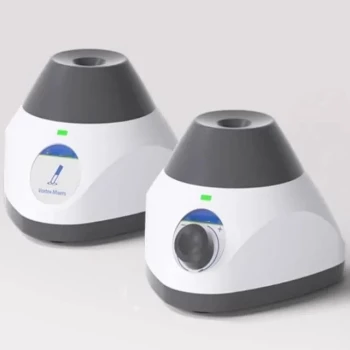
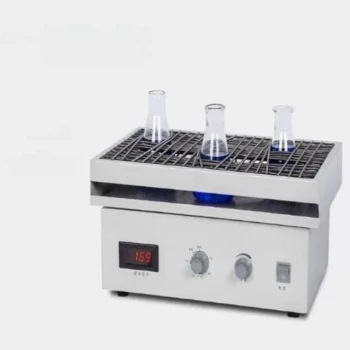
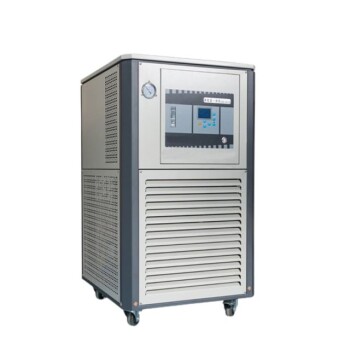
A thermostatic shaker or oscillator is required to provide continuous mechanical stirring throughout the adsorption process. This constant agitation ensures thorough contact between the solid Schiff base particles and the aqueous copper(II) solution, which is fundamental for generating reliable kinetic data.
By maintaining uniform kinetic conditions, the shaker overcomes mass transfer resistance in the liquid phase. This allows copper(II) ions to rapidly access nitrogen and oxygen active sites, ensuring that measured adsorption rates and equilibrium times reflect the true chemical interaction rather than diffusion limitations.
Overcoming Physical Barriers
Eliminating Mass Transfer Resistance
In a static solution, a thin film of liquid can form around solid particles, acting as a barrier to ion movement.
A thermostatic shaker generates continuous mechanical stirring to disrupt this film. This agitation reduces the mass transfer resistance in the liquid phase, allowing ions to move freely from the bulk solution to the adsorbent surface.
Ensuring Uniform Kinetic Conditions
For kinetic data to be valid, the concentration of ions must be consistent throughout the mixture.
The oscillator ensures that the solid Schiff base particles are uniformly suspended within the aqueous solution. This prevents particle settling and guarantees that all surface areas are equally exposed to the copper(II) ions.
Facilitating Chemical Interaction
Targeting Active Sites
The primary goal of the adsorption process is to bind copper(II) ions to specific chemical targets on the Schiff base material.
Specifically, the ions must reach nitrogen and oxygen donor atoms, which serve as the active sites for adsorption. Mechanical stirring ensures that these sites are physically accessible to the ions in the solution.
Accurate Rate Determination
To calculate how fast adsorption occurs (kinetics) and when it stops (equilibrium), the experiment must not be limited by how fast the fluid moves.
By removing physical transport barriers, the shaker ensures that the data collected represents the actual rate of chemical binding. This is essential for accurately determining adsorption rates and equilibrium times.
The Consequence of Inadequate Mixing
The Risk of Diffusion-Limited Data
If a shaker is not used or if agitation is insufficient, the experiment measures the speed of diffusion rather than the speed of adsorption.
This leads to erroneous results where the reaction appears slower than it actually is. It obscures the true affinity between the copper(II) ions and the Schiff base material, rendering the kinetic analysis scientifically invalid.
Ensuring Experimental Precision
To maximize the reliability of your adsorption study, align your equipment usage with your specific analytical goals:
- If your primary focus is determining reaction rates: Ensure the stirring speed is high enough to eliminate liquid film resistance so you are measuring chemical kinetics, not diffusion.
- If your primary focus is mechanism identification: Use the shaker to guarantee that copper(II) ions have full access to the nitrogen and oxygen donor atoms on the adsorbent surface.
Consistent mechanical agitation is the only way to ensure that your kinetic data reflects the true chemical potential of your material.
Summary Table:
| Feature | Role in Adsorption Kinetics | Impact on Result |
|---|---|---|
| Mechanical Stirring | Disrupts liquid-phase film barriers | Eliminates mass transfer resistance |
| Particle Suspension | Prevents solid Schiff base settling | Ensures uniform access to active sites |
| Thermal Stability | Maintains constant temperature | Guarantees kinetic data reproducibility |
| Agitation Speed | Controls ion transport rates | Distinguishes chemical kinetics from diffusion |
Elevate Your Material Research with KINTEK Precision
Achieving accurate adsorption kinetics requires equipment that delivers consistent, reliable performance. KINTEK specializes in high-quality laboratory solutions, including high-performance shakers and oscillators designed to optimize mass transfer for your chemical studies.
Our extensive portfolio also includes high-temperature furnaces (muffle, vacuum, CVD), high-pressure reactors, and specialized battery research tools, providing target researchers with the precision needed to determine true chemical potential.
Ready to eliminate diffusion limitations and secure valid equilibrium data? Contact us today to find the perfect equipment for your lab!
References
- Chuan Wei Oo, Maizatul Akmar Md. Zin. The Uptake of Copper(II) Ions by Chelating Schiff Base Derived from 4-Aminoantipyrine and 2-Methoxybenzaldehyde. DOI: 10.4236/ijnm.2013.21001
This article is also based on technical information from Kintek Solution Knowledge Base .
Related Products
- Laboratory Vortex Mixer Orbital Shaker Multifunctional Rotation Oscillation Mixer
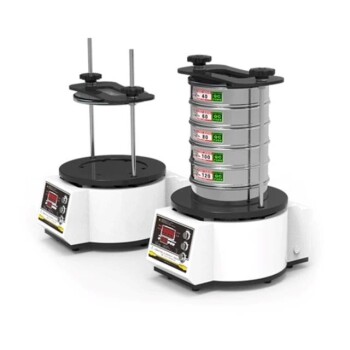
- Laboratory Wet Three-Dimensional Vibratory Sieve Shaker Machine
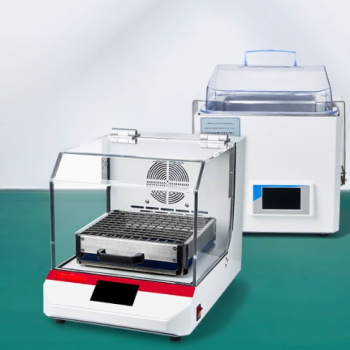
- Shaking Incubators for Diverse Laboratory Applications
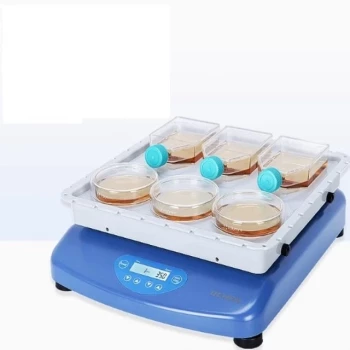
- Laboratory Oscillating Orbital Shaker
- Laboratory Multifunctional Small Speed-Adjustable Horizontal Mechanical Shaker for Lab
People Also Ask
- What is the role of a laboratory orbital shaker in copper recovery? Optimize Industrial Waste Liquid Processing
- What is the role of a laboratory orbital shaker in activated carbon synthesis? Maximize Pore Depth & Surface Area
- What is a laboratory mixer used for? Choose the Right Tool for Liquids or Solids
- What is a laboratory mixer? A Guide to Achieving Perfect Sample Homogeneity
- What are laboratory mixers used for? Achieve Perfect Sample Homogeneity and Reliable Results