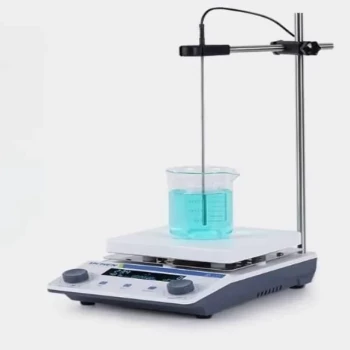
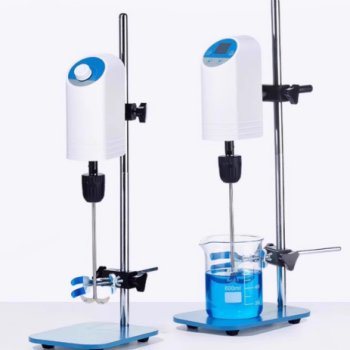
A thermostatic stirred reactor acts as the stabilizing heart of the uranium leaching process, ensuring the rigorous thermodynamic and kinetic conditions required for successful extraction. By combining precise temperature control—often at levels such as 85°C—with continuous mechanical agitation, this equipment allows operators to accelerate reaction rates and maintain total system uniformity.
Core Takeaway In uranium extraction, the limiting factors are often inconsistent temperatures and particle sedimentation. The thermostatic stirred reactor eliminates these variables by synchronizing thermal energy with mechanical motion, enabling the solvent to overcome diffusion resistance and maximize the conversion of raw minerals into soluble uranium.
Controlling the Reaction Environment
The Importance of Thermal Stability
To extract uranium effectively using acidic or alkaline solvents, the system requires a specific, elevated energy state. A thermostatic reactor allows you to lock in precise temperatures, such as 85°C, creating a stable thermodynamic baseline.
Accelerating Kinetics
Heat is the primary driver of reaction speed. By maintaining a constant high temperature, the reactor ensures that the chemical interaction between the mineral and the solvent occurs at an accelerated rate, significantly reducing process time.
The Role of Mechanical Agitation
Preventing Sedimentation
Uranium ore particles are dense and naturally prone to settling at the bottom of a vessel. Continuous mechanical stirring counteracts gravity, keeping the solid particles suspended and fully exposed to the chemical solvent.
Ensuring System Uniformity
Without active mixing, "dead zones" can form where temperature and solvent concentration drop. The reactor’s stirring mechanism guarantees a uniform distribution of heat and acidity (or alkalinity) throughout the entire liquid volume.
Overcoming Physical Barriers
Battling Layer Diffusion Resistance
As the leaching reaction progresses, a passive layer can form around the ore particle, blocking fresh solvent from reaching the unreacted mineral. The reactor's combination of heat and turbulence helps the solvent penetrate this layer, overcoming diffusion resistance.
Optimizing Conversion Rates
The ultimate goal of leaching is maximizing yield. By ensuring every particle is subjected to the same optimal conditions, the reactor facilitates the highest possible conversion rate of solid mineral to dissolved uranium.
The Consequence of Poor Control
Understanding the Risks of Gradients
If the reactor fails to maintain a thermostatic or stirred environment, thermal and concentration gradients will develop immediately. This leads to incomplete leaching, where some ore remains untouched while other sections are over-processed.
The Impact on Efficiency
Inconsistent conditions do not just lower yields; they introduce unpredictability. Without the stable environment provided by the reactor, it becomes impossible to reliably predict batch completion times or solvent consumption.
Making the Right Choice for Your Process
To optimize your uranium leaching circuit, consider which parameter dictates your current bottleneck:
- If your primary focus is maximizing reaction speed: Prioritize the reactor's heating capacity to maintain elevated temperatures (e.g., 85°C) to drive kinetic acceleration.
- If your primary focus is maximizing resource yield: Focus on the reactor's agitation capability to prevent settling and overcome layer diffusion resistance.
Ultimately, the thermostatic stirred reactor transforms a chaotic chemical mixture into a controlled, high-efficiency extraction system.
Summary Table:
| Feature | Function in Uranium Leaching | Benefit to Process |
|---|---|---|
| Thermostatic Control | Maintains constant temperature (e.g., 85°C) | Accelerates reaction kinetics & ensures stability |
| Mechanical Agitation | Keeps ore particles suspended | Prevents sedimentation & eliminates 'dead zones' |
| Turbulence Generation | Breaks down passive mineral layers | Overcomes diffusion resistance for higher yields |
| System Uniformity | Distributes heat & solvent evenly | Prevents concentration gradients & processing errors |
Maximize Your Extraction Yield with KINTEK Precision
In the demanding field of uranium mineral processing, equipment failure or thermal inconsistency can lead to significant resource waste. KINTEK specializes in high-performance laboratory equipment, providing the precision needed for complex chemical leaching.
Our advanced high-temperature high-pressure reactors and autoclaves, combined with robust crushing and milling systems, ensure your minerals are perfectly prepared and processed for maximum recovery. Whether you are optimizing acidic or alkaline leaching, KINTEK offers the thermal stability and mechanical reliability your research demands.
Ready to upgrade your laboratory’s efficiency? Contact KINTEK today to discover our comprehensive range of reactors, furnaces, and consumables tailored for the nuclear and battery research industries.
References
- Reda M. Attia, Nilly A. Kawady. Comparative evaluation of chemical and bio techniques for uranium leaching from low grade sandstone rock sample, Abu Thor, southwestern Sinai, Egypt. DOI: 10.1007/s10967-022-08621-6
This article is also based on technical information from Kintek Solution Knowledge Base .
Related Products
- Laboratory Small Constant Temperature Heated Magnetic Stirrer Heater and Stirrer
- High Performance Laboratory Stirrers for Diverse Applications
- Customizable Laboratory High Temperature High Pressure Reactors for Diverse Scientific Applications
- High Pressure Laboratory Autoclave Reactor for Hydrothermal Synthesis
- Custom PTFE Teflon Parts Manufacturer for Magnetic Stirring Bar
People Also Ask
- What role does a magnetic stirrer with heating play in ZnO nanoparticle synthesis? Precision Control for Quality Results
- What role does a constant temperature heating magnetic stirrer play in MFC-HAp synthesis? Achieve Material Homogeneity
- What is the function of a laboratory magnetic stirrer in Ni–Cr–P electrodeposition? Optimize Ion Transport & Coating
- Why is a laboratory magnetic stirrer required for benzoic acid esters? Boost Reaction Speed & Yield with High RPM
- What role does a laboratory magnetic stirrer play in TiO2 and TiO2-Ag sol preparation? Master Chemical Kinetics