Precise control over electrochemical potential is the only way to accurately map corrosion behavior. A three-electrode electrochemical cell system is necessary because it isolates the polarization of the working electrode (the Ni-Cr sample) from the counter electrode. This separation ensures that the current flow does not distort the voltage measurement, enabling exact identification of the alloy's kinetic states.
The three-electrode configuration decouples current transmission from potential sensing. This eliminates significant errors caused by solution resistance, providing the high-resolution data needed to distinguish between the passivation, dissolution, and reprecipitation phases of Ni-Cr alloys.
The Mechanics of the Three-Electrode System
The Role of Each Component
To study corrosion kinetics, the system employs three distinct components.
The Working Electrode is the Ni-Cr alloy sample itself, the specific material you are investigating.
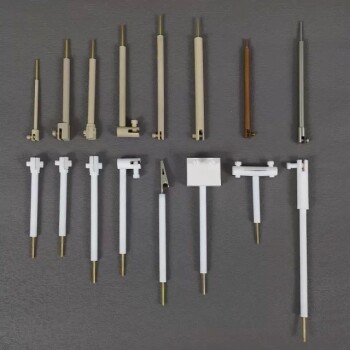
The Reference Electrode maintains a stable, constant potential, serving as the benchmark against which the sample's voltage is measured.
The Platinum Counter Electrode completes the electrical circuit, allowing current to flow through the electrolyte without participating in the reaction.
Isolating the Polarization Process
The primary value of this setup is the separation of functions.
Current is driven between the Working Electrode and the Counter Electrode. Meanwhile, the potential (voltage) is measured strictly between the Working Electrode and the Reference Electrode.
By ensuring no current flows through the Reference Electrode, the system maintains a distortion-free measurement of the interface at the metal surface.
Capturing Ni-Cr Alloy Kinetics
Identifying Kinetic Regions
Ni-Cr alloys exhibit complex behavior under potentiodynamic scanning.
You must accurately identify distinct kinetic regions, specifically passivation (protective film formation), dissolution (active corrosion), and reprecipitation.
The three-electrode system provides the sensitivity required to detect the precise voltages where these transitions occur.
Eliminating Environmental Interference
Accuracy also depends on controlling the chemical environment.
Continuous purging with high-purity nitrogen gas is used to de-aerate the electrolyte.
Removing dissolved oxygen ensures that oxide film growth is driven solely by the applied potential, rather than uncontrolled chemical oxidation.
Understanding the Trade-offs
The Problem with Two-Electrode Systems
In a simpler two-electrode setup, the Counter Electrode acts as both the current carrier and the reference.
This leads to a "voltage drop" error across the solution resistance. As current increases, your voltage reading becomes inaccurate, obscuring the true behavior of the Ni-Cr alloy.
Complexity vs. Accuracy
The three-electrode system requires more complex instrumentation (a potentiostat) and careful setup of the reference bridge.
However, this added complexity is the non-negotiable cost of obtaining kinetic data that is scientifically valid and reproducible.
Making the Right Choice for Your Goal
To ensure your corrosion study yields valid data, consider the following:
- If your primary focus is defining the passivation window: You must use a three-electrode system to accurately locate the exact potential range where the protective oxide film remains stable.
- If your primary focus is measuring active dissolution rates: A three-electrode setup is required to compensate for solution resistance, which would otherwise underestimate the corrosion rate.
The three-electrode system is not just an equipment choice; it is the fundamental standard for isolating the true electrochemical response of your material.
Summary Table:
| Component | Role in Ni-Cr Corrosion Study | Primary Benefit |
|---|---|---|
| Working Electrode | Ni-Cr Alloy Sample | Targeted site for corrosion reaction analysis |
| Reference Electrode | Stable Potential Benchmark | Provides distortion-free voltage measurements |
| Counter Electrode | Completes Electrical Circuit | Prevents current flow from affecting reference sensing |
| Nitrogen Purging | Electrolyte De-aeration | Eliminates uncontrolled oxidation interference |
Elevate Your Electrochemical Research with KINTEK Precision
Don't let measurement errors compromise your alloy research. KINTEK specializes in advanced laboratory equipment designed for high-resolution corrosion studies. Whether you need high-performance electrolytic cells and electrodes, specialized high-temperature high-pressure reactors, or precision homogenizers, our solutions ensure your data is scientifically valid and reproducible.
From battery research tools to essential ceramic crucibles and PTFE consumables, KINTEK provides everything you need to define passivation windows and measure dissolution rates with confidence.
Ready to upgrade your lab setup? Contact our technical experts today to find the perfect electrochemical configuration for your specific material science needs!
References
- Penghao Xiao, Brandon C. Wood. Atomic-scale understanding of oxide growth and dissolution kinetics of Ni-Cr alloys. DOI: 10.1038/s41467-024-54627-x
This article is also based on technical information from Kintek Solution Knowledge Base .
Related Products
- H Type Electrolytic Cell Triple Electrochemical Cell
- PTFE Electrolytic Cell Electrochemical Cell Corrosion-Resistant Sealed and Non-Sealed
- Electrolytic Electrochemical Cell Gas Diffusion Liquid Flow Reaction Cell
- Electrolytic Electrochemical Cell with Five-Port
- Electrolytic Electrochemical Cell for Coating Evaluation
People Also Ask
- What is a H type cell? A Guide to Divided Electrochemical Cells for Accurate Experiments
- How should the electrolyte be prepared and added to the H-type electrolytic cell? Best Practices for Purity and Safety
- What is the technical necessity of using an H-type electrolytic cell for NO3RR tests? Protect Your Ammonia Yields
- How does the design of an H-type electrolytic cell benefit the neutral water electrolysis process for metal recovery?
- What is the primary function of an H-type electrolytic cell in NitRR? Ensure Accurate Product Yields