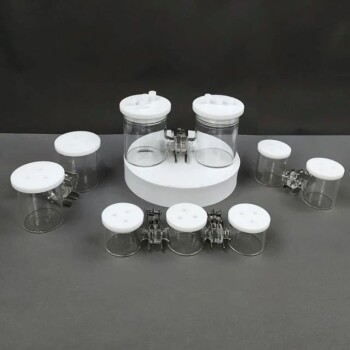
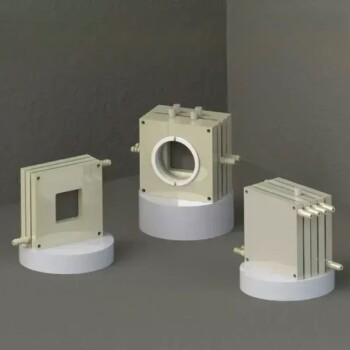
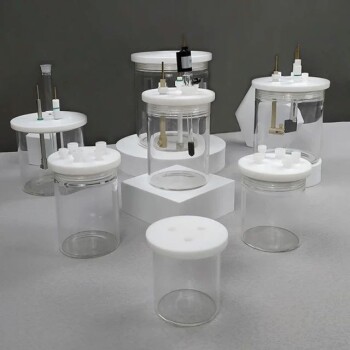
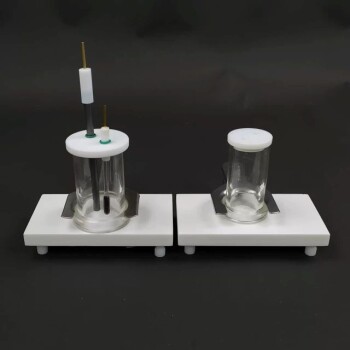
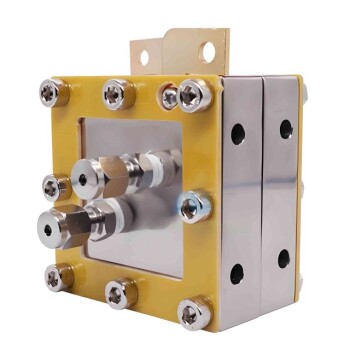
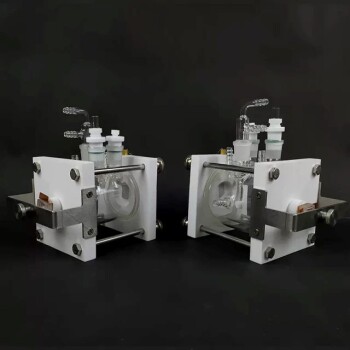
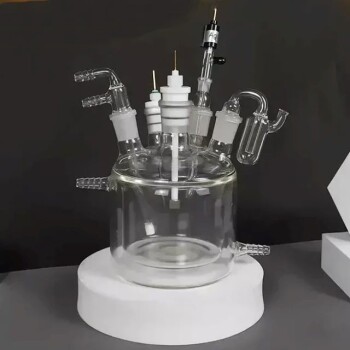
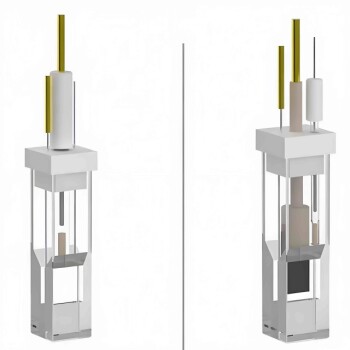
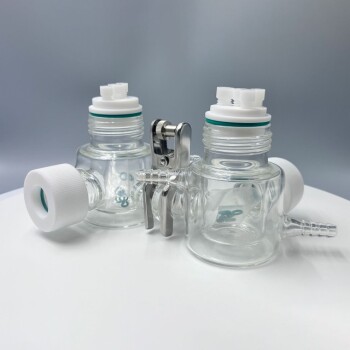
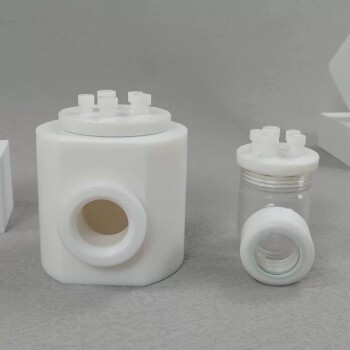
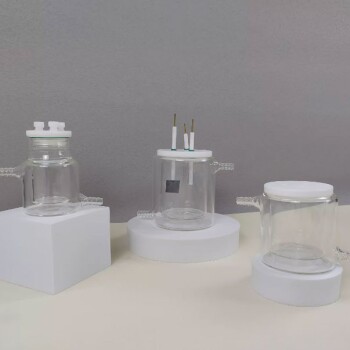
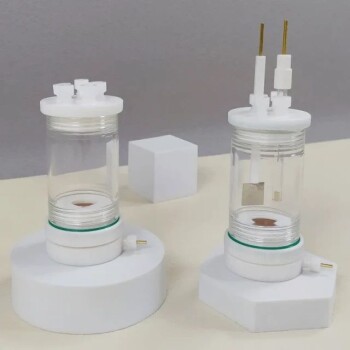
The three-electrode electrolytic cell is the foundational architecture for precise electrochemical characterization. This configuration is necessary for Hydrogen Evolution Reaction (HER) testing because it decouples the measurement of electrode potential from the current-carrying circuit. By using a dedicated Reference Electrode (RE), researchers can isolate the behavior of the Working Electrode (WE), ensuring that data such as overpotentials and Tafel slopes reflect the catalyst's intrinsic activity rather than system-wide interference.
Core Takeaway: A three-electrode setup eliminates errors caused by counter electrode polarization and ohmic resistance. It provides a stable, independent reference point that is essential for capturing the accurate kinetic performance of HER catalysts in acidic environments.
Precise Control of the Electrochemical Interface
The Necessity of Potential Isolation
In a standard two-electrode system, the potential difference is measured across the entire cell, conflating the reactions at both the anode and cathode. The three-electrode system introduces a Reference Electrode (RE), such as Ag/AgCl or Saturated Calomel (SCE), which maintains a constant chemical potential.
This isolation ensures that any change in potential recorded during the HER process is attributed solely to the Working Electrode (WE). This is critical in acidic electrolytes like 0.5 M $H_2SO_4$, where even minor fluctuations in potential can significantly alter the perceived catalytic efficiency.
Eliminating Counter Electrode Polarization
During HER testing, the Counter Electrode (CE)—often a graphite rod or platinum wire—must facilitate the complementary reaction (oxygen evolution) to complete the circuit. This process causes the CE to "polarize," meaning its own potential shifts as current flows.
In a three-electrode configuration, the potential is measured between the WE and the RE, while the current flows between the WE and the CE. This ensures that the polarization of the counter electrode does not skew the voltage readings of the catalyst being tested.
Accuracy in Kinetic Data and Performance Metrics
Determining Onset Overpotential and Tafel Slopes
The Tafel slope and onset overpotential are the primary indicators of a catalyst's kinetic efficiency. To calculate these, the relationship between the applied potential and the resulting current density must be captured with extreme precision.
Because the three-electrode system provides a "clean" potential measurement, it allows for the derivation of intrinsic kinetic parameters. This prevents the misidentification of system resistance as poor catalytic performance, ensuring that the recorded exchange current density is accurate.
Minimizing Ohmic Voltage Drops
Acidic electrolytes offer high conductivity, but resistance still exists within the electrolyte and the circuit (IR drop). A three-electrode setup, particularly when using a Luggin capillary, allows researchers to measure and compensate for this resistance.
By minimizing the ohmic voltage drop, the system ensures that the measured overpotential is the actual energy required to drive the hydrogen evolution at the catalyst surface. This is essential for comparing different materials under standardized conditions.
Understanding the Trade-offs and Limitations
System Complexity and Material Selection
While superior in accuracy, three-electrode cells are more complex to assemble and require careful selection of the Counter Electrode. For instance, using a Platinum (Pt) counter electrode in some acidic tests can lead to Pt dissolution and subsequent re-deposition onto the Working Electrode, which may lead to false-positive HER activity.
Reference Electrode Stability in Acid
Not all reference electrodes are equally stable in highly acidic media. Over time, the internal filling solution may leak or the junction may become clogged, leading to potential drift. Regular calibration against the Reversible Hydrogen Electrode (RHE) scale is required to maintain the integrity of the long-term stability data.
How to Apply This to Your Research
Implementing the Three-Electrode Configuration
To achieve the most reliable HER activity measurements, your testing protocol should be tailored to the specific goals of your material analysis.
- If your primary focus is intrinsic kinetic activity: Use a high-purity graphite rod as the counter electrode to avoid metal contamination and ensure rigorous IR compensation is applied to your polarization curves.
- If your primary focus is long-term durability: Monitor the potential of the Reference Electrode before and after the stability test to ensure that any observed degradation is due to the catalyst and not reference potential drift.
- If your primary focus is bench-marking against literature: Always convert your measured potentials to the RHE scale using the Nernst equation to account for the specific pH of your acidic electrolyte.
By strictly adhering to the three-electrode configuration, you ensure that your HER data is both scientifically rigorous and reproducible across the global research community.
Summary Table:
| Component | Primary Function | Key Benefit for HER Testing |
|---|---|---|
| Working Electrode (WE) | Material under study | Direct measurement of intrinsic catalyst activity |
| Reference Electrode (RE) | Constant potential point | Isolates WE behavior from system-wide interference |
| Counter Electrode (CE) | Completes the circuit | Prevents electrode polarization from skewing voltage |
| Luggin Capillary | Resistance compensation | Minimizes ohmic voltage (IR) drops for cleaner data |
Elevate Your Electrochemical Research with KINTEK
Precision is the backbone of groundbreaking material science. At KINTEK, we provide the specialized tools you need to achieve rigorous, reproducible results in Hydrogen Evolution Reaction (HER) testing and beyond.
Our extensive portfolio features high-performance electrolytic cells and electrodes, battery research tools, and high-temperature furnaces (CVD, PECVD, vacuum) designed for absolute accuracy. Whether you require stable reference electrodes, high-purity consumables like PTFE and ceramics, or precision hydraulic presses, we ensure your lab is equipped for excellence.
Ready to optimize your HER testing protocol and eliminate measurement errors? Contact us today to discover how KINTEK’s laboratory solutions can enhance your research efficiency and data integrity.
References
- Tianyu Yang, Zhenhui Kang. In Situ Insertion of Silicon Nanowires into Hollow Porous Co/NC Polyhedra Enabling Large‐Current‐Density Hydrogen Evolution Electrocatalysis. DOI: 10.1002/smll.202305873
This article is also based on technical information from Kintek Solution Knowledge Base .
Related Products
- H Type Electrolytic Cell Triple Electrochemical Cell
- Electrolytic Electrochemical Cell Gas Diffusion Liquid Flow Reaction Cell
- Electrolytic Electrochemical Cell with Five-Port
- PTFE Electrolytic Cell Electrochemical Cell Corrosion-Resistant Sealed and Non-Sealed
- Super Sealed Electrolytic Electrochemical Cell
People Also Ask
- What is a H type cell? A Guide to Divided Electrochemical Cells for Accurate Experiments
- How should the electrolyte be prepared and added to the H-type electrolytic cell? Best Practices for Purity and Safety
- What is the technical necessity of using an H-type electrolytic cell for NO3RR tests? Protect Your Ammonia Yields
- How does the design of an H-type electrolytic cell benefit the neutral water electrolysis process for metal recovery?
- What is the primary function of an H-type electrolytic cell in NitRR? Ensure Accurate Product Yields