The three-electrode system is essential for Carbon Nitride measurements because it decouples the potential control from the current flow. This configuration allows researchers to precisely monitor the electrical potential at the catalyst-electrolyte interface without interference from the counter electrode's polarization or resistance-induced voltage drops.
By isolating the working electrode from the counter electrode's electrochemical fluctuations, the three-electrode system provides the high-fidelity data required to quantify charge separation efficiency and interfacial kinetics in semiconductor catalysts.
Precision Control of the Electrochemical Interface
The Role of the Reference Electrode
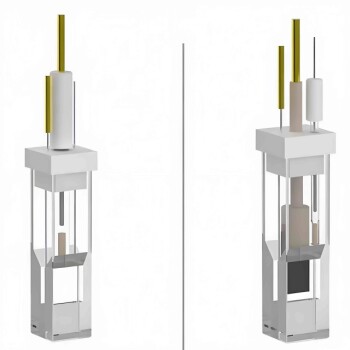
A three-electrode setup utilizes a working electrode (the Carbon Nitride catalyst), a counter electrode (typically platinum), and a reference electrode (such as Ag/AgCl). The reference electrode maintains a stable, constant potential, acting as a "ruler" against which the catalyst's potential is measured.
Eliminating Counter Electrode Interference
In a simpler two-electrode system, the potential measured includes the polarization of the counter electrode. The three-electrode configuration bypasses this by ensuring that no significant current flows through the reference electrode, keeping the measured potential at the Carbon Nitride surface accurate and stable.
Compensating for IR Drop
Resistance within the electrolyte can cause a "potential drop" known as IR drop, which distorts voltage readings. The three-electrode system allows electrochemical workstations to compensate for this resistance, ensuring the voltage applied to the catalyst is exactly what the researcher intended.
Quantifying Photoelectrochemical Performance
Measuring Transient Photocurrent Responses
Carbon Nitride catalysts are often evaluated for their ability to generate electrons under light. The three-electrode cell allows for the precise recording of transient photocurrents, which indicate how efficiently photogenerated electrons migrate from the catalyst to the external circuit.
Analyzing Interfacial Charge Transfer Kinetics
Researchers use Electrochemical Impedance Spectroscopy (EIS) within this setup to map the resistance at the catalyst's surface. This data is critical for determining how quickly charges move across the interface and where recombination "bottlenecks" might be occurring.
Assessing Overpotential and Durability
By providing a stable redox environment, this system allows for the quantitative assessment of the overpotential required for reactions like hydrogen or oxygen evolution. It also enables long-term stability testing by ensuring the catalyst is subjected to a constant, controlled electrochemical stress.
Understanding the Trade-offs and Limitations
Reference Electrode Stability
While the reference electrode provides precision, it is not "set and forget." Reference electrodes can drift over time or become contaminated by specific ions in the electrolyte, which can lead to false potential readings if not regularly calibrated.
Electrolyte Compatibility and pH Sensitivity
The choice of electrolyte (e.g., Na2SO4 or KOH) significantly impacts the behavior of Carbon Nitride. A three-electrode system requires careful matching of the reference electrode filling solution with the electrolyte to prevent junction potentials that can skew data.
Geometric and Positioning Constraints
The physical placement of the reference electrode (the Luggin capillary) relative to the working electrode is critical. If placed too far away, the uncompensated resistance increases; if too close, it may shield the catalyst surface from light or ionic flow.
How to Apply This to Your Research
Making the Right Choice for Your Goal
- If your primary focus is quantifying charge separation: Utilize the three-electrode setup to perform transient photocurrent measurements under chopped light to isolate electronic movement from thermal effects.
- If your primary focus is catalytic mechanism analysis: Use Electrochemical Impedance Spectroscopy (EIS) to identify the specific resistances at the Carbon Nitride/electrolyte interface.
- If your primary focus is material durability: Conduct long-term chronoamperometry in a three-electrode cell to ensure the potential at the catalyst surface remains constant throughout the aging process.
By mastering the three-electrode configuration, you ensure that the observed performance of your Carbon Nitride catalyst is a result of its intrinsic properties rather than an artifact of the testing environment.
Summary Table:
| Component | Role in Carbon Nitride Testing | Key Research Benefit |
|---|---|---|
| Working Electrode | Holds the Carbon Nitride catalyst | Measures intrinsic catalytic activity and charge separation. |
| Reference Electrode | Provides a stable potential "ruler" | Eliminates potential drift and ensures reproducible voltage data. |
| Counter Electrode | Completes the electrical circuit | Prevents counter-electrode polarization from skewing results. |
| Electrochemical Cell | Houses the electrolyte and electrodes | Enables precise control of interfacial kinetics and IR drop compensation. |
Elevate Your Catalyst Research with KINTEK Precision
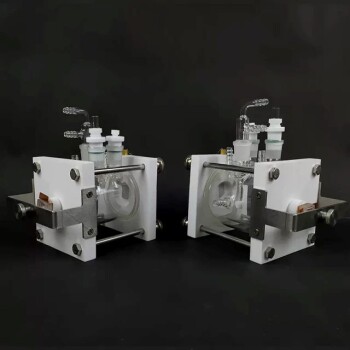
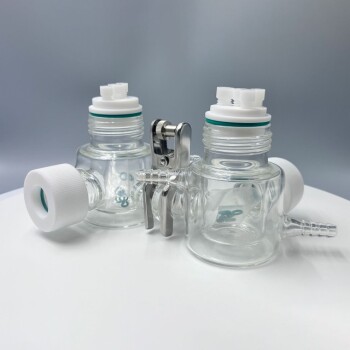
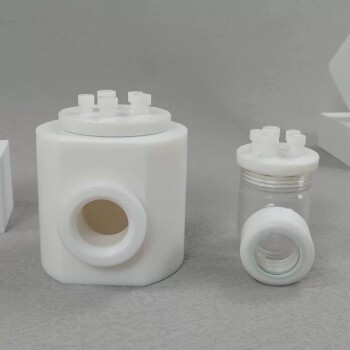
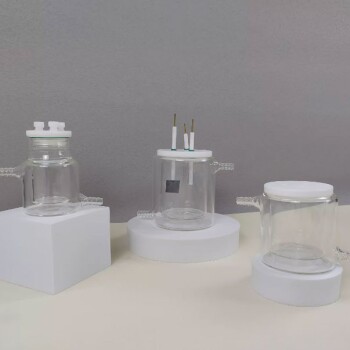
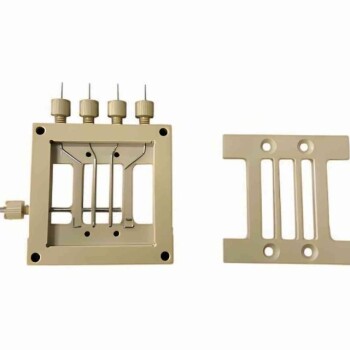
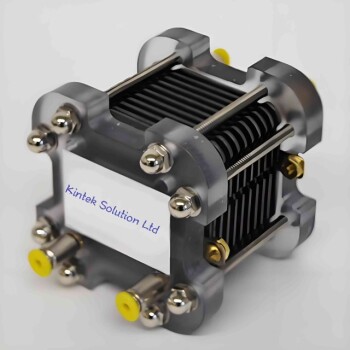
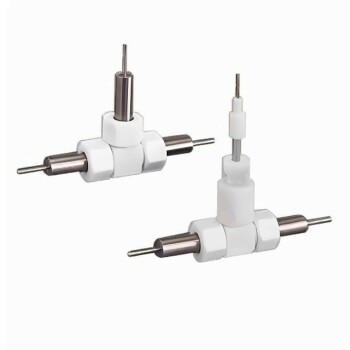
Achieving high-fidelity data in photoelectrochemical measurements requires more than just expertise—it requires world-class equipment. KINTEK specializes in high-performance laboratory solutions tailored for advanced material science. Our extensive portfolio features specialized electrolytic cells and electrodes designed to provide the stability and precision needed for rigorous Carbon Nitride catalyst analysis.
Beyond electrochemistry, KINTEK supports your entire workflow with a comprehensive range of equipment, including:
- High-Temperature Furnaces: Muffle, tube, CVD, and PECVD systems for catalyst synthesis.
- Sample Preparation: Hydraulic presses and crushing/milling systems for consistent electrode fabrication.
- Thermal Management: ULT freezers and chillers for sensitive experimental conditions.
Whether you are quantifying interfacial charge transfer kinetics or assessing long-term durability, KINTEK provides the reliable tools you need to drive innovation. Contact us today to find the perfect system for your laboratory!
References
- Fengting He, Shaobin Wang. Rejoint of Carbon Nitride Fragments into Multi‐Interfacial Order‐Disorder Homojunction for Robust Photo‐Driven Generation of H<sub>2</sub>O<sub>2</sub>. DOI: 10.1002/adma.202307490
This article is also based on technical information from Kintek Solution Knowledge Base .
Related Products
- H Type Electrolytic Cell Triple Electrochemical Cell
- Electrolytic Electrochemical Cell Gas Diffusion Liquid Flow Reaction Cell
- Electrolytic Electrochemical Cell with Five-Port
- PTFE Electrolytic Cell Electrochemical Cell Corrosion-Resistant Sealed and Non-Sealed
- Super Sealed Electrolytic Electrochemical Cell
People Also Ask
- What is a H type cell? A Guide to Divided Electrochemical Cells for Accurate Experiments
- How should the electrolyte be prepared and added to the H-type electrolytic cell? Best Practices for Purity and Safety
- What is the technical necessity of using an H-type electrolytic cell for NO3RR tests? Protect Your Ammonia Yields
- How does the design of an H-type electrolytic cell benefit the neutral water electrolysis process for metal recovery?
- What is the primary function of an H-type electrolytic cell in NitRR? Ensure Accurate Product Yields