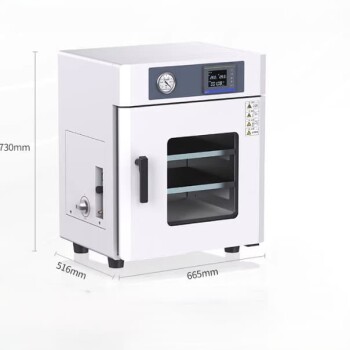
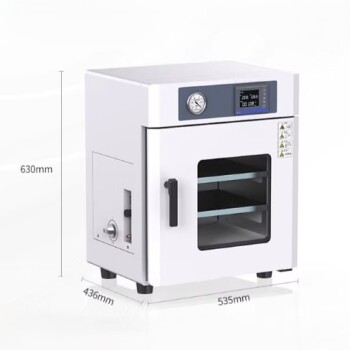
A vacuum drying oven is the recommended tool for drying vanadium dioxide nanopowders because it enables the rapid removal of moisture and solvents at low temperatures while strictly controlling the atmosphere. This process prevents the chemical degradation of the material and preserves its delicate physical structure.
Core Takeaway: Standard drying methods often destroy the functional properties of vanadium dioxide. A vacuum oven lowers the boiling point of solvents, allowing for effective drying at approximately 60°C, which prevents oxidation into unwanted phases and maintains the critical thermochromic activity of the nanomaterial.
Protecting Chemical Phase Purity
Preventing Unwanted Oxidation
Vanadium dioxide (VO2) is chemically sensitive. Exposure to high heat in the presence of air often causes it to oxidize further into higher-valent vanadium oxides.
If this occurs, the material loses the specific phase purity required for its application. A vacuum oven operates under reduced pressure, effectively removing oxygen from the environment to block this chemical shift.
The Advantage of Low-Temperature Evaporation
Under standard atmospheric pressure, removing solvents requires high heat. A vacuum environment significantly lowers the boiling point of residual solvents and moisture.
This allows the material to dry thoroughly at much lower temperatures, such as 60°C. This "gentle" thermal profile is essential for preventing thermal degradation that would occur in a standard high-heat oven.
Preserving Microscopic Structure and Function
Minimizing Hard Agglomeration
Nanopowders have a natural tendency to clump together. When dried aggressively, these particles can form hard agglomerates that are difficult to break apart and unusable in precision applications.
Vacuum drying mitigates this issue. By removing solvents rapidly at low temperatures, it minimizes the formation of these hard bonds between particles.
Maintaining Thermochromic Activity
The utility of vanadium dioxide lies in its thermochromic activity—its ability to change properties at specific temperatures. This activity is often tied to the material's morphology, such as a specific nanorod shape.
By preventing agglomeration and oxidation, vacuum drying ensures the microscopic morphology (the shape of the nanorods) remains intact, thereby preserving the material's functional performance.
Common Pitfalls to Avoid
The Risk of Standard Convection Ovens
Using a standard laboratory oven is a common error in nanomaterial processing. Without a vacuum, you must increase the temperature to drive off solvents.
This combination of high heat and oxygen exposure guarantees the degradation of vanadium dioxide. The result is often a powder that is chemically impure and physically fused, rendering it useless for advanced applications.
Incomplete Solvent Removal
Simply air-drying at low temperatures is also insufficient. Without reduced pressure, residual solvents often remain trapped within the nanopowder structure.
This residual moisture can interfere with subsequent processing steps or lead to slow, long-term oxidation of the sample.
Making the Right Choice for Your Goal
To ensure your vanadium dioxide nanopowders perform as intended, align your drying process with your specific quality metrics:
- If your primary focus is Phase Purity: Use a vacuum oven to eliminate oxygen exposure and prevent the formation of higher-valent oxides.
- If your primary focus is Functional Performance: Prioritize low-temperature vacuum drying (approx. 60°C) to prevent agglomeration and preserve thermochromic activity.
Precision in the drying stage is not a luxury; it is the deciding factor in the final quality of reactive nanomaterials.
Summary Table:
| Feature | Vacuum Drying Oven (Recommended) | Standard Convection Oven (Avoid) |
|---|---|---|
| Temperature | Low (approx. 60°C) | High (Required for evaporation) |
| Atmosphere | Oxygen-free / Reduced Pressure | Air / Oxygen exposure |
| Material Purity | High phase purity (prevents oxidation) | High risk of higher-valent oxides |
| Morphology | Preserves nanorod shape & activity | Causes hard agglomeration |
| Solvent Removal | Rapid and complete | Often incomplete or slow |
Elevate Your Nanomaterial Research with KINTEK
Precision in the drying stage is the deciding factor in the quality of reactive materials like vanadium dioxide. KINTEK specializes in high-performance laboratory equipment designed to protect your most sensitive samples.
Our advanced vacuum drying ovens provide the precise temperature control and atmospheric stability required to prevent oxidation and preserve the thermochromic activity of your nanopowders. Beyond drying solutions, KINTEK offers a comprehensive range of crushing and milling systems, high-temperature furnaces, high-pressure reactors, and battery research tools to support every phase of your lab workflow.
Don't let standard drying methods compromise your research results. Contact KINTEK today to find the perfect equipment solution for your laboratory!
References
- Youbin Hao, Jie Yang. One-Step Hydrothermal Synthesis, Thermochromic and Infrared Camouflage Properties of Vanadium Dioxide Nanorods. DOI: 10.3390/nano12193534
This article is also based on technical information from Kintek Solution Knowledge Base .
Related Products
- 56L Vertical Laboratory Vacuum Drying Oven
- 23L Laboratory Vacuum Drying Oven
- Laboratory Scientific Electric Heating Blast Drying Oven
- Benchtop Laboratory Vacuum Freeze Dryer
- Vacuum Heat Treat Sintering Brazing Furnace
People Also Ask
- Why is a laboratory vacuum drying oven recommended for rice straw residues? Protect Your Biomass Integrity
- What role does a laboratory vacuum drying oven play in the preparation of modified multi-walled carbon nanotubes?
- What is the importance of using a laboratory vacuum drying oven? Preserving Slow-Release Microcapsule Integrity
- Why is a Laboratory Vacuum Drying Oven recommended for PBAT microspheres? Protect Sensitive Polymer Integrity
- What role does a laboratory vacuum drying oven play in processing nanoparticle powder samples? Protect Sample Integrity