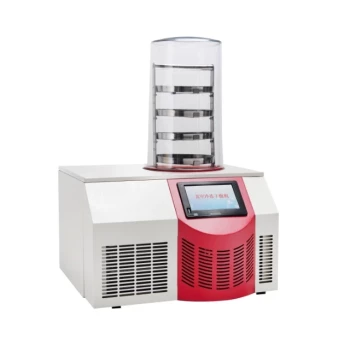
A vacuum drying oven is strictly required to ensure the complete removal of trace moisture and residual solvents from Polyethylene Oxide (PEO) and associated salts before processing. Because these materials are highly hygroscopic, vacuum drying at elevated temperatures (typically 60 °C) creates an anhydrous environment that prevents catastrophic side reactions and ensures the electrochemical stability necessary for high-performance batteries.
The critical function of the vacuum drying oven is to establish a strictly anhydrous state within the polymer matrix. Without this step, trapped moisture or solvents will react with lithium components, leading to electrode corrosion, increased impedance, and ultimately, battery failure.
The Critical Need for Dehydration
The preparation of Solid Polymer Electrolytes (SPE) is chemically sensitive. The primary reason for using a vacuum oven lies in the inherent properties of the raw materials and the volatile nature of battery chemistry.
Counteracting Hygroscopic Properties
PEO and commonly used lithium salts (like LiTFSI) are highly hygroscopic, meaning they aggressively absorb moisture from the surrounding atmosphere. Standard air drying is insufficient to remove water molecules that have bound to the polymer chains or salt crystals.
Preventing Electrochemical Instability
Water is a contaminant that severely compromises the electrochemical stability of a lithium battery. If moisture remains in the raw materials, it acts as a catalyst for degradation rather than an inert component.
Avoiding Side Reactions
The most dangerous consequence of residual moisture is the triggering of undesirable side reactions. In solid-state batteries, moisture can react violently with the metallic lithium anode, causing corrosion and safety hazards.
The Role of Vacuum Pressure
While heat drives evaporation, the vacuum component is what makes the process effective and safe for delicate polymers.
Facilitating Deep Moisture Removal
A vacuum environment lowers the boiling point of liquids, allowing for deep removal of trace moisture without requiring excessive temperatures that could degrade the polymer. The negative pressure physically pulls trapped volatiles out of the complex polymer matrix.
Removing Residual Solvents
In solution casting methods, solvents like DMAc, DMF, or acetonitrile are used to dissolve the polymer. The vacuum oven efficiently removes these organic solvents, which, if left behind, would increase interface impedance and degrade cycling performance.
Ensuring Reproducibility
Consistent experimental results rely on standardizing the water content of the material. Vacuum drying ensures that every batch begins in a verifiable anhydrous state, eliminating variables that could skew performance data.
Understanding the Trade-offs
While vacuum drying is essential, the parameters must be carefully managed to avoid damaging the SPE.
Temperature vs. Polymer Integrity
You cannot simply maximize heat to speed up the process. PEO has a relatively low melting point; therefore, the process typically requires moderate temperatures (around 60 °C to 80 °C) combined with low pressure to dry the material without melting or thermally degrading the polymer structure.
The Necessity of Time
Deep drying is not instantaneous. The process often requires extended periods (sometimes up to 48 hours) to ensure that moisture deep within the membrane or powder is fully extracted. Rushing this step is a common cause of poor ionic conductivity and instability.
Making the Right Choice for Your Goal
When establishing your processing protocol, tailor the vacuum drying parameters to your specific performance objectives.
- If your primary focus is Electrochemical Stability: Prioritize a high-vacuum environment to ensure the absolute removal of water, preventing corrosion at the lithium anode interface.
- If your primary focus is Ionic Conductivity: Ensure sufficient drying time to remove residual organic solvents (like DMF), as their presence can block ion transport and increase impedance.
- If your primary focus is Material Integrity: Strictly control the temperature (e.g., maintain at 60 °C) to prevent thermal degradation of the PEO matrix while relying on vacuum pressure to drive evaporation.
The vacuum drying oven is not merely a drying tool; it is the gatekeeper of chemical purity that makes a functional solid-state battery possible.
Summary Table:
| Parameter | Purpose in SPE Processing | Impact on Performance |
|---|---|---|
| Vacuum Pressure | Lowers boiling point & pulls trace volatiles | Prevents polymer degradation; ensures deep drying |
| Temperature (60-80°C) | Facilitates moisture evaporation | Maintains PEO structural integrity & prevents melting |
| Drying Time (~48h) | Complete removal of bound water/solvents | Minimizes interface impedance; boosts ionic conductivity |
| Anhydrous State | Eliminates H2O-Lithium side reactions | Prevents electrode corrosion & battery failure |
Elevate Your Battery Research with KINTEK Precision Solutions
Don't let trace moisture compromise your solid-state electrolyte performance. KINTEK specializes in high-performance laboratory equipment designed for the rigorous demands of material science. From advanced vacuum drying ovens that ensure a strictly anhydrous environment for PEO-based SPEs to our comprehensive range of high-temperature furnaces, hydraulic presses for pellet preparation, and specialized battery research tools, we provide the precision you need for reproducible results.
Ready to optimize your lab's workflow? Our experts are here to help you select the ideal drying, crushing, or thermal processing systems tailored to your specific research goals. Contact us today to find your perfect laboratory solution!
Related Products
- 56L Vertical Laboratory Vacuum Drying Oven
- 23L Laboratory Vacuum Drying Oven
- Laboratory Scientific Electric Heating Blast Drying Oven
- Benchtop Laboratory Vacuum Freeze Dryer
- Vacuum Heat Treat Sintering Brazing Furnace
People Also Ask
- Why is a laboratory vacuum drying oven recommended for rice straw residues? Protect Your Biomass Integrity
- What role does a laboratory vacuum drying oven play in the preparation of modified multi-walled carbon nanotubes?
- What is the importance of using a laboratory vacuum drying oven? Preserving Slow-Release Microcapsule Integrity
- Why is a Laboratory Vacuum Drying Oven recommended for PBAT microspheres? Protect Sensitive Polymer Integrity
- What role does a laboratory vacuum drying oven play in processing nanoparticle powder samples? Protect Sample Integrity