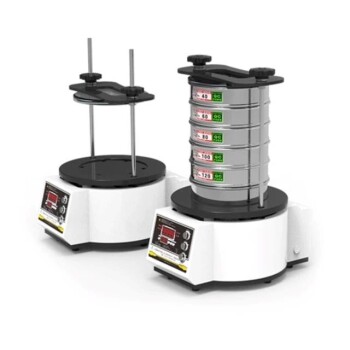
High-precision sieving is essential because it eliminates the thermal and physical variables that occur when particles of different sizes are processed together. By isolating specific size fractions—such as the 40–63 μm range—researchers and engineers can ensure uniform heating rates and eliminate internal temperature gradients. This consistency is the only way to achieve repeatable kinetic data and predictable combustion behavior in coal and biomass fuels.
Core Takeaway: High-precision sieving transforms raw, heterogeneous fuel into a standardized material by narrowing the particle size distribution. This uniformity is fundamental for stabilizing heat and mass transfer rates, which ensures the accuracy of kinetic modeling and the efficiency of industrial fuel processing.
Eliminating Thermal and Kinetic Variables
Standardizing Heat Transfer Rates
In thermal analysis, particle size directly determines how fast a material reaches its reaction temperature. High-precision sieving ensures that every particle in a sample responds to heat at the same rate, preventing "thermal lag" in larger pieces. This uniformity is critical for obtaining accurate devolatilization data in thermogravimetric analyzers or flat flame reactors.
Eliminating Internal Temperature Gradients
Larger particles often suffer from internal temperature gradients where the surface is significantly hotter than the core. By using precision equipment to limit samples to narrow ranges, such as 36–72 µm, these gradients are minimized. This ensures that the entire volume of the particle reacts simultaneously, which is vital for establishing reliable mathematical models.
Ensuring Repeatable Devolatilization
Kinetic modeling relies on the assumption that the fuel sample is homogenous in its physical behavior. Precision sieving allows for the extraction of specific fuel fractions that yield highly repeatable results. Without this level of control, variations in particle size would introduce "noise" into the data, making it impossible to verify combustion characteristics.
Optimizing Industrial and Chemical Processes
Enhancing Surface Area for Chemical Activation
When producing activated carbon from biomass, the specific surface area is a primary factor in quality. Refining particle size through precision sieving (e.g., using 300μm meshes) allows chemical activators like zinc chloride to penetrate the material uniformly. This leads to a more consistent pore structure during the carbonization process.
Improving Biomass Pellet Quality
In the production of biomass pellets, particle size distribution influences the "self-locking" effect within the pellet mill die holes. Selecting specific fractions, typically between 250 µm and 2 mm, ensures optimal filling and mechanical bonding. This results in pellets with higher physical density and improved structural integrity.
Stabilizing Residence Time in Furnaces
In drop tube furnaces used for co-firing experiments, the size of a particle determines its residence time and buoyancy. By strictly controlling the particle size range (e.g., 75–125 µm), engineers ensure consistent combustion conditions. This eliminates the impact of size variations on emission results and overall combustion efficiency.
Understanding the Trade-offs and Pitfalls
Precision vs. Processing Volume
High-precision sieving is often a slower process than bulk classification. Attempting to force high volumes of material through fine meshes can lead to "blinding," where particles clog the mesh openings and skew the distribution results.
Material Degradation During Sieving
Pulverized coal and biomass can be brittle. Prolonged mechanical sieving to achieve high precision may inadvertently cause further particle breakdown, resulting in a finer sample than intended.
The Cost of Mesh Maintenance
Fine-mesh screens required for high-precision work are delicate and expensive. They require specialized cleaning, such as ultrasonic baths, to maintain their accuracy and prevent cross-contamination between different fuel batches.
How to Apply Precision Sieving to Your Project
Matching Equipment to Your Goal
The required level of sieving precision depends entirely on whether your objective is fundamental research or industrial-scale production.
- If your primary focus is kinetic modeling and research: Utilize narrow fractions (e.g., 40–63 μm) to eliminate all thermal variables and ensure repeatable data.
- If your primary focus is biomass pelletization: Target a broader but controlled distribution (e.g., 250 µm – 2 mm) to maximize density and self-locking effects.
- If your primary focus is pyrolysis byproduct yields: Ensure all particles are below 0.25 mm to maximize specific surface area and heat transfer efficiency.
- If your primary focus is combustion emission testing: Use a narrow range (e.g., 80–120 μm) to maintain consistent residence times within the furnace.
Precision sieving is the bridge between raw material inconsistency and predictable, high-performance fuel behavior.
Summary Table:
| Application | Target Size Range | Primary Benefit |
|---|---|---|
| Kinetic Modeling | 40–63 μm | Eliminates thermal lag and internal temperature gradients |
| Pellet Production | 250 μm – 2 mm | Optimizes physical density and structural integrity |
| Pyrolysis Research | < 0.25 mm | Maximizes surface area for uniform chemical activation |
| Combustion Testing | 80–120 μm | Stabilizes furnace residence time and emission consistency |
Elevate Your Material Research with KINTEK Precision
Consistency is the foundation of reliable kinetic data. KINTEK specializes in high-performance laboratory solutions, offering advanced sieving equipment, crushing and milling systems, and high-temperature furnaces (muffle, tube, and vacuum) designed to handle the rigorous demands of coal and biomass analysis. Whether you are optimizing biomass pellet quality or conducting complex devolatilization studies, our precision tools ensure your samples are perfectly standardized.
Ready to eliminate variables and achieve repeatable results? Contact our experts today to discover the ideal equipment for your laboratory needs.
References
- R. Lemaire, Sébastien Menanteau. Kinetic Modeling of the Devolatilization of Pulverized Coal, Poplar Wood, and Their Blends in a Thermogravimetric Analyzer and a Flat Flame Reactor. DOI: 10.1021/acsomega.3c03110
This article is also based on technical information from Kintek Solution Knowledge Base .
Related Products
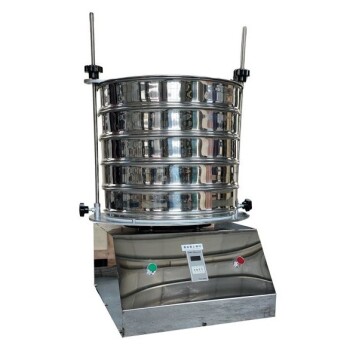
- Laboratory Test Sieves and Sieving Machines
- Three-dimensional electromagnetic sieving instrument
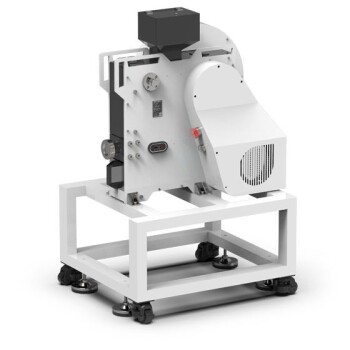
- Laboratory Jaw Crusher
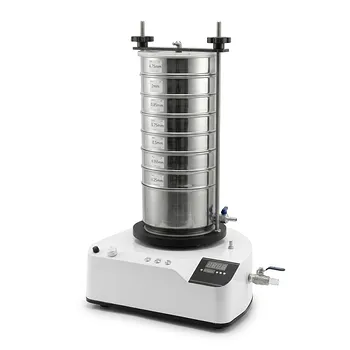
- Laboratory Vibratory Sieve Shaker Machine for Dry and Wet Three-Dimensional Sieving
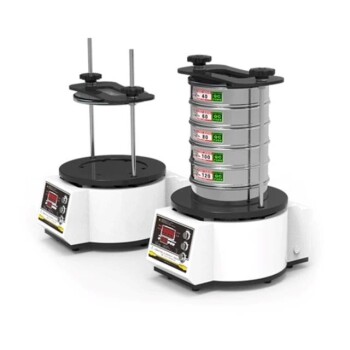
- Laboratory Test Sieves and Vibratory Sieve Shaker Machine
People Also Ask
- What are laboratory test sieves used for? A Guide to Particle Size Analysis
- How do you calculate the sieve test? Master Particle Size Distribution for Quality Control
- How does a lab test sieve contribute to biomass charcoal powder preparation? Achieve Uniform Particle Size
- What are the specifications for test sieves? A Guide to ASTM & ISO Standards for Accurate Particle Analysis
- What materials are required for sieving? Achieve Accurate Particle Size Analysis