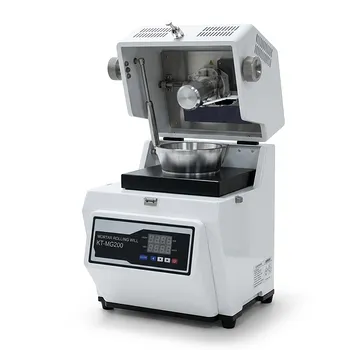
Achieving uniformity is the critical first step in diamond tool manufacturing. Thoroughly mixing diamond particles with metal powders is necessary to create a homogenous blend where the "hard phase" (diamond) and the binder matrix are indistinguishable in their distribution. Without this mechanical intervention, the components will naturally separate, compromising the structural integrity of the final product.
Uniform mixing prevents material segregation, ensuring that every diamond particle is adequately supported by the metal binder. This homogeneity is the deciding factor in creating a sintered body that delivers stable, consistent grinding performance.
The Mechanics of the Mix
Balancing the Hard Phase and Binder
In diamond tool production, you are combining two drastically different materials. You have the hard phase, consisting of diamond monocrystals, and the binder, composed of metal powders such as copper, tin, zinc, and nickel.
These materials often vary in density and particle size. Without active mixing, they will not naturally form a stable suspension.
The Role of Specialized Equipment
To achieve true homogeneity, simple agitation is rarely sufficient. Manufacturers rely on specialized equipment, such as three-dimensional mixers or shakers.
This equipment forces the particles to interact in multiple planes of motion. This ensures that the diamond crystals are evenly dispersed throughout the metal powder volume, rather than settling at the bottom or clumping together.
The Impact on Final Performance
Preventing Segregation
The primary enemy of a high-quality sintered tool is segregation. This occurs when the diamond and metal powders separate into distinct pockets before or during the sintering process.
Thorough mixing eliminates segregation. It locks the particles into a uniform distribution that remains stable as the material is pressed and heated.
Ensuring Consistent Grinding results
The performance of the final tool is directly tied to how well the mix was prepared. A tool with uneven diamond distribution will exhibit erratic behavior.
If the mix is uniform, the tool wears evenly. This guarantees that fresh diamond edges are exposed at a predictable rate, providing stable grinding performance throughout the tool's life.
Common Pitfalls to Avoid
Overlooking Micro-Level Distribution
It is not enough for the mix to look grey and uniform to the naked eye. If the diamonds are clustered microscopically, the tool will suffer from "soft spots" where the binder wears away too quickly.
Relying on Passive Blending
Avoiding the use of active mixing equipment like shakers is a critical error. Passive blending techniques cannot overcome the physical differences between heavy metal powders and lighter diamond particles.
Making the Right Choice for Your Production
To ensure your diamond tools meet professional standards, consider these manufacturing priorities:
- If your primary focus is Tool Longevity: Prioritize aggressive mixing to ensure every diamond is fully encapsulated by the binder, preventing premature pull-out.
- If your primary focus is Surface Finish: Ensure absolute homogeneity to prevent diamond clustering, which can cause scratches or uneven grinding patterns.
Precise mixing is the technical bridge that transforms raw, loose powders into a reliable, high-performance industrial tool.
Summary Table:
| Mixing Factor | Impact on Diamond Tool Quality |
|---|---|
| Homogeneity | Prevents diamond clustering and ensures even structural support. |
| Segregation Control | Stops heavy metal powders and light diamonds from separating. |
| Equipment Type | 3D mixers/shakers are required for multi-plane particle dispersion. |
| Final Performance | Guarantees consistent wear rates and predictable grinding results. |
Elevate Your Material Preparation with KINTEK
Precise blending is the foundation of high-performance diamond tools. At KINTEK, we specialize in the advanced laboratory equipment necessary to achieve perfect homogeneity in your production cycle.
Our extensive portfolio includes professional-grade crushing and milling systems, three-dimensional mixing solutions, and high-precision hydraulic presses (pellet, hot, and isostatic) designed specifically for material research and industrial manufacturing. Whether you are optimizing binder matrices or refining diamond distribution, our technical experts are ready to provide the tools that ensure consistent results and tool longevity.
Ready to optimize your sintering process? Contact KINTEK today to discover how our high-performance equipment can transform your laboratory and production outcomes.
Related Products
- Laboratory Disc Rotary Mixer for Efficient Sample Mixing and Homogenization
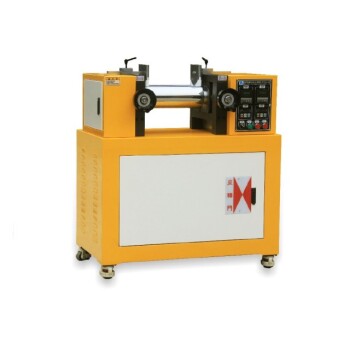
- Open Type Two Roll Mixing Mill Machine for Rubber Crusher
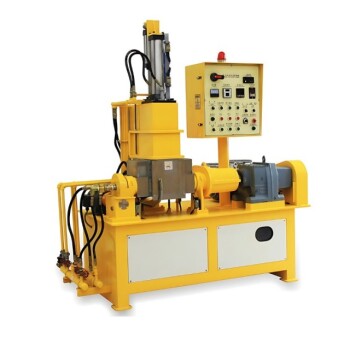
- Lab Internal Rubber Mixer Rubber Kneader Machine for Mixing and Kneading
- Laboratory Vortex Mixer Orbital Shaker Multifunctional Rotation Oscillation Mixer
- Laboratory Oscillating Orbital Shaker
People Also Ask
- What is a laboratory mixer used for? Choose the Right Tool for Liquids or Solids
- What is a laboratory mixer? A Guide to Achieving Perfect Sample Homogeneity
- What are laboratory mixers used for? Achieve Perfect Sample Homogeneity and Reliable Results
- How does a high-efficiency homogenizing mixer contribute to the preparation of Tobermorite and Xonotlite precursors?
- Why is precision mixing required for concrete corrosion studies? Ensure Data Integrity through Homogenization