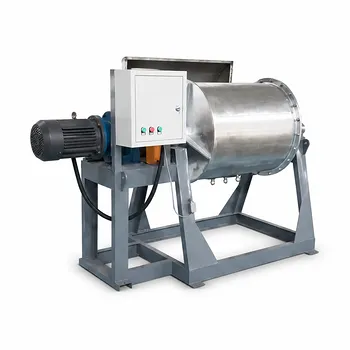
The extreme thermal sensitivity of low-dimensional materials dictates this preference. High-energy ball milling is preferred over traditional furnaces because low-dimensional (1DN and 0DN) lithium-rich anti-perovskite materials are structurally unstable and prone to melting or collapsing at temperatures near 300 K. By utilizing mechanical force rather than thermal energy, ball milling drives the necessary chemical reactions without subjecting the material to the destructive heat inherent in solid-state sintering.
Core Takeaway The transition from 3D to low-dimensional (1DN/0DN) structures drastically reduces thermal stability, causing these materials to exhibit liquid-like behavior near room temperature. Mechanochemical synthesis is the superior choice because it generates reaction energy through physical impact, preserving the delicate superionic conductor structure that would otherwise be destroyed by the thermal load of a furnace.
The Critical Vulnerability: Thermal Instability
Structural Collapse at Low Temperatures
Unlike their 3D counterparts, low-dimensional lithium-rich anti-perovskites possess a fragile lattice structure. These 1DN and 0DN materials exhibit significant thermal instability.
The 300 K Threshold
The risk of failure for these materials begins at surprisingly low temperatures, often near 300 K (approx. 27°C). At this threshold, the material may undergo phase transitions, structural collapse, or even melting.
The Danger of Traditional Sintering
Traditional high-temperature furnaces are designed to apply heat to drive solid-state diffusion. For materials that destabilize near room temperature, the thermal energy provided by a standard furnace is excessive and destructive, leading to the loss of the desired superionic conductor phase.
How Mechanochemical Synthesis Solves the Problem
Substituting Heat with Kinetic Energy
High-energy ball mills replace thermal energy with mechanical activation energy. Intense collisions and shear forces between grinding balls generate the energy required to induce chemical reactions.
Enabling Cold Reactions
This process allows for the synthesis of complex structures at temperatures significantly lower than those required for sintering. By keeping the processing temperature below the material's stability threshold, the synthesis prevents thermal degradation.
Preserving Electrochemical Performance
The primary goal is to create a superionic conductor. By avoiding the melting or phase separation caused by thermal effects, mechanochemical synthesis ensures the final product retains the specific crystalline structure necessary for optimal ionic conductivity.
Understanding the Trade-offs
The Risk of Thermal Overshoot
While high-precision furnaces exist, the margin for error with low-dimensional anti-perovskites is incredibly slim. Even minor temperature overshooting can lead to liquid-like behavior and phase separation, ruining the electrolyte's performance.
Efficiency vs. Precision
Furnaces require strict, customized sintering curves to attempt this synthesis, which adds complexity and risk. In contrast, ball milling provides a more robust method for facilitating coordination reactions—often with minimal solvent—making it a "greener" and potentially more scalable option for these specific heat-sensitive materials.
Making the Right Choice for Your Goal
To determine the best synthesis method for your specific material constraints, consider the following:
- If your primary focus is preserving structural integrity in 1DN/0DN materials: Choose high-energy ball milling to completely bypass the risks of thermal collapse and melting associated with heating near 300 K.
- If your primary focus is industrial scalability and green chemistry: Leverage mechanochemical synthesis to utilize solvent-free coordination reactions that are suitable for scale-up without the energy costs of high-temperature heating.
By matching the energy source to the material's stability profile, you ensure the successful synthesis of high-performance solid-state electrolytes.
Summary Table:
| Feature | Traditional High-Temperature Furnace | Mechanochemical Synthesis (Ball Mill) |
|---|---|---|
| Energy Source | Thermal Energy (Heat) | Kinetic/Mechanical Activation |
| Material Stability | Risk of collapse/melting at >300 K | Preserves delicate lattice structures |
| Primary Risk | Thermal overshoot and phase separation | Minimal risk of thermal degradation |
| Reaction Type | Solid-state diffusion via sintering | Solvent-free coordination reactions |
| Application | 3D stable structures | 1DN and 0DN low-dimensional materials |
Elevate Your Material Research with KINTEK Precision
Don't let thermal instability compromise your breakthrough in solid-state electrolytes. KINTEK provides the specialized equipment needed to master low-dimensional material synthesis. Whether you require high-energy crushing and milling systems to bypass thermal degradation or high-precision muffle and vacuum furnaces for more stable 3D structures, our comprehensive portfolio is designed for the modern laboratory.
From high-temperature high-pressure reactors and battery research tools to PTFE consumables and cooling solutions, we empower researchers to achieve superior results with precision and efficiency.
Ready to optimize your synthesis process? Contact KINTEK experts today to find the perfect equipment for your lab!
Related Products
- High Energy Planetary Ball Mill Milling Machine for Laboratory
- High Energy Planetary Ball Mill for Laboratory Horizontal Tank Type Milling Machine
- High-Energy Omnidirectional Planetary Ball Mill Milling Machine for Laboratory
- High Energy Planetary Ball Mill Milling Machine for Laboratory
- High Energy Planetary Ball Mill Machine for Laboratory Horizontal Tank Type
People Also Ask
- What role do planetary ball mills and zirconia media play in LLZT preparation? Optimize Your Solid Electrolyte Research
- What is the primary function of a planetary ball mill? Mastering SiC/Al Composite Mixing for Homogeneity
- What is the primary purpose of using a planetary ball mill for LAGP? Achieve High-Purity Solid-State Electrolytes
- What role does a planetary ball mill play in the preparation of LGVO powders? Precision Refinement for Aerosol Deposition
- What is the function of a planetary ball mill in the preparation of high-entropy rare earth silicate multi-phase ceramics?