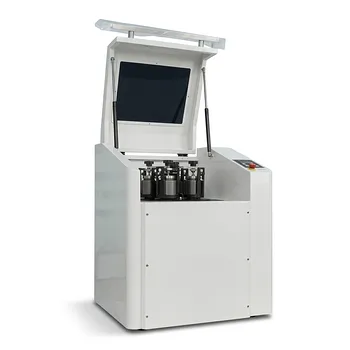
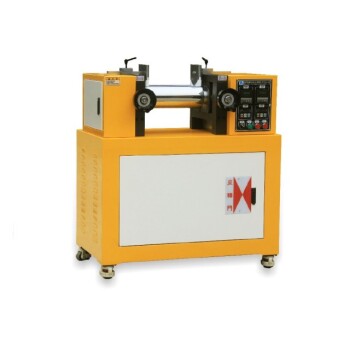
Milling equipment serves as the essential catalyst for structural transformation before heat is ever applied. By applying intense mechanical forces, milling reduces the particle size of dicyandiamide (DCDA) precursors and generates fresh, highly reactive surfaces. This mechanochemical pretreatment increases the density of reaction sites and induces the formation of new chemical bonds, ensuring a more thorough condensation during the subsequent thermal polymerization phase.
Mechanochemical pretreatment transitions DCDA from a passive precursor to a highly reactive state by maximizing surface area and reaction site density. This fundamental shift leads to a higher degree of condensation, which is critical for optimizing the electrochemical resistance and catalytic performance of the resulting graphitic carbon nitride.
The Physics of Mechanochemical Activation
Surface Area Expansion and Particle Reduction
The primary role of milling is to break down the crystalline structure of DCDA into smaller fragments. This reduction in particle size exponentially increases the total surface area available for chemical interaction.
By exposing the interior of the precursor, milling creates new active surfaces that were previously shielded. These surfaces act as the primary interface for the chemical reactions that drive polymerization.
Energy Storage and Bond Formation
Mechanical milling does not just change the shape of the material; it provides the energy necessary to induce new chemical bonds. This stored mechanical energy lowers the activation barrier for the subsequent thermal process.
The process creates a state of high "chemical potential" within the powder. This ensures that when heat is finally applied, the DCDA is already primed to transition into a polymerized state.
Impact on the Polymerization Pathway
Increasing Reaction Site Density
A higher density of reaction sites is the direct result of successful mechanochemical pretreatment. With more sites available, the frequency of molecular collisions and bonding events increases significantly.
This density is crucial for achieving a higher degree of condensation. Without this pretreatment, the polymerization may be incomplete, leading to structural defects in the final carbon nitride product.
Optimizing Final Material Properties
The ultimate goal of using milling equipment is to refine the performance of the end product, typically graphitic carbon nitride. Proper pretreatment directly correlates to improved electrochemical resistance.
Furthermore, the enhanced condensation yields a material with superior catalytic activity. This makes the resulting carbon nitride more effective in applications like water splitting or environmental remediation.
Understanding the Trade-offs
Potential for Contamination
While milling is highly effective, the high-energy impact can lead to abrasion of the milling media. This may introduce trace impurities from the grinding balls or the vial into the DCDA precursor.
These impurities can act as unintended dopants, which might either enhance or degrade the catalytic properties of the final material. Selecting the right media, such as zirconia or stainless steel, is vital to control this variable.
Risks of Over-Processing
Excessive milling time can lead to agglomeration, where the fine particles begin to stick together due to van der Waals forces. This effectively reverses the benefits of particle size reduction.
Over-processing can also lead to excessive heat buildup within the mill. This may cause premature decomposition of the DCDA before it ever reaches the controlled environment of the thermal furnace.
How to Apply This to Your Project
Recommendations for Implementation
- If your primary focus is Maximum Catalytic Activity: Prioritize high-energy ball milling to maximize reaction site density and ensure the highest possible degree of condensation.
- If your primary focus is Material Purity: Utilize chemically inert milling media and shorter processing intervals to prevent contamination from the equipment.
- If your primary focus is Scalability: Focus on optimizing the milling duration to find the "sweet spot" where particle size is minimized without causing particle agglomeration.
Mastering the mechanical pretreatment of precursors allows for precise control over the molecular architecture and functional performance of advanced carbon materials.
Summary Table:
| Feature | Impact on Pretreatment | Benefit to Final Material |
|---|---|---|
| Particle Size Reduction | Increases total surface area | Higher degree of condensation |
| Energy Storage | Lowers thermal activation barrier | Efficient thermal polymerization |
| Surface Activation | Generates new active reaction sites | Enhanced catalytic activity |
| Structural Density | Increases molecular collision frequency | Improved electrochemical resistance |
Elevate Your Material Synthesis with KINTEK Precision
Maximize your research outcomes with KINTEK’s specialized laboratory solutions. We provide the high-performance crushing and milling systems essential for DCDA mechanochemical activation, alongside a comprehensive range of muffle, vacuum, and atmosphere furnaces for precise thermal polymerization.
Whether you are developing graphitic carbon nitride for energy storage or environmental remediation, KINTEK offers the high-temperature high-pressure reactors, PTFE products, and zirconia milling media you need to ensure purity and performance.
Ready to optimize your workflow? Contact our technical experts today to find the perfect equipment for your lab!
References
- Ganesh Kesavan, Alexander Star. Optimizing dicyandiamide pretreatment conditions for enhanced structure and electronic properties of polymeric graphitic carbon nitride. DOI: 10.1039/d3tc02412a
This article is also based on technical information from Kintek Solution Knowledge Base .
Related Products
- Mini Planetary Ball Mill Machine for Laboratory Milling
- High-Energy Omnidirectional Planetary Ball Mill Milling Machine for Laboratory
- High Energy Planetary Ball Mill Milling Machine for Laboratory
- Laboratory Horizontal Planetary Ball Mill Milling Machine
- Laboratory Planetary Ball Mill Rotating Ball Milling Machine
People Also Ask
- How does a laboratory ball mill ensure the mixing quality of Mn3Zn0.8Sn0.2N and Ti? Achieve Perfect Homogeneity
- Why is a laboratory ball mill required for ultra-fine fly ash? Unlock Nano-Scale Adsorption Power
- Why is a laboratory ball mill used in Co-Ni catalyst research? Optimize CO2 Conversion with Precise Milling
- What is the function of a laboratory ball mill in the pretreatment of waste tire char (WTC)? Optimize Material Reactivity
- What is the primary function of a laboratory ball mill in the modification of sulfide-based solid electrolytes with LiPO2F2?