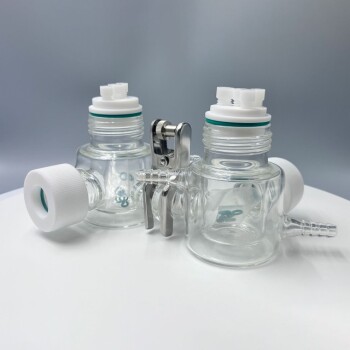
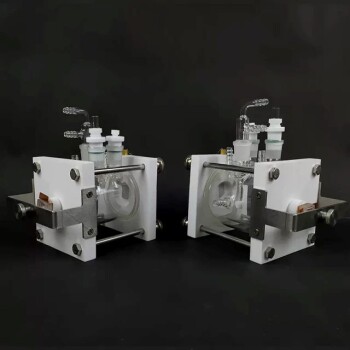
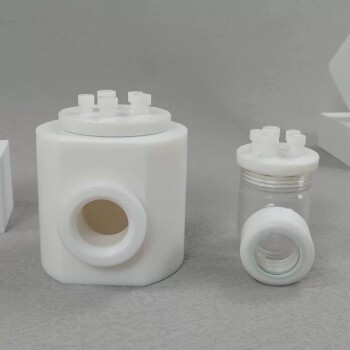
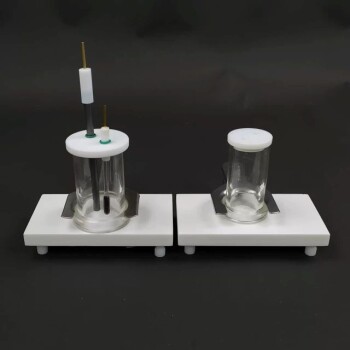
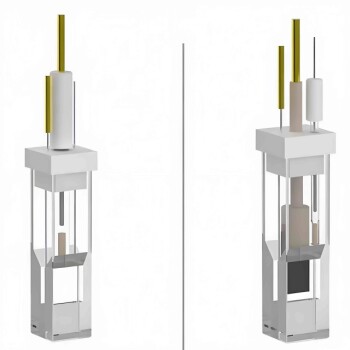
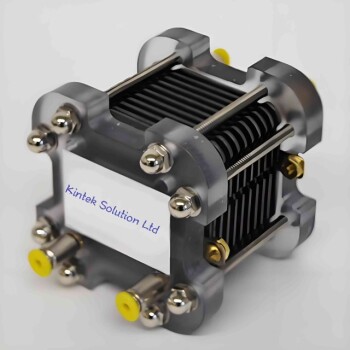
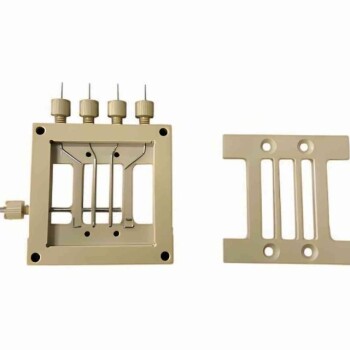
The critical design of a high-airtightness H-type electrolytic cell focuses on preserving reaction integrity through physical isolation. By utilizing a proton exchange membrane to separate the cathode and anode chambers, this design prevents reduction products—specifically alcohols and hydrocarbons—from diffusing to the anode and undergoing re-oxidation. This architecture is essential for maintaining precise carbon dioxide saturation and ensuring the accurate quantitative analysis of multi-carbon (C2+) product selectivity.
The core value of this design is data fidelity: by preventing product cross-contamination and ensuring a stable gas environment, the H-type cell allows researchers to measure exactly what the catalyst produces without interference from the counter-electrode.
The Mechanics of Reaction Isolation
Preventing Product Re-oxidation
In Carbon Dioxide Reduction (CO2RR) experiments, the cathode generates valuable reduction products such as alcohols and hydrocarbons.
If these products migrate to the anode, they are susceptible to re-oxidation, which effectively destroys them before they can be measured.
The H-type cell uses a proton exchange membrane to physically separate the chambers, blocking this diffusion and ensuring the products generated are the products analyzed.
Ensuring Carbon Dioxide Saturation
Airtightness is not merely about preventing leaks; it is about maintaining a controlled chemical environment.
The design incorporates precise gas inlets and outlets to ensure the electrolyte remains saturated with carbon dioxide.
This saturation provides a consistent reactant supply, which is necessary for calculating Faradaic efficiency accurately.
Facilitating Quantitative Analysis
To determine the selectivity of multi-carbon (C2+) products, the chemical environment must remain stable over time.
The isolation provided by the H-type design creates a "quiet" environment where cross-interference is minimized.
This allows for the precise calculation of reaction efficiency and product distribution, which is the primary metric of success in CO2RR research.
Structural Requirements for Observation
Transparency and Material Stability
While the internal separation is critical, the external construction plays a vital supporting role.
High-quality cells often utilize high-transparency glass or corrosion-resistant plastics.
This allows researchers to visually monitor the reaction for anomalies while ensuring that the cell materials do not degrade and contaminate the sensitive electrolyte.
Understanding the Trade-offs
Limitations on Mass Transfer
While the H-type cell is excellent for accuracy and product separation, it has inherent limitations regarding mass transfer.
Traditional H-type cells often suffer from low carbon dioxide solubility and restricted movement of reactants to the catalyst surface.
Current Density Constraints
Due to these mass transfer limits, H-type cells are generally not suitable for testing at industrial-grade current densities (e.g., up to 400 mA cm-2).
For experiments requiring high-throughput conversion, researchers often transition to flow cells, which construct a compact tri-phase interface to overcome these specific bottlenecks.
Making the Right Choice for Your Goal
Selecting the correct cell architecture depends entirely on the specific stage and goals of your research.
- If your primary focus is fundamental analysis: Use the high-airtightness H-type cell to ensure maximum product selectivity accuracy and to prevent the re-oxidation of C2+ products.
- If your primary focus is industrial scalability: Consider a customized flow cell to achieve higher current densities and overcome mass transfer limitations.
Ultimately, the H-type cell is the standard for precision and validation, acting as the foundation for accurate electrochemical characterization.
Summary Table:
| Feature | H-Type Cell Benefit | Impact on CO2RR Research |
|---|---|---|
| Membrane Separation | Prevents cathode product migration to anode | Stops re-oxidation of alcohols & hydrocarbons |
| Airtight Design | Maintains CO2 gas saturation | Ensures consistent reactant supply for Faradaic efficiency |
| Physical Isolation | Minimizes cross-electrode interference | Enables precise quantitative analysis of C2+ products |
| Transparency | High-quality glass/material construction | Allows real-time visual monitoring of reaction stability |
Advance Your Electrochemical Research with KINTEK Precision
Maximize the accuracy of your CO2RR and battery research with KINTEK’s premium electrolytic cells and electrodes. Beyond our high-airtightness H-type cells, we provide a comprehensive range of laboratory solutions—from high-temperature furnaces and reactors to crushing systems, hydraulic presses, and cooling solutions (ULT freezers & freeze dryers).
Whether you are focusing on fundamental catalyst analysis or industrial scalability, KINTEK delivers the high-performance consumables (PTFE, ceramics, crucibles) and equipment you need to ensure data fidelity.
Ready to elevate your lab's performance? Contact our experts today to find the perfect equipment tailored to your research goals.
References
- Damian Giziński, Tomasz Czujko. Nanostructured Anodic Copper Oxides as Catalysts in Electrochemical and Photoelectrochemical Reactions. DOI: 10.3390/catal10111338
This article is also based on technical information from Kintek Solution Knowledge Base .
Related Products
- H-Type Double-Layer Optical Electrolytic Electrochemical Cell with Water Bath
- H Type Electrolytic Cell Triple Electrochemical Cell
- Customizable PEM Electrolysis Cells for Diverse Research Applications
- Electrolytic Electrochemical Cell with Five-Port
- Super Sealed Electrolytic Electrochemical Cell
People Also Ask
- What is the overall structure of the H-type double-layer optical water bath electrolytic cell? Precision Design for Controlled Experiments
- How is the electrolyte managed in H-type electrolytic cells for specific reactions? Achieve Precise Control and High Purity
- What checks should be performed on the H-type electrolytic cell before use? Ensure Accurate Electrochemical Data
- What is important regarding temperature control for the H-type electrolytic cell? Ensure Precision and Data Integrity
- What is the overall structure of the H-type electrolytic cell? Understanding Dual-Chamber Electrochemical Designs