Knowledge Why must a vacuum reactor be used when mixing conductive polymer dispersions? Prevent Voids & Ensure Dielectric Integrity
Author avatar

Tech Team · Kintek Solution

Updated 1 day ago

Why must a vacuum reactor be used when mixing conductive polymer dispersions? Prevent Voids & Ensure Dielectric Integrity


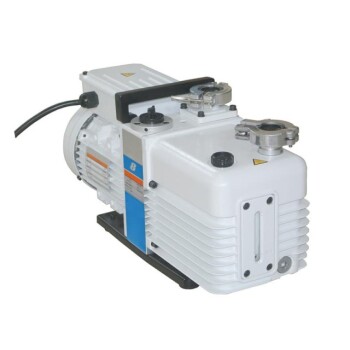
A vacuum reactor is a non-negotiable requirement when mixing conductive polymer dispersions with curing agents because high-speed agitation inevitably traps air within the mixture. By maintaining a negative pressure environment during stirring (often reaching speeds like 2400 rpm), the reactor forcibly extracts these air pockets and residual volatile substances before the material cures.

The vacuum process is the only reliable way to convert an aerated mixture into a structurally dense composite. Without it, trapped bubbles create internal defects that destroy the material's electrical insulation properties and invalidate testing data.

The Physical Challenge of Mixing

The Consequence of High-Speed Agitation

To properly blend a conductive polymer dispersion with a curing agent, high-speed stirring is often required. Speeds can reach 2400 rpm to ensure homogeneity.

However, this mechanical violence naturally folds air into the viscous liquid. Without intervention, this trapped air remains suspended in the mixture as it hardens.

Eliminating Residual Volatiles

In addition to air, the mixture may contain residual volatile substances. A vacuum environment lowers the pressure, which effectively pulls these volatiles out of the solution.

This ensures that the final solid matrix is composed only of the intended polymer and curing agent, rather than trapped gases or unreacted solvents.

Impact on Electrical Performance

Preventing Dielectric Breakdown

The most critical reason for using a vacuum reactor is to preserve dielectric breakdown strength. In organic dielectric coatings, air bubbles act as weak points.

If the cured composite contains micropores or bubbles, high voltage can easily arc through these voids. This causes the insulation to fail at much lower voltages than the pure material would withstand.

Ensuring Measurement Accuracy

For professionals characterizing materials, internal bubbles interfere with data collection. They disrupt the uniformity required for accurate dielectric constant measurements.

A vacuum-degassed sample ensures the sensor measures the properties of the conductive polymer composite itself, not the properties of the air pockets hidden inside it.

Common Pitfalls to Avoid

The Illusion of Viscosity

A thick, viscous mixture often hides bubbles that will not rise to the surface naturally. Relying on gravity alone to degas a conductive polymer mixture is a frequent cause of failure.

Overlooking Volatile Expansion

If volatile substances are not removed during the mixing phase via vacuum, they may expand during the curing process or subsequent thermal cycling. This can lead to internal cracking or delamination, permanently damaging the component's structure.

Making the Right Choice for Your Goal

To ensure your conductive polymer project succeeds, apply the vacuum process based on your specific end-use requirements:

  • If your primary focus is Electrical Insulation: Use the vacuum reactor to maximize density, as even microscopic voids will significantly lower the voltage at which the coating fails.
  • If your primary focus is Material Characterization: Prioritize vacuum degassing to ensure your dielectric constant readings reflect the true chemistry of the polymer, rather than artifacts caused by trapped air.

A vacuum reactor transforms a chemically correct mixture into a physically reliable material.

Summary Table:

Feature Impact of Vacuum Mixing Risk of Mixing Without Vacuum
Structural Density High; creates a solid, void-free matrix Low; results in porous, weakened material
Electrical Insulation Maximizes dielectric breakdown strength Causes premature insulation failure (arcing)
Material Purity Removes residual volatile substances Trapped volatiles cause cracking/delamination
Data Accuracy Precise dielectric constant measurements Inaccurate readings due to air pocket interference

Elevate Your Polymer Research with KINTEK Precision

Don't let microscopic bubbles compromise your material's electrical performance or research integrity. KINTEK specializes in advanced laboratory solutions, including high-performance vacuum reactors, high-temperature autoclaves, and crushing systems designed for the most demanding conductive polymer applications. From battery research tools to precision hydraulic presses, our equipment ensures your composites meet the highest standards of dielectric strength and structural density.

Ready to optimize your mixing process? Contact KINTEK today to discover how our high-vacuum solutions can transform your laboratory's output.

Related Products

People Also Ask

Related Products

Stainless High Pressure Autoclave Reactor Laboratory Pressure Reactor

Stainless High Pressure Autoclave Reactor Laboratory Pressure Reactor

Discover the versatility of Stainless High Pressure Reactor - a safe and reliable solution for direct and indirect heating. Built with stainless steel, it can withstand high temperatures and pressures. Learn more now.

Customizable Laboratory High Temperature High Pressure Reactors for Diverse Scientific Applications

Customizable Laboratory High Temperature High Pressure Reactors for Diverse Scientific Applications

High-pressure lab reactor for precise hydrothermal synthesis. Durable SU304L/316L, PTFE liner, PID control. Customizable volume & materials. Contact us!

Customizable High Pressure Reactors for Advanced Scientific and Industrial Applications

Customizable High Pressure Reactors for Advanced Scientific and Industrial Applications

This laboratory-scale high-pressure reactor is a high-performance autoclave engineered for precision and safety in demanding research and development environments.

High Pressure Laboratory Autoclave Reactor for Hydrothermal Synthesis

High Pressure Laboratory Autoclave Reactor for Hydrothermal Synthesis

Discover the applications of Hydrothermal Synthesis Reactor - a small, corrosion-resistant reactor for chemical labs. Achieve rapid digestion of insoluble substances in a safe and reliable way. Learn more now.

Laboratory High Pressure Horizontal Autoclave Steam Sterilizer for Lab Use

Laboratory High Pressure Horizontal Autoclave Steam Sterilizer for Lab Use

The horizontal autoclave steam sterilizer adopts the gravity displacement method to remove the cold air in the inner chamber, so that the inner steam and cold air content is less, and the sterilization is more reliable.

Portable High Pressure Laboratory Autoclave Steam Sterilizer for Lab Use

Portable High Pressure Laboratory Autoclave Steam Sterilizer for Lab Use

Portable autoclave sterilization pressure is a device that uses pressure saturated steam to quickly and effectively sterilize items.

Desktop Fast High Pressure Laboratory Autoclave Sterilizer 16L 24L for Lab Use

Desktop Fast High Pressure Laboratory Autoclave Sterilizer 16L 24L for Lab Use

The desktop fast steam sterilizer is a compact and reliable device used for rapid sterilization of medical, pharmaceutical, and research items.

Portable Digital Display Automatic Laboratory Sterilizer Lab Autoclave for Sterilization Pressure

Portable Digital Display Automatic Laboratory Sterilizer Lab Autoclave for Sterilization Pressure

Portable autoclave sterilization pressure is a device that uses pressure saturated steam to quickly and effectively sterilize items.

Laboratory High Pressure Steam Sterilizer Vertical Autoclave for Lab Department

Laboratory High Pressure Steam Sterilizer Vertical Autoclave for Lab Department

Vertical pressure steam sterilizer is a kind of sterilization equipment with automatic control, which is composed of heating system, microcomputer control system and overheating and overpressure protection system.

Laboratory Sterilizer Lab Autoclave Vertical Pressure Steam Sterilizer for Liquid Crystal Display Automatic Type

Laboratory Sterilizer Lab Autoclave Vertical Pressure Steam Sterilizer for Liquid Crystal Display Automatic Type

Liquid crystal display automatic vertical sterilizer is a safe, reliable and automatic control sterilization equipment, which is composed of heating system, microcomputer control system and overheating and overvoltage protection system.

Manual High Temperature Heated Hydraulic Press Machine with Heated Plates for Lab

Manual High Temperature Heated Hydraulic Press Machine with Heated Plates for Lab

The High Temperature Hot Press is a machine specifically designed for pressing, sintering and processing materials in a high temperature environment. It is capable of operating in the range of hundreds of degrees Celsius to thousands of degrees Celsius for a variety of high temperature process requirements.

Laboratory Sterilizer Lab Autoclave Pulsating Vacuum Desktop Steam Sterilizer

Laboratory Sterilizer Lab Autoclave Pulsating Vacuum Desktop Steam Sterilizer

The pulsating vacuum desktop steam sterilizer is a compact and reliable device used for rapid sterilization of medical, pharmaceutical, and research items.

Desktop Fast Laboratory Autoclave Sterilizer 20L 24L for Lab Use

Desktop Fast Laboratory Autoclave Sterilizer 20L 24L for Lab Use

The desktop fast steam sterilizer is a compact and reliable device used for rapid sterilization of medical, pharmaceutical, and research items.

Desktop Fast Laboratory Autoclave Sterilizer 35L 50L 90L for Lab Use

Desktop Fast Laboratory Autoclave Sterilizer 35L 50L 90L for Lab Use

The desktop fast steam sterilizer is a compact and reliable device used for rapid sterilization of medical, pharmaceutical, and research items. It efficiently sterilizes surgical instruments, glassware, medicines, and resistant materials, making it suitable for various applications.

Warm Isostatic Press WIP Workstation 300Mpa for High Pressure Applications

Warm Isostatic Press WIP Workstation 300Mpa for High Pressure Applications

Discover Warm Isostatic Pressing (WIP) - A cutting-edge technology that enables uniform pressure to shape and press powdered products at a precise temperature. Ideal for complex parts and components in manufacturing.

Square Bidirectional Pressure Mold for Lab Use

Square Bidirectional Pressure Mold for Lab Use

Discover precision in molding with our Square Bidirectional Pressure Mold. Ideal for creating diverse shapes and sizes, from squares to hexagons, under high pressure and uniform heating. Perfect for advanced material processing.

Round Bidirectional Press Mold for Lab

Round Bidirectional Press Mold for Lab

The round bidirectional press mold is a specialized tool used in high-pressure molding processes, particularly for creating intricate shapes from metal powders.

Laboratory Sealed Hammer Crusher for Efficient Sample Preparation

Laboratory Sealed Hammer Crusher for Efficient Sample Preparation

Discover the Laboratory Sealed Hammer Crusher for efficient sample preparation. Ideal for coal, metallurgy, and research, this crusher ensures high production efficiency and environmental friendliness.

Platinum Sheet Electrode for Laboratory and Industrial Applications

Platinum Sheet Electrode for Laboratory and Industrial Applications

Elevate your experiments with our Platinum Sheet Electrode. Crafted with quality materials, our safe and durable models can be tailored to fit your needs.

Customizable PEM Electrolysis Cells for Diverse Research Applications

Customizable PEM Electrolysis Cells for Diverse Research Applications

Custom PEM test cell for electrochemical research. Durable, versatile, for fuel cells & CO2 reduction. Fully customizable. Get a quote!


Leave Your Message