The Unseen Flaw in a Perfect Part
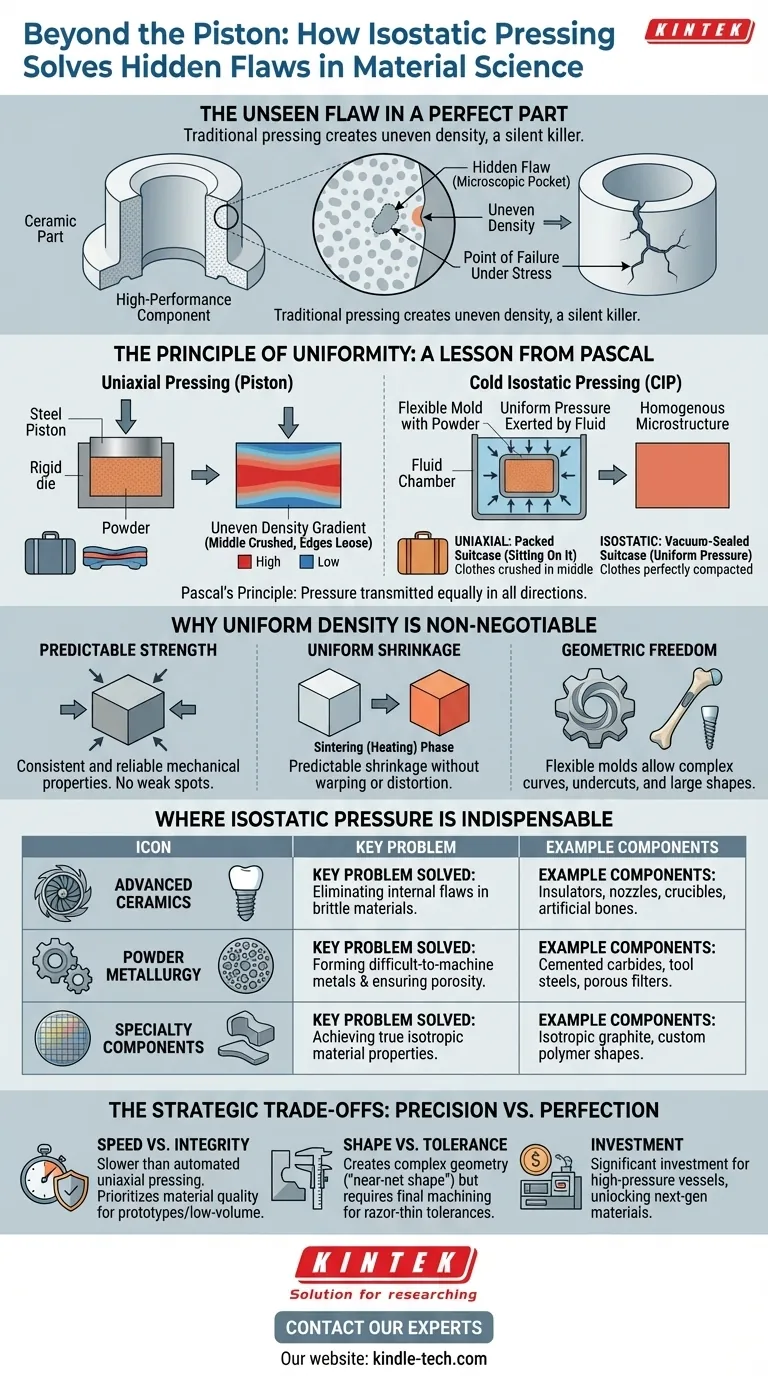
Imagine a high-performance ceramic component—a turbine blade, a medical implant, an insulator for a particle accelerator. It looks flawless. Its dimensions are perfect. But deep within its microstructure, a hidden flaw resides: a tiny, almost imperceptible variation in density.
This is the silent killer of high-performance materials. Under stress, this microscopic pocket of lower density becomes a point of failure. The part cracks. The system fails.
The root of this problem often lies in how the part was formed. Our intuition for "pressing" something is based on the simple piston: pressure from one or two directions. But this simple action creates a complex, and often fatal, problem of uneven density.
The Principle of Uniformity: A Lesson from Pascal
Cold Isostatic Pressing (CIP) operates on a fundamentally different principle, one articulated by Blaise Pascal centuries ago: pressure exerted on a confined fluid is transmitted equally in all directions.
Instead of a steel piston hammering powder into a rigid die, CIP works more elegantly.
- A powder is sealed in a flexible, watertight mold.
- This mold is submerged in a chamber of fluid.
- The fluid is pressurized, squeezing the mold from every conceivable angle simultaneously and with equal force.
Think of it this way: Uniaxial pressing is like packing a suitcase by sitting on it. The clothes in the middle get crushed, while things at the edges remain loose. Isostatic pressing is like vacuum-sealing the entire suitcase—every item is compacted with uniform pressure.
Why Uniform Density is Non-Negotiable
This application of uniform pressure eliminates the density gradients that plague conventional methods. The result is a "green" part (an unsintered component) with a homogenous microstructure. This homogeneity is not just an academic detail; it has profound engineering consequences.
- Predictable Strength: With no hidden weak spots, the material's mechanical properties are consistent and reliable throughout the entire part.
- Uniform Shrinkage: During the final sintering (heating) phase, the part shrinks predictably without the warping or distortion caused by density variations.
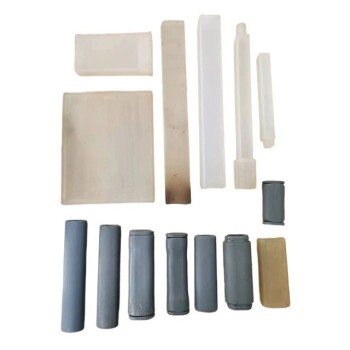
- Geometric Freedom: Because the "die" is a flexible mold, designers are freed from the constraints of traditional tooling. Complex curves, undercuts, and large-scale geometries become practical and possible.
Where Isostatic Pressure is Indispensable
The decision to use CIP is a decision to prioritize material integrity. It is the go-to method when the cost of failure is unacceptably high.
For Materials That Cannot Afford to Fail
In the world of advanced ceramics—like silicon carbide, silicon nitride, and boron carbide—brittleness is the primary challenge. Internal flaws don't just weaken the material; they cause catastrophic failure. CIP is essential for producing reliable ceramic insulators, refractory nozzles, and crucibles that must perform under extreme conditions.
For Metals That Resist Being Shaped
Powder metallurgy uses CIP to form preforms from materials that are notoriously difficult to machine, such as tool steels and cemented carbides. It is also the ideal method for creating porous metal filters where consistent, uniform permeability is the most critical performance metric.
For Components Demanding Isotropic Perfection
Some applications, like graphite components in semiconductor manufacturing, require isotropic properties—meaning the material behaves identically regardless of the direction of force. CIP is the only practical way to create large blocks of isotropic graphite by ensuring powder particles are compacted without a preferential orientation.
| Application Domain | Key Problem Solved | Example Components |
|---|---|---|
| Advanced Ceramics | Eliminating internal flaws to prevent failure | Insulators, nozzles, crucibles, artificial bones |
| Powder Metallurgy | Forming difficult materials, ensuring porosity | Cemented carbides, tool steels, porous filters |
| Specialty Components | Achieving true isotropic material properties | Isotropic graphite, custom polymer shapes |
The Strategic Trade-Offs: Precision vs. Perfection
CIP is not a universal solution. It represents a set of strategic engineering trade-offs, where internal perfection is prioritized over other metrics.
- Speed vs. Integrity: The process is inherently slower than automated uniaxial pressing. It's best suited for prototypes and low-to-mid-volume production runs where material quality is the primary driver.
- Shape vs. Tolerance: CIP is a "near-net shape" process. It creates the complex geometry perfectly, but often requires final machining to achieve razor-thin dimensional tolerances. This is a planned step, not a shortcoming.
- Investment: The high-pressure vessels and control systems represent a significant investment in capability. For a laboratory, this investment unlocks the potential to develop next-generation materials that were previously impossible to form.
For researchers and engineers pushing the boundaries of material science, mastering techniques like CIP is essential. The right equipment makes all the difference. If your project demands unparalleled material uniformity and design freedom, KINTEK's laboratory-scale solutions can provide the capability you need.
Visual Guide
Related Products
- Electric Split Lab Cold Isostatic Press CIP Machine for Cold Isostatic Pressing
- Electric Lab Cold Isostatic Press CIP Machine for Cold Isostatic Pressing
- Automatic Lab Cold Isostatic Press CIP Machine Cold Isostatic Pressing
- Manual Cold Isostatic Pressing Machine CIP Pellet Press
- Warm Isostatic Press for Solid State Battery Research