Blog Escaping the Black Box: The Architecture of Insight in Electrochemistry
Escaping the Black Box: The Architecture of Insight in Electrochemistry

Escaping the Black Box: The Architecture of Insight in Electrochemistry

1 day ago

The Limits of Blind Data

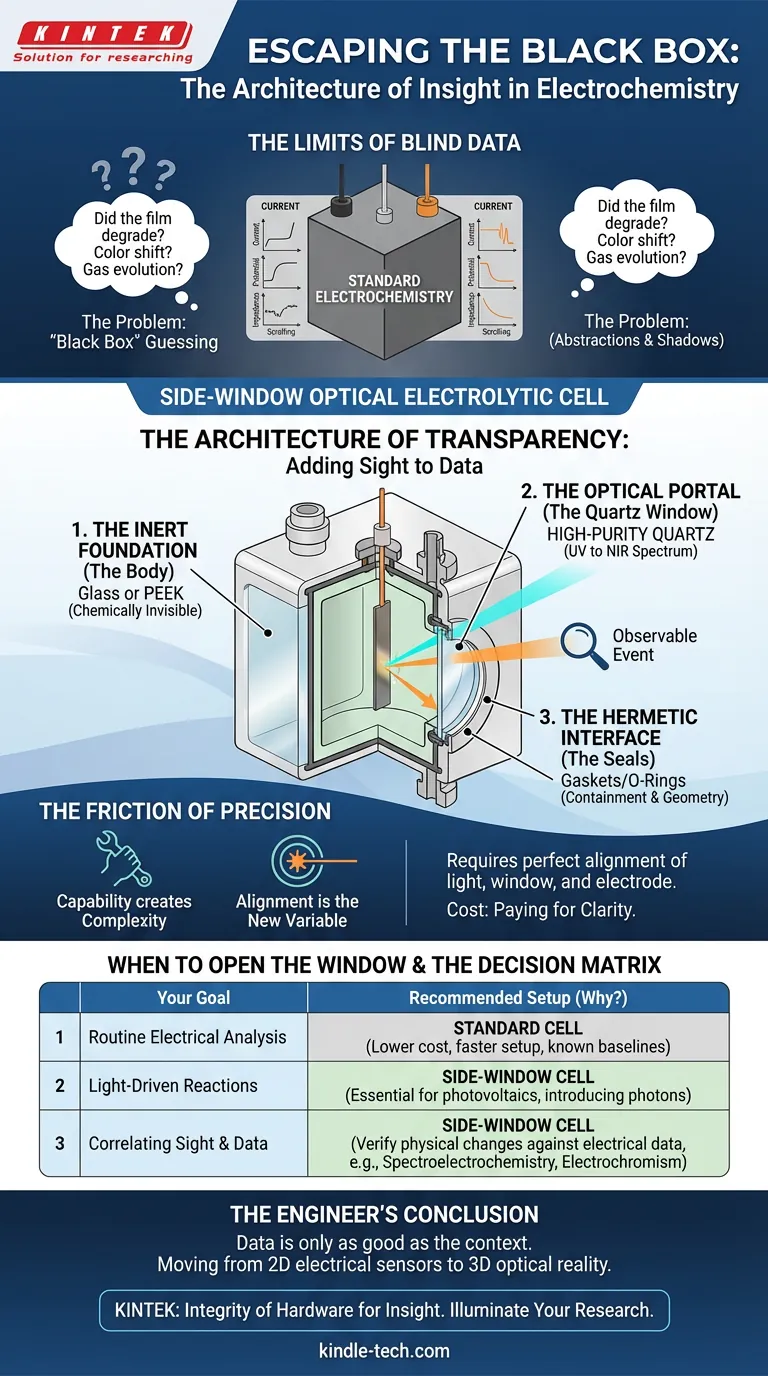
In standard electrochemistry, we often work in the dark.

You set up your cell. You apply a voltage. You watch the numbers scroll across a screen—current, potential, impedance. You get a graph that tells you something happened.

But graphs are abstractions. They are shadows of the reality occurring on the electrode surface.

Did the film degrade? Did the color shift? Was the gas evolution uniform?

In a standard opaque setup, you are guessing. You are treating the reaction as a "black box," feeding inputs and analyzing outputs without witnessing the process.

To truly understand the mechanism, you need to add a new sense to your data: Sight.

This is the engineering philosophy behind the Side-Window Optical Electrolytic Cell. It is not just a container; it is an instrument designed to bridge the gap between electrical data and physical reality.

The Architecture of Transparency

A side-window cell is a specialized vessel designed for experiments that merge optical analysis with electrochemistry.

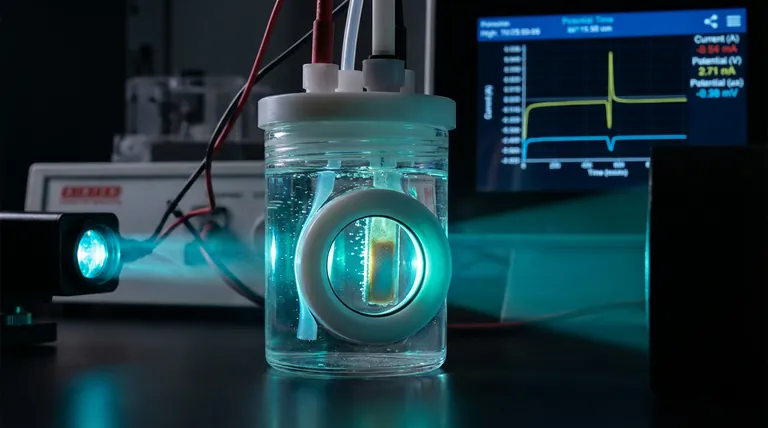
It is built on a simple premise with complex execution: allow a researcher to shine light onto an electrode while simultaneously measuring the electrical response.

It transforms the experiment from a blind measurement into an observable event. To achieve this, the hardware requires three specific engineering choices.

1. The Inert Foundation (The Body)

The cell body is the stage. It holds the electrolyte.

It is typically machined from Glass or PEEK (polyether ether ketone). The choice of material is not aesthetic; it is defensive. The body must remain chemically invisible, refusing to react with the solution even under aggressive potentials.

2. The Optical Portal (The Quartz Window)

This is the defining feature. Standard glass blocks UV light.

Side-window cells utilize high-purity quartz. Quartz is transparent across a broad spectrum, from Ultraviolet (UV) to visible and Near-Infrared (NIR).

This allows the window to act as a precise interface. It lets a controlled beam of light enter the "black box" and strike the working electrode without distortion or absorption.

3. The Hermetic Interface (The Seals)

The most common point of failure in any pressurized or fluid system is the joint.

The electrode ports use gaskets or O-rings to create a hermetic seal. This serves two purposes:

  • Containment: It prevents electrolyte leakage.
  • Geometry: It locks the electrodes in a fixed, reproducible position. In optics, geometry is everything.

The Friction of Precision

There is a psychological trade-off in engineering: Capability creates complexity.

A beaker is easy to use. A side-window cell is a precision instrument. Using one requires a shift in mindset.

Alignment is the new variable. In a standard cell, you just drop the electrodes in. In a side-window cell, the light source, the quartz window, and the working electrode must be perfectly aligned. If the angle is off by a fraction of a degree, your light misses the target, or the refraction skews your data.

The Optical Path. You must account for the electrolyte itself. The fluid between the window and the electrode can scatter or absorb light. The distance is no longer arbitrary; it is a variable in your equation.

The Cost. High-purity quartz and precision machining cost more than standard glass. You are paying for the privilege of clarity.

When to Open the Window

Not every experiment needs this level of scrutiny.

If you are running routine Cyclic Voltammetry (CV) to check a known standard, this tool is overkill. Complexity without purpose is just waste.

However, if you are working at the frontier of materials science, "seeing" is not optional.

You need a side-window cell if:

  • Solar Fuels: You are testing materials for photovoltaics and need to drive the reaction with light.
  • Spectroelectrochemistry: You need to correlate a spike in current with a change in absorbance or fluorescence.
  • Electrochromism: You are studying materials that change color under potential.

The Decision Matrix

Your Goal Recommended Setup Why?
Routine Electrical Analysis Standard Cell Lower cost, faster setup, sufficient for known baselines.
Light-Driven Reactions Side-Window Cell Essential. You must introduce photons to the electrode surface.
Correlating Sight & Data Side-Window Cell Required to verify physical changes (color/bubbles) against electrical data.

The Engineer’s Conclusion

Data is only as good as the context surrounding it.

When you rely solely on electrical sensors, you are seeing a reaction in 2D. Adding an optical window renders it in 3D. It allows you to confirm that the spike in your graph actually correlates to the physical degradation you suspected.

At KINTEK, we understand that the quality of your research often rests on the integrity of your hardware. We build side-window optical electrolytic cells for researchers who refuse to accept the "black box."

If you are ready to illuminate your research and stop guessing at what is happening inside your reactor, we can help you configure the precise alignment you need.

Contact Our Experts

Visual Guide

Escaping the Black Box: The Architecture of Insight in Electrochemistry Visual Guide

Related Products

Related Articles

Related Products

Side Window Optical Electrolytic Electrochemical Cell

Side Window Optical Electrolytic Electrochemical Cell

Experience reliable and efficient electrochemical experiments with a side window optical electrolytic cell. Boasting corrosion resistance and complete specifications, this cell is customizable and built to last.

Electrolytic Electrochemical Cell with Five-Port

Electrolytic Electrochemical Cell with Five-Port

Streamline your laboratory consumables with Kintek's Electrolytic Cell with five-port design. Choose from sealed and non-sealed options with customizable electrodes. Order now.

Super Sealed Electrolytic Electrochemical Cell

Super Sealed Electrolytic Electrochemical Cell

Super-sealed electrolytic cell offers enhanced sealing capabilities, making it ideal for experiments that require high airtightness.

H-Type Double-Layer Optical Electrolytic Electrochemical Cell with Water Bath

H-Type Double-Layer Optical Electrolytic Electrochemical Cell with Water Bath

Double-layer H-type optical water bath electrolytic cells, with excellent corrosion resistance and a wide range of specifications available. Customization options are also available.

Electrolytic Electrochemical Cell for Coating Evaluation

Electrolytic Electrochemical Cell for Coating Evaluation

Looking for corrosion-resistant coating evaluation electrolytic cells for electrochemical experiments? Our cells boast complete specifications, good sealing, high-quality materials, safety, and durability. Plus, they're easily customizable to meet your needs.

Electrolytic Electrochemical Cell Gas Diffusion Liquid Flow Reaction Cell

Electrolytic Electrochemical Cell Gas Diffusion Liquid Flow Reaction Cell

Looking for a high-quality gas diffusion electrolysis cell? Our liquid flow reaction cell boasts exceptional corrosion resistance and complete specifications, with customizable options available to suit your needs. Contact us today!

Double-Layer Water Bath Electrolytic Electrochemical Cell

Double-Layer Water Bath Electrolytic Electrochemical Cell

Discover the temperature-controllable electrolytic cell with a double-layer water bath, corrosion resistance, and customization options. Complete specifications included.

PTFE Electrolytic Cell Electrochemical Cell Corrosion-Resistant Sealed and Non-Sealed

PTFE Electrolytic Cell Electrochemical Cell Corrosion-Resistant Sealed and Non-Sealed

Choose our PTFE Electrolytic Cell for reliable, corrosion-resistant performance. Customize specifications with optional sealing. Explore now.

H Type Electrolytic Cell Triple Electrochemical Cell

H Type Electrolytic Cell Triple Electrochemical Cell

Experience versatile electrochemical performance with our H-type Electrolytic Cell. Choose from membrane or non-membrane sealing, 2-3 hybrid configurations. Learn more now.

Quartz Electrolytic Electrochemical Cell for Electrochemical Experiments

Quartz Electrolytic Electrochemical Cell for Electrochemical Experiments

Looking for a reliable quartz electrochemical cell? Our product boasts excellent corrosion resistance and complete specifications. With high-quality materials and good sealing, it's both safe and durable. Customize to meet your needs.

Thin-Layer Spectral Electrolysis Electrochemical Cell

Thin-Layer Spectral Electrolysis Electrochemical Cell

Discover the benefits of our thin-layer spectral electrolysis cell. Corrosion-resistant, complete specifications, and customizable for your needs.

Double Layer Five-Port Water Bath Electrolytic Electrochemical Cell

Double Layer Five-Port Water Bath Electrolytic Electrochemical Cell

Experience optimal performance with our Water Bath Electrolytic Cell. Our double-layer, five-port design boasts corrosion resistance and longevity. Customizable to fit your specific needs. View specs now.

Customizable PEM Electrolysis Cells for Diverse Research Applications

Customizable PEM Electrolysis Cells for Diverse Research Applications

Custom PEM test cell for electrochemical research. Durable, versatile, for fuel cells & CO2 reduction. Fully customizable. Get a quote!

Flat Corrosion Electrolytic Electrochemical Cell

Flat Corrosion Electrolytic Electrochemical Cell

Discover our flat corrosion electrolytic cell for electrochemical experiments. With exceptional corrosion resistance and complete specifications, our cell guarantees optimal performance. Our high-quality materials and good sealing ensure a safe and durable product, and customization options are available.

Customizable CO2 Reduction Flow Cell for NRR ORR and CO2RR Research

Customizable CO2 Reduction Flow Cell for NRR ORR and CO2RR Research

The cell is meticulously crafted from high-quality materials to ensure chemical stability and experimental accuracy.

Customizable Swagelok Type Test Cells for Advanced Battery Research Electrochemical Analysis

Customizable Swagelok Type Test Cells for Advanced Battery Research Electrochemical Analysis

The KINTEK Swagelok-type test cell is a modular, T-shaped device constructed from high-quality, chemically inert materials.

FS Electrochemical Hydrogen Fuel Cells for Diverse Applications

FS Electrochemical Hydrogen Fuel Cells for Diverse Applications

KINTEK's FS Electrochemical Cell: Modular PEM fuel cell stack for R&D and training. Acid-resistant, scalable, and customizable for reliable performance.

Gold Electrochemical Sheet Electrode Gold Electrode

Gold Electrochemical Sheet Electrode Gold Electrode

Discover high-quality gold sheet electrodes for safe and durable electrochemical experiments. Choose from complete models or customize to meet your specific needs.

RRDE rotating disk (ring disk) electrode / compatible with PINE, Japanese ALS, Swiss Metrohm glassy carbon platinum

RRDE rotating disk (ring disk) electrode / compatible with PINE, Japanese ALS, Swiss Metrohm glassy carbon platinum

Elevate your electrochemical research with our Rotating Disk and Ring Electrodes. Corrosion resistant and customizable to your specific needs, with complete specifications.

Laboratory manual slicer

Laboratory manual slicer

Manual microtome is a high-precision cutting device designed for laboratories, industry and medical fields. It is suitable for the preparation of thin slices of various materials such as paraffin samples, biological tissues, battery materials, food, etc.


Leave Your Message