The Hidden War Against Voids
Every engineer who creates a physical object is fighting an invisible war. The enemy is empty space. Pores, voids, and micro-cracks—these are the hidden seeds of catastrophic failure, lurking within even the most meticulously designed components.
In materials science, this battle is fought on two distinct fronts. The first is about creation: giving precise form to loose matter. The second is about perfection: forging an already solid object into its strongest possible state.
These two strategies are embodied by two powerful technologies: Cold Isostatic Pressing (CIP) and Hot Isostatic Pressing (HIP). Understanding them isn’t about choosing an alternative; it’s about knowing which battle you need to win.
The Architect's Work: Cold Isostatic Pressing (CIP)
Imagine a pile of advanced metal or ceramic powder. It holds immense potential, but for now, it is formless dust. The first challenge is to transform this potential into a tangible, handleable shape. This is the domain of CIP.
Giving Form to Powder
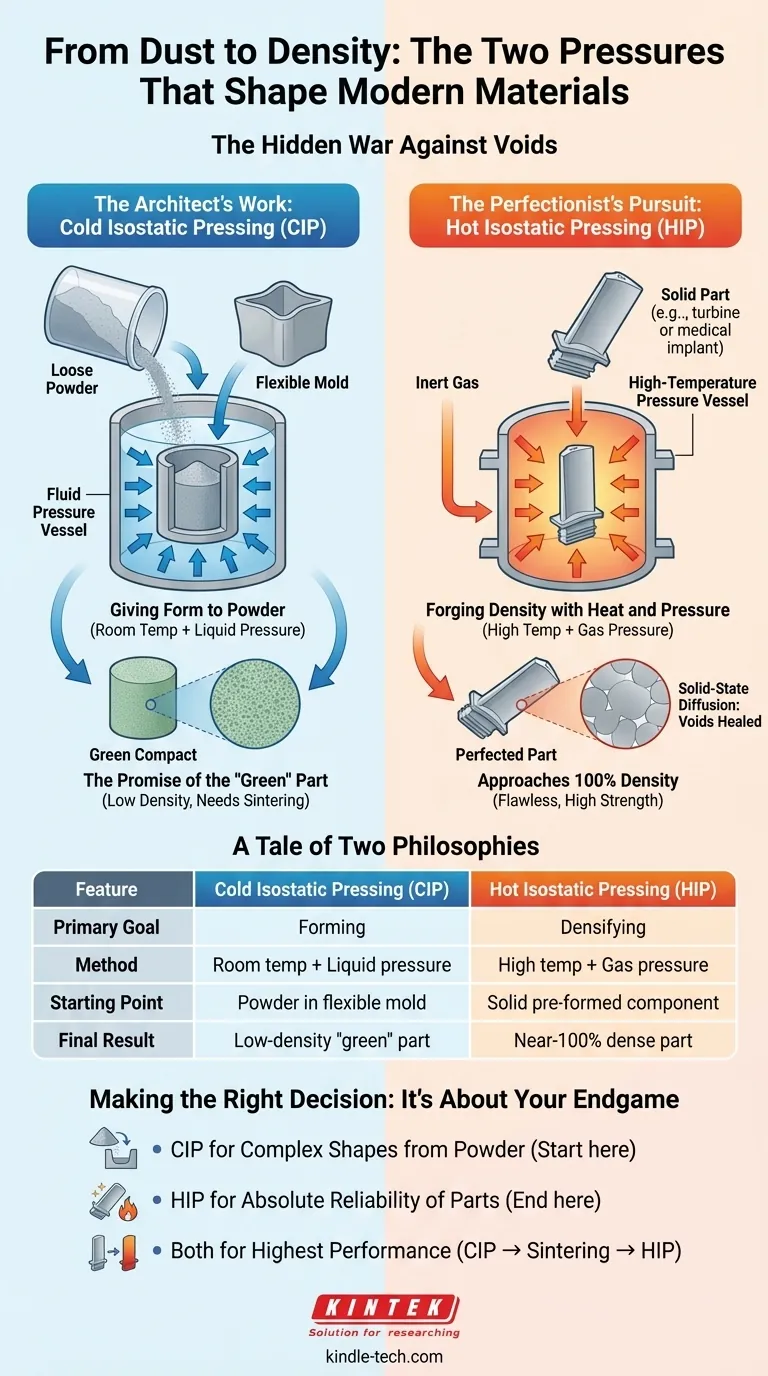
In Cold Isostatic Pressing, the powder is sealed within a flexible mold. This mold is then submerged in a fluid and subjected to immense, uniform pressure from all directions.
Think of it as a perfectly uniform, three-dimensional hug. This isostatic pressure compacts the powder particles together into a coherent mass. Because the force is applied equally from all sides, the resulting density is exceptionally even, preventing the weak spots that can plague other forming methods.
The Promise of the "Green" Part
The result of CIP is a "green compact." It has the desired shape and is solid enough to be handled, but it has not yet reached its final strength. It is a promise of the final part—an architectural blueprint rendered in compacted powder.
To fulfill this promise, the green part must be heated in a subsequent process called sintering, where the particles fuse together, building the strength and density required for its application. CIP is the brilliant first act.
The Perfectionist's Pursuit: Hot Isostatic Pressing (HIP)
Now, consider a different scenario. A part already exists. It might be a critical turbine blade fresh from a casting mold or a complex medical implant from a 3D printer. It looks and feels perfect.
When Good Isn't Good Enough
The most demanding applications, from aerospace to medicine, cannot rely on appearances. The fear is of the flaws you can't see. Internal porosity left over from casting or printing can drastically reduce a component's fatigue life. Under extreme stress, these voids become failure points.
This is where the perfectionist's tool, Hot Isostatic Pressing, comes into play.
Forging Density with Heat and Pressure
HIP takes an already solid part and places it into a high-temperature vessel filled with an inert gas like Argon. Both pressure and temperature are raised to extreme levels.
This combination triggers a phenomenon called solid-state diffusion. The material's own atoms are energized and forced to move, migrating into the internal voids and welding them shut from the inside out. It's not shaping the part; it's healing it on an atomic level.
The result is a component that approaches 100% of its theoretical maximum density, with dramatically improved mechanical properties. It’s the process that ensures a jet engine blade can withstand incredible forces for thousands of hours.
A Tale of Two Philosophies
The choice between CIP and HIP is a choice of purpose. One is an act of creation; the other is an act of refinement.
| Feature | Cold Isostatic Pressing (CIP) | Hot Isostatic Pressing (HIP) |
|---|---|---|
| The Primary Goal | Forming a shape from loose powder | Densifying an existing solid part |
| The Method | Room temperature + Liquid pressure | High temperature + Gas pressure |
| The Starting Point | A flexible mold filled with powder | A pre-formed solid component |
| The Final Result | A low-density "green" part needing sintering | A near-100% dense, high-strength, perfected part |
In short:
- CIP is for beginnings. It turns powder into a predictable shape.
- HIP is for endings. It takes a good part and makes it flawless.
Making the Right Decision: It's About Your Endgame
To select the right process, you must define your ultimate goal.
-
If you need to create a complex shape from a specialized powder, your journey starts with CIP to establish the form, followed by sintering to build its strength.
-
If you need to guarantee the absolute reliability of a critical cast or 3D-printed component, your journey ends with HIP as a final post-processing step to eliminate any internal defects.
-
If you are pursuing the highest possible material performance, you will use both. You will start with CIP to form the part, then sinter it, and finally use HIP to achieve a level of density and reliability that is otherwise unattainable.
This level of material control—from shaping dust into form to forging flawless density—isn't magic. It's the result of precise, reliable laboratory equipment. At KINTEK, we provide the specialized tools necessary for both of these critical processes, serving researchers and engineers pushing the boundaries of what's possible.
Whether your goal is to architect a new component from powder or to perfect an existing one, having the right tools is paramount. To explore the equipment that can transform your material processing workflow, Contact Our Experts.
Visual Guide
Related Products
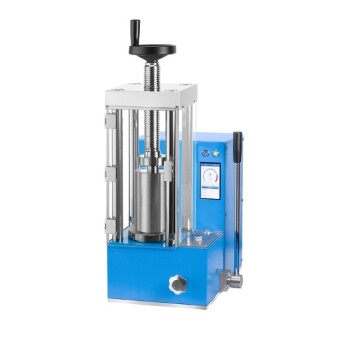
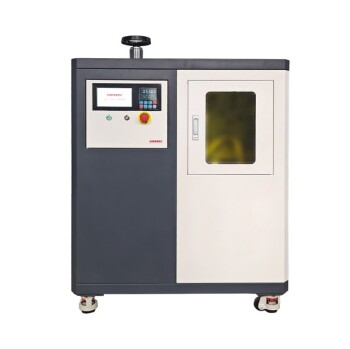
- Electric Lab Cold Isostatic Press CIP Machine for Cold Isostatic Pressing
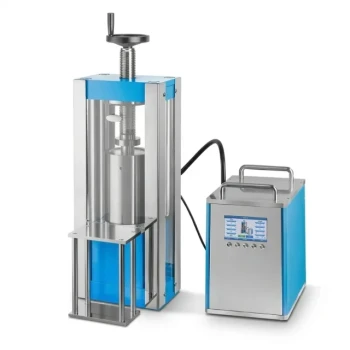
- Electric Split Lab Cold Isostatic Press CIP Machine for Cold Isostatic Pressing
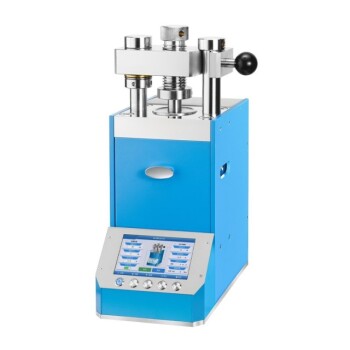
- Automatic Lab Cold Isostatic Press CIP Machine Cold Isostatic Pressing
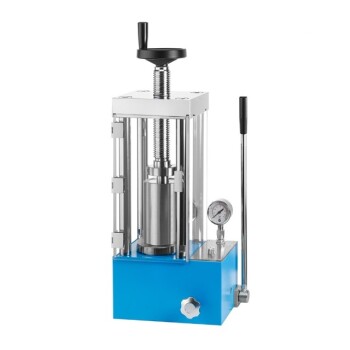
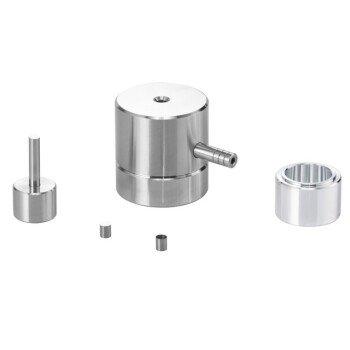
- Manual Cold Isostatic Pressing Machine CIP Pellet Press
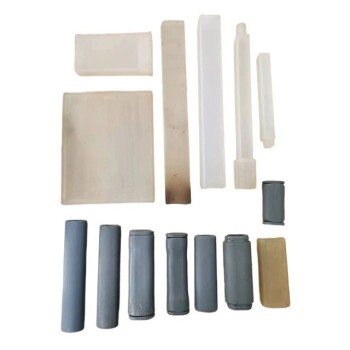
- Isostatic Molding Pressing Molds for Lab
Related Articles
- Electric Lab Cold Isostatic Press (CIP): Applications, Benefits, and Customization
- Operating steps and precautions for electric isostatic press
- Comprehensive Application of Cold Isostatic Pressing Technology
- Technical Aspects of Cold Isostatic Pressing
- Beyond the Furnace: Mastering Material Density with Cold Isostatic Pressing