The Unseen Pressure That Creates Perfection
Imagine holding a handful of fine ceramic powder. Your challenge is to transform this chaotic dust into a solid, perfectly uniform component—strong enough for a jet engine or biocompatible enough for a medical implant.
The primary enemy in this process is inconsistency. If you simply press the powder from the top down, you create hidden density gradients, weak points that will cause warping, cracking, and failure during final sintering.
The elegant solution is to borrow a principle from the deep ocean: isostatic pressure. By submerging the powder in a fluid and pressurizing it, the force is applied equally from every conceivable direction. This uniform "squeeze" compacts the powder into a "green part" with near-perfectly consistent density.
But how you apply this pressure creates a fundamental fork in the road for any engineer or lab manager. This is the choice between two philosophies: the wet-bag and the dry-bag method.
The Artisan's Method: Wet-Bag Pressing
Think of an R&D lab tasked with creating a novel turbine blade prototype. The shape is complex, with intricate curves. They will only make a few, and the design will likely change after testing.
For them, the wet-bag method is the perfect tool.
In this process, the powder is sealed inside a flexible, rubber-like mold. This entire sealed package is then submerged in the fluid of a pressure vessel. It is literally a "wet bag."
This approach decouples the mold from the machine, granting immense freedom. It’s a batch process, methodical and deliberate.
- Its strength is flexibility. You can create large, complex, one-off parts without significant investment in permanent tooling.
- Its mindset is discovery. It’s for prototyping, for R&D, for situations where the design is fluid and the volume is low.
The Manufacturer's Engine: Dry-Bag Pressing
Now, picture a factory that produces millions of identical spark plug insulators per year. The goal is not discovery, but relentless efficiency, speed, and repeatability.
Here, the dry-bag method reigns supreme.
In a dry-bag press, the flexible mold is an integrated, permanent part of the pressure vessel. It’s a durable membrane that isolates the powder from the fluid. An operator (or a robot) simply fills the cavity with powder, the machine cycles automatically, and the compacted part is ejected.
The process is fast, clean, and designed for automation.
- Its strength is velocity. Cycle times are measured in seconds, not minutes, making it ideal for mass production.
- Its mindset is optimization. It’s for turning a proven design into a high-volume, cost-effective product.
The Strategic Crossroads: Flexibility vs. Velocity
Choosing between wet-bag and dry-bag isn't a simple technical comparison; it's a strategic business decision that balances investment, ambition, and scale.
The Question of Volume: Craft vs. Production
This is the most critical deciding factor. Wet-bag is a craftsman's tool, perfect for low-volume, high-complexity work. Dry-bag is a factory's engine, built for high-throughput mass manufacturing. Your required parts-per-year will immediately point you in one direction.
The Geometry of Ambition: Complexity vs. Simplicity
The wet-bag method's independent tooling allows for almost limitless geometric complexity and size. If you can design it and create a mold for it, you can likely press it. Dry-bag tooling is fixed, which constrains it to simpler shapes like tubes and rods—shapes conducive to high-speed production.
The Economics of Time: Investment vs. Throughput
Here lies the psychological trap. Wet-bag tooling is inexpensive to create, making the initial barrier to entry low. However, the labor-intensive, slow cycle time means the per-part cost is high.
Dry-bag systems require a significant upfront capital investment in the press and its integrated tooling. But once running, the per-part cost plummets due to speed and automation, delivering massive returns at scale.
A Framework for Your Decision
Ultimately, the choice hinges on your primary objective. Are you exploring new designs or are you scaling a proven one? The table below clarifies the trade-offs.
| Feature | Wet-Bag CIP | Dry-Bag CIP |
|---|---|---|
| Primary Goal | R&D, Prototyping, Complex Parts | High-Volume, Automated Production |
| Production Volume | Low to Medium | High to Very High |
| Cycle Time | Slower (Manual Batch Process) | Faster (Automated or Semi-Continuous) |
| Tooling Cost | Low Initial Cost | High Initial Cost |
| Part Complexity | High Flexibility (Large & Intricate) | Low Flexibility (Simple Shapes) |
| Per-Part Cost | Higher (at scale) | Lower (at scale) |
The decision isn't about which method is "better," but which one aligns with your operational philosophy. Are you in the business of discovery or the business of delivery?
Answering that question requires the right partner and the right equipment. At KINTEK, we specialize in providing the laboratory equipment and consumables that power both discovery and delivery. Whether your lab requires the versatility of a wet-bag press for groundbreaking research or the efficiency of a dry-bag system for scaling production, we provide the tools and expertise to ensure your material consolidation process is a success.
To find the perfect CIP solution for your unique goals, Contact Our Experts.
Visual Guide

Related Products
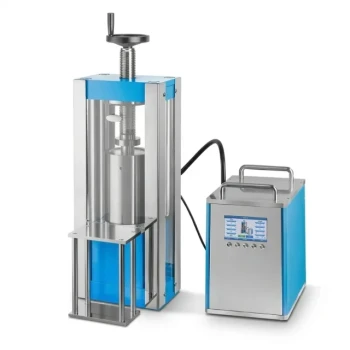
- Electric Split Lab Cold Isostatic Press CIP Machine for Cold Isostatic Pressing
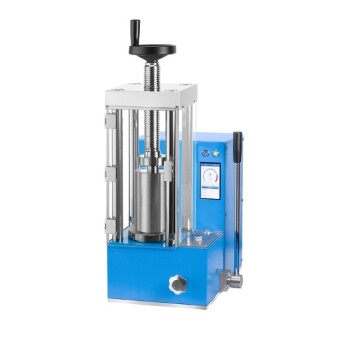
- Electric Lab Cold Isostatic Press CIP Machine for Cold Isostatic Pressing
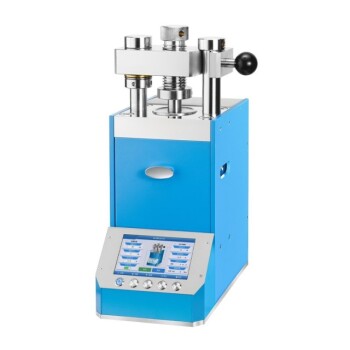
- Automatic Lab Cold Isostatic Press CIP Machine Cold Isostatic Pressing
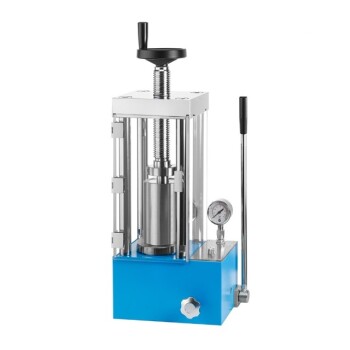
- Manual Cold Isostatic Pressing Machine CIP Pellet Press
- Warm Isostatic Press for Solid State Battery Research