You've set your lab kiln to 900°C for calcination, precisely the temperature cited in the literature. Yet, the results are a chaotic mess. Some batches are perfect, but others emerge as a frustrating mix of unreacted raw material and over-burnt, useless dust. You've spent weeks tweaking the feed rate and re-calibrating sensors, but your process remains stubbornly unpredictable. Does this sound familiar?
You're not alone. This is a story we hear constantly from labs and process development teams. The goal seems simple—heat a material to transform it—but the reality is a minefield of inconsistency.
The Costly Cycle of Chasing a "Magic Number"
When faced with unreliable results, the instinct is to double down on what we think we know. Engineers and scientists often find themselves trapped in a loop of failed "solutions":
- Pushing the Temperature Higher: "Maybe 900°C isn't enough. Let's try 950°C, or even 1000°C." This brute-force approach often leads to damaged product and wasted energy, not better results.
- Endless Parameter Tweaking: Adjusting rotation speed, feed rates, and residence times without a guiding principle, hoping to stumble upon a stable configuration.
- Blaming the Raw Materials: Questioning the consistency of your feedstock, leading to expensive and often unnecessary material analysis.
This cycle isn't just frustrating; it has severe business consequences. Promising R&D projects stall, unable to produce the reliable data needed for scale-up. Budgets are consumed by failed test runs, burning through expensive materials and energy. Most critically, confidence erodes. Without a dependable process, you can't guarantee product quality, and the path to commercialization becomes blocked.
The fundamental issue is that all these efforts are based on a flawed premise. You're trying to solve the wrong problem.
The Revelation: It’s Not the Destination, It’s the Thermal Journey
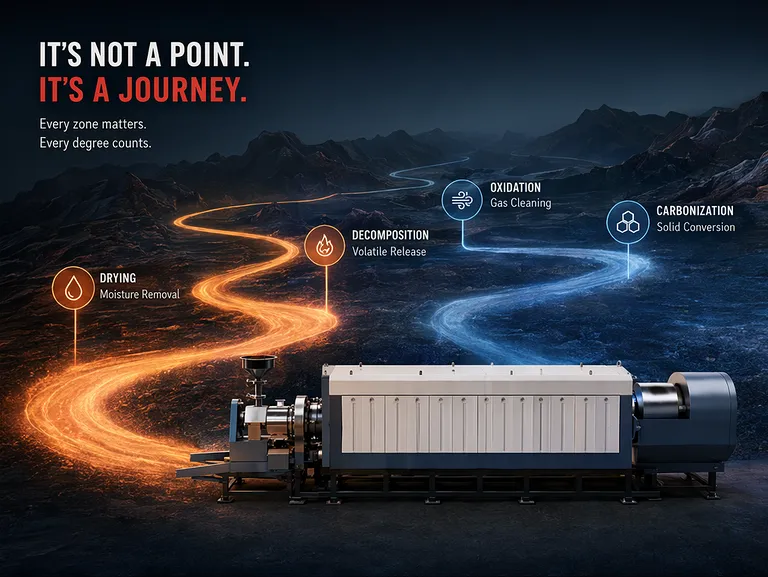
The most common mistake in thermal processing is focusing on a single peak temperature. Asking for "the" temperature of a rotary kiln is like asking a race car driver for "the" speed they used to win a race. The answer is meaningless. Victory isn't about hitting one top speed; it's about the entire sequence of accelerating, braking, and holding speed through the turns.
Your material requires the same carefully choreographed treatment. Success depends on its thermal journey, a precise temperature profile it experiences as it travels through the kiln.
A Journey in Three Acts
A typical rotary kiln process isn't a single event, but a sequence of critical stages:
- Act I: Pre-heating and Drying. As material enters the cooler end of the kiln, it needs to be gently heated. The goal here is to drive off moisture and prepare it for the main reaction. Rushing this stage by exposing it to high heat too quickly can cause thermal shock, fracturing particles and creating dust.
- Act II: The Reaction Zone. This is the main event—where calcination, sintering, or another chemical transformation occurs. Here, the material must be held at a precise, stable temperature (e.g., ~900°C for lime or ~1500°C for cement) for a specific duration to ensure the reaction completes fully.
- Act III: Controlled Cooling. As the material exits the hottest zone, the cooling rate can be just as important for locking in its desired final properties.
The "solutions" from the previous section fail because they ignore this journey. Cranking up the heat (brute force) is like hitting the gas from a standstill—you'll burn out the engine before you even get to the first turn. You are damaging the material in Act I, dooming the results before Act II even begins.
From Guesswork to Engineering: The Right Tool for the Journey
To escape the cycle of trial-and-error, you need to stop guessing and start engineering. This requires a tool designed not just to get hot, but to give you deliberate control over the entire thermal journey.
This is precisely why KINTEK's laboratory rotary kilns are engineered for process control. They are built on the understanding that mastering the profile is the key to repeatability and quality. They empower you to move from a "hot box" mentality to a sophisticated process design mindset by directly addressing the root cause of inconsistency.
-
Problem: Materials need a specific temperature curve.
- KINTEK's Solution: Our kilns feature multiple, independently controlled heating zones. This allows you to create a precise temperature profile—a gentle ramp for drying, a stable plateau for reaction, and a controlled descent for cooling—all within a single pass.
-
Problem: Materials must spend the right amount of time in each zone.
- KINTEK's Solution: Adjustable rotation speed and inclination angle give you direct control over residence time. You can ensure your material gets exactly the heat treatment it needs, for exactly as long as it needs it.
-
Problem: Repeatability requires precision, not guesswork.
- KINTEK's Solution: With precise temperature monitoring and robust control systems, you can define, execute, and repeat the ideal thermal journey for your material, batch after batch.
Our equipment isn't just a collection of features; it's a complete toolkit for designing and validating successful thermal processes.
Beyond Fixing Problems: What Reliable Thermal Processing Unlocks
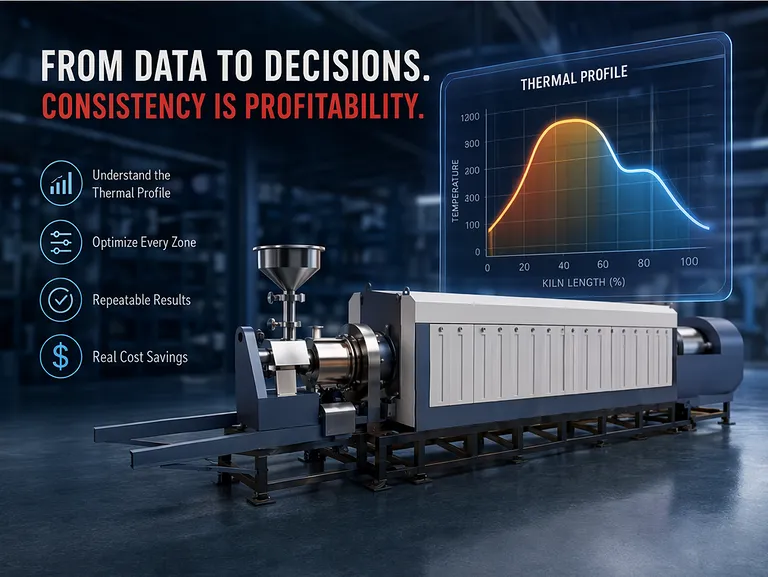
When you gain control over the thermal journey, you do more than just solve an inconsistency problem. You unlock a new level of capability for your entire organization.
Instead of fighting with your equipment, you can now:
- Accelerate R&D: Rapidly test and define the optimal thermal profile for a new material in days, not months.
- Guarantee Scalability: Develop a robust, repeatable process in the lab that you can scale to production with confidence.
- Innovate with New Materials: Successfully process sensitive or complex materials that were previously impossible to work with.
- Optimize Your Process: Fine-tune the temperature and residence time to use the absolute minimum energy and time required, drastically lowering operational costs.
Defining a robust thermal process is more than a technical victory; it's the foundation for a successful product. It's the difference between a project stuck in the lab and a product succeeding in the market. If you're ready to stop chasing ghosts and start engineering results, our team is here to help you design the perfect journey for your material.
Let's discuss the specific challenges and goals of your project. We can help you configure a system that provides the control and reliability you need to move forward with confidence. Contact Our Experts
Related Products
- Electric Rotary Kiln Small Rotary Furnace Biomass Pyrolysis Plant
- Electric Rotary Kiln Continuous Working Small Rotary Furnace Heating Pyrolysis Plant
- Electric Rotary Kiln Small Rotary Furnace for Activated Carbon Regeneration
- Electric Rotary Kiln Pyrolysis Furnace Plant Machine Calciner Small Rotary Kiln Rotating Furnace
- Vacuum Sealed Continuous Working Rotary Tube Furnace Rotating Tube Furnace
Related Articles
- Why Your Lab's Rotary Kiln Fails: It’s Not Your Process, It’s the Parts
- Your Rotary Kiln Isn't an Oven: The Secret to Consistent Thermal Processing
- Why Your Rotary Kiln Results Are Unpredictable—And How to Finally Fix Them
- Stop Asking About 'Temperature Range': The Real Key to Rotary Kiln Success
- Why More Fuel Isn't Fixing Your Rotary Kiln—And What Will