Blog The Architecture of Certainty: Why Three Electrodes Are Better Than Two
The Architecture of Certainty: Why Three Electrodes Are Better Than Two

The Architecture of Certainty: Why Three Electrodes Are Better Than Two

1 week ago

The Cost of Uncertainty

In science, as in life, uncertainty is the enemy.

We crave a stable baseline. We need to know that a change in outcome is caused by a change in variable, not a flaw in the measurement tool itself.

In the world of electrochemistry, this distinction is often blurred.

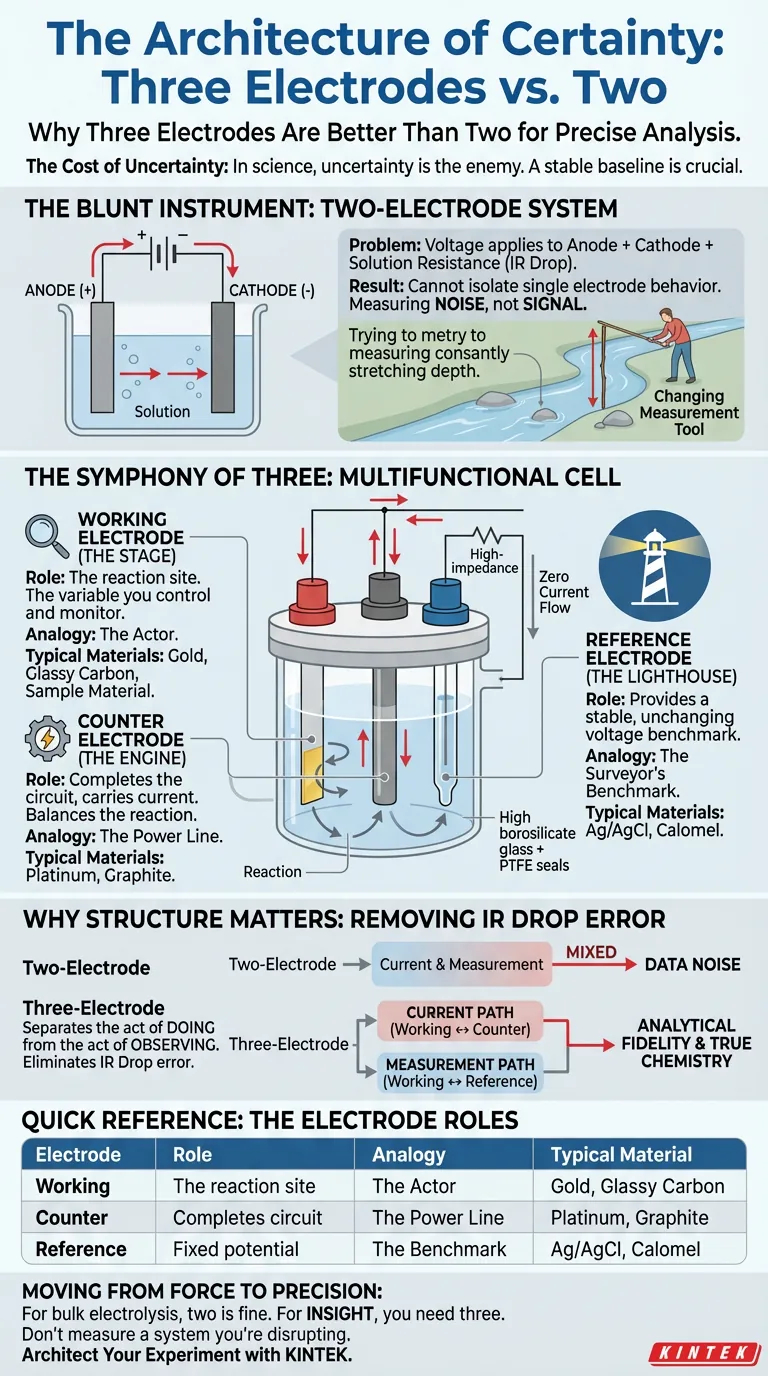
Imagine trying to measure the depth of a river while the stick you are using is constantly changing length based on the speed of the current. That is the fundamental flaw of a simple, two-electrode system when used for precise analysis.

To solve this, engineers and chemists developed a more elegant architecture: the three-electrode multifunctional electrolytic cell. It is a system designed not just to make reactions happen, but to understand exactly how they happen.

The Blunt Instrument: Two-Electrode Systems

To understand the solution, we must first appreciate the problem.

A standard electrolytic cell has two actors:

  1. The Anode
  2. The Cathode

You apply voltage across them to drive a reaction. This works perfectly for bulk electrolysis—like plating gold or producing chlorine. You pump in energy, and you get a product.

But if your goal is analysis—measuring reaction kinetics or potential thresholds—this system fails.

Why? Because the voltage you apply is consumed by three things simultaneously: the reaction at the anode, the reaction at the cathode, and the resistance of the solution itself (the IR drop).

You cannot isolate the behavior of a single electrode. You are measuring the noise of the entire system, not the signal of your specific reaction.

The Symphony of Three

The "multifunctional" cell introduces a third player to solve the problem of noise.

It separates the act of doing (driving current) from the act of observing (measuring potential). It transforms a blunt instrument into a scalpel.

Here is how the three roles interact.

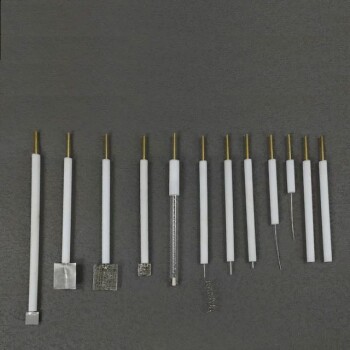
1. The Working Electrode (The Stage)

This is where the story happens.

Whether you are studying corrosion, testing a catalyst, or developing a sensor, the Working Electrode is the site of that specific reaction.

It is the variable you want to control. In a KINTEK cell, this is the component you monitor with obsession. Everything else in the cell exists to ensure this electrode can tell its truth without interference.

2. The Counter Electrode (The Engine)

Electricity requires a circuit. Electrons leaving the working electrode must go somewhere.

The Counter Electrode (or auxiliary electrode) acts as this sink or source. It balances the reaction.

It is the "mule" of the system. It carries the current so the measurement tools don’t have to. Usually made of inert platinum or graphite, it is designed to be invisible to the chemistry but essential to the physics.

3. The Reference Electrode (The Lighthouse)

This is the most critical component for precision.

The Reference Electrode has one job: to provide a stable, unchanging voltage benchmark (like Ag/AgCl).

It connects to the system through a high-impedance path. This means almost zero current flows through it. Because no current flows, its potential never changes, regardless of what chaos is happening in the rest of the cell.

It acts as a fixed point in a shifting sea. It allows the potentiostat to measure the difference between the Working Electrode and this fixed point, ignoring the voltage drops elsewhere in the solution.

Why Structure Matters

The elegance of the three-electrode system is that it removes the "IR drop" error from your data.

By separating the current path (Working ↔ Counter) from the measurement path (Working ↔ Reference), you achieve analytical fidelity.

However, the quality of the data is only as good as the physical integrity of the cell.

Material Integrity

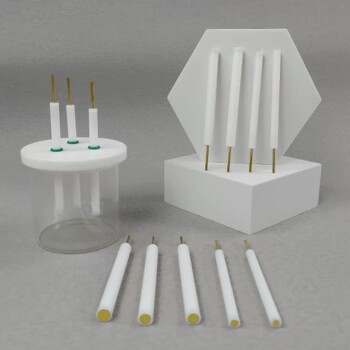
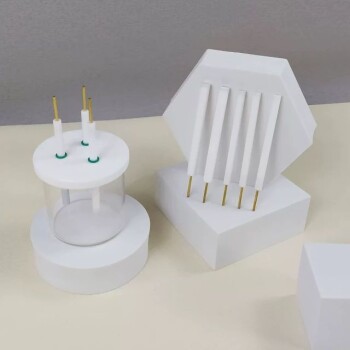
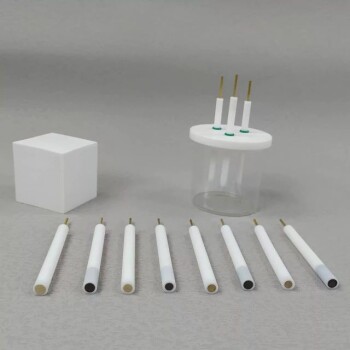
In high-precision labs, contamination is a subtle disaster. This is why multifunctional cells are crafted from:

  • High Borosilicate Glass: For optical clarity and chemical resistance.
  • PTFE (Teflon) Seals: To prevent polymer leaching or corrosion.

The cell body must be an inert vessel. It should contain the experiment, not participate in it.

Quick Reference: The Electrode Roles

Electrode Role Analogy Typical Material
Working The reaction site The Actor on Stage Gold, Glassy Carbon, Sample Material
Counter Completes the circuit The Power Line Platinum, Graphite
Reference Provides fixed potential The Surveyor's Benchmark Ag/AgCl, Calomel

Moving From Force to Precision

If your goal is simply to make a gas or plate a metal, a two-electrode system is fine. It is cost-effective and robust.

But if your goal is insight—if you need to know the exact potential where a molecule oxidizes, or the precise rate of a corrosion mechanism—you cannot rely on a two-electrode setup.

The three-electrode system is the standard for modern research because it acknowledges a fundamental truth: you cannot accurately measure a system that you are simultaneously disrupting.

By isolating the reference point, you gain the ability to see the chemistry as it truly is.

Architect Your Experiment

At KINTEK, we believe that the equipment you use should be as precise as the questions you ask. Whether you need the inert stability of high-quality glass or the exactitude of a calibrated reference electrode, our systems are built to eliminate the noise so you can focus on the signal.

Contact Our Experts

Visual Guide

The Architecture of Certainty: Why Three Electrodes Are Better Than Two Visual Guide

Related Products

Related Articles

Related Products

Lab Electrochemical Workstation Potentiostat for Laboratory Use

Lab Electrochemical Workstation Potentiostat for Laboratory Use

Electrochemical workstations, also known as laboratory electrochemical analyzers, are sophisticated instruments designed for precise monitoring and control in various scientific and industrial processes.

Platinum Sheet Electrode for Battery Lab Applications

Platinum Sheet Electrode for Battery Lab Applications

Platinum sheet is composed of platinum, which is also one of the refractory metals. It is soft and can be forged, rolled and drawn into rod, wire, plate, tube and wire.

Platinum Sheet Electrode for Laboratory and Industrial Applications

Platinum Sheet Electrode for Laboratory and Industrial Applications

Elevate your experiments with our Platinum Sheet Electrode. Crafted with quality materials, our safe and durable models can be tailored to fit your needs.

Glassy Carbon Sheet RVC for Electrochemical Experiments

Glassy Carbon Sheet RVC for Electrochemical Experiments

Discover our Glassy Carbon Sheet - RVC. Perfect for your experiments, this high-quality material will elevate your research to the next level.

Electrode Polishing Material for Electrochemical Experiments

Electrode Polishing Material for Electrochemical Experiments

Looking for a way to polish your electrodes for electrochemical experiments? Our polishing materials are here to help! Follow our easy instructions for best results.

High Purity Gold Platinum Copper Iron Metal Sheets

High Purity Gold Platinum Copper Iron Metal Sheets

Elevate your experiments with our high-purity sheet metal. Gold, platinum, copper, iron, and more. Perfect for electrochemistry and other fields.

Laboratory Jar Mill with Agate Grinding Jar and Balls

Laboratory Jar Mill with Agate Grinding Jar and Balls

Grind your materials with ease using Agate Grinding Jars with Balls. Sizes from 50ml to 3000ml, perfect for planetary and vibration mills.

Custom PTFE Teflon Parts Manufacturer for Acid and Alkali Resistant Chemical Powder Material Scoops

Custom PTFE Teflon Parts Manufacturer for Acid and Alkali Resistant Chemical Powder Material Scoops

Known for its excellent thermal stability, chemical resistance and electrical insulating properties, PTFE is a versatile thermoplastic material.

Assemble Square Lab Press Mold for Laboratory Applications

Assemble Square Lab Press Mold for Laboratory Applications

Achieve perfect sample preparation with Assemble Square Lab Press Mold. Quick disassembly eliminates sample deformation. Perfect for battery, cement, ceramics, and more. Customizable sizes available.

Customizable Laboratory High Temperature High Pressure Reactors for Diverse Scientific Applications

Customizable Laboratory High Temperature High Pressure Reactors for Diverse Scientific Applications

High-pressure lab reactor for precise hydrothermal synthesis. Durable SU304L/316L, PTFE liner, PID control. Customizable volume & materials. Contact us!

Automatic Laboratory Hydraulic Pellet Press Machine for Lab Use

Automatic Laboratory Hydraulic Pellet Press Machine for Lab Use

Experience efficient sample preparation with our Automatic Lab Press Machine. Ideal for material research, pharmacy, ceramics, and more. Features a compact size and hydraulic press functionality with heating plates. Available in various sizes.

Automatic Lab Cold Isostatic Press CIP Machine Cold Isostatic Pressing

Automatic Lab Cold Isostatic Press CIP Machine Cold Isostatic Pressing

Efficiently prepare samples with our Automatic Lab Cold Isostatic Press. Widely used in material research, pharmacy, and electronic industries. Provides greater flexibility and control compared to electric CIPs.

kbr pellet press 2t

kbr pellet press 2t

Introducing the KINTEK KBR Press - a handheld laboratory hydraulic press designed for entry-level users.

Vacuum Hot Press Furnace Machine for Lamination and Heating

Vacuum Hot Press Furnace Machine for Lamination and Heating

Experience clean and precise lamination with Vacuum Lamination Press. Perfect for wafer bonding, thin-film transformations, and LCP lamination. Order now!

Custom PTFE Teflon Parts Manufacturer for Sampling Solution Sample and Dry Powder Spoons

Custom PTFE Teflon Parts Manufacturer for Sampling Solution Sample and Dry Powder Spoons

The PTFE sampling spoon, also known as a solution spoon or sample spoon, is a crucial tool for accurately introducing dry powder samples in various analytical processes. Made from PTFE, these spoons offer excellent chemical stability, corrosion resistance, and non-stick properties, making them ideal for handling delicate and reactive substances in laboratory settings.

Warm Isostatic Press WIP Workstation 300Mpa for High Pressure Applications

Warm Isostatic Press WIP Workstation 300Mpa for High Pressure Applications

Discover Warm Isostatic Pressing (WIP) - A cutting-edge technology that enables uniform pressure to shape and press powdered products at a precise temperature. Ideal for complex parts and components in manufacturing.

Laboratory Sterilizer Lab Autoclave Vertical Pressure Steam Sterilizer for Liquid Crystal Display Automatic Type

Laboratory Sterilizer Lab Autoclave Vertical Pressure Steam Sterilizer for Liquid Crystal Display Automatic Type

Liquid crystal display automatic vertical sterilizer is a safe, reliable and automatic control sterilization equipment, which is composed of heating system, microcomputer control system and overheating and overvoltage protection system.

Custom PTFE Teflon Parts Manufacturer for Magnetic Stirring Bar

Custom PTFE Teflon Parts Manufacturer for Magnetic Stirring Bar

The PTFE magnetic stirring bar, made from high-quality PTFE, offers exceptional resistance to acids, alkalis, and organic solvents, coupled with high-temperature stability and low friction. Ideal for laboratory use, these stirring bars are compatible with standard flask ports, ensuring stability and safety during operations.

Desktop Fast Laboratory Autoclave Sterilizer 35L 50L 90L for Lab Use

Desktop Fast Laboratory Autoclave Sterilizer 35L 50L 90L for Lab Use

The desktop fast steam sterilizer is a compact and reliable device used for rapid sterilization of medical, pharmaceutical, and research items. It efficiently sterilizes surgical instruments, glassware, medicines, and resistant materials, making it suitable for various applications.

Laboratory Disc Rotary Mixer for Efficient Sample Mixing and Homogenization

Laboratory Disc Rotary Mixer for Efficient Sample Mixing and Homogenization

Efficient Laboratory Disc Rotary Mixer for Precise Sample Mixing, Versatile for Various Applications, DC Motor and Microcomputer Control, Adjustable Speed and Angle.


Leave Your Message