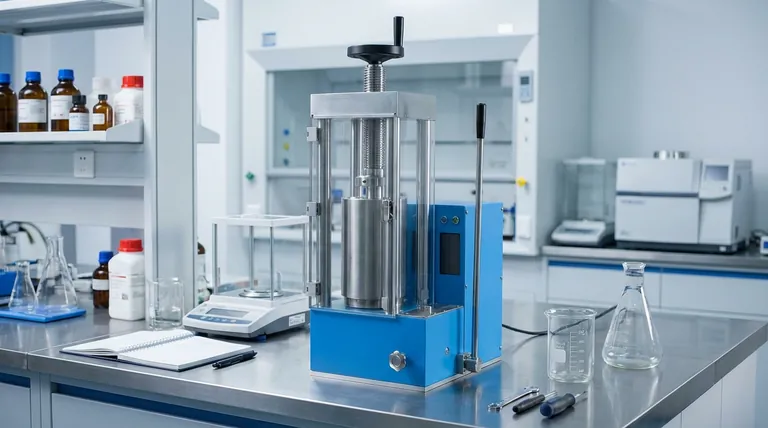
The Hidden Flaw in Brute Force
In materials science, failure often begins with a secret. It’s a microscopic void, an invisible stress line, a subtle variation in density deep within a component that looks perfect on the outside.
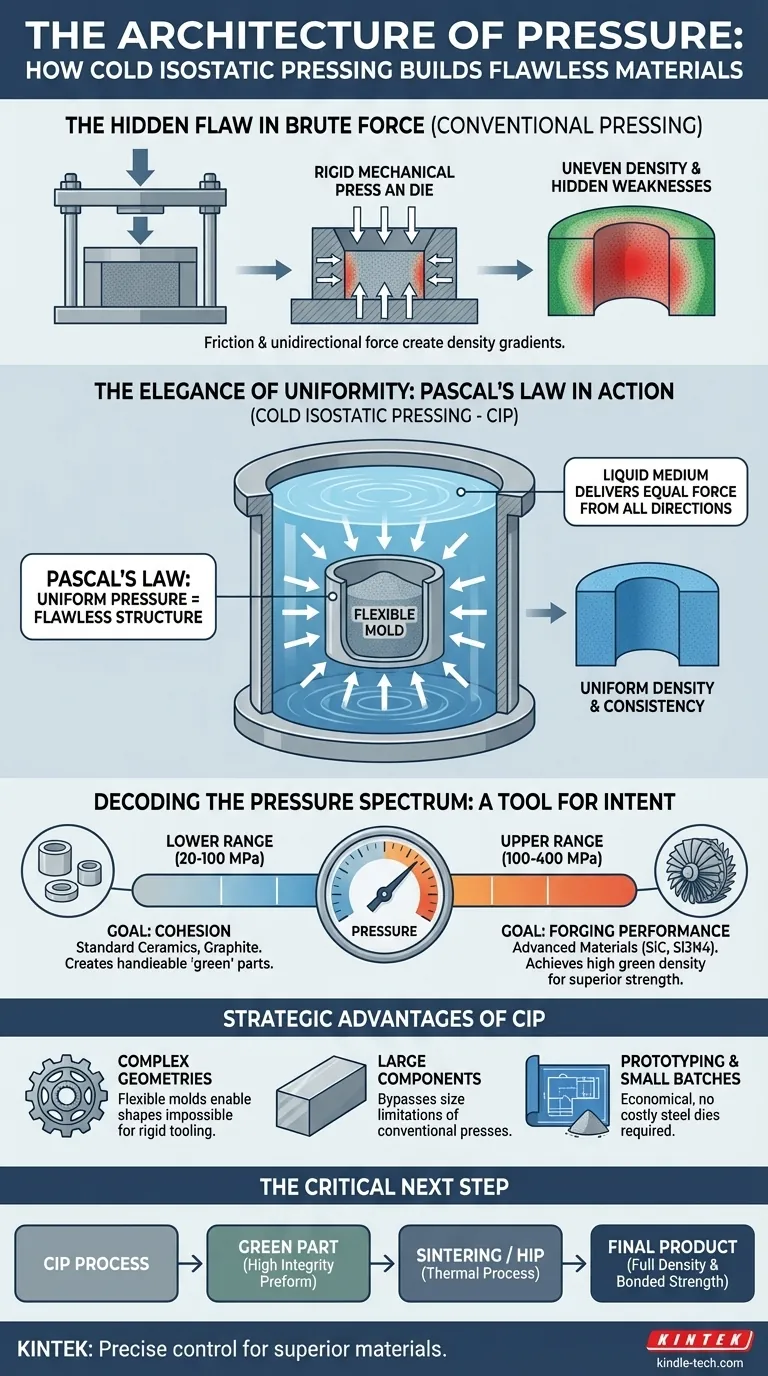
Conventional mechanical pressing, for all its power, often creates these secrets. By applying force from one or two directions, it engages in a brute-force argument with the material. Friction against the die walls creates resistance, leaving the core of the part less compacted than the edges.
This is not a failure of force, but a failure of communication. The pressure isn't distributed evenly, and the result is a preform with built-in, hidden weaknesses.
The Elegance of Uniformity: Pascal's Law in Action
Cold Isostatic Pressing (CIP) operates on a profoundly different and more elegant principle. Instead of a solid die, it uses a liquid.
The powder, sealed in a flexible mold, is submerged in a fluid-filled pressure chamber. As an external pump pressurizes the fluid, the force is transmitted equally to every single point on the mold’s surface. This is Pascal's Law, and it is the key to perfection.
The liquid medium acts as a perfect messenger, delivering the same compressive force from all directions simultaneously. There are no pressure gradients, no die-wall friction, and no internal stresses. The powder particles are simply encouraged, from every angle, to find their most stable and compact arrangement.
This is the engineer's romance: a fundamental law of physics applied to solve a complex manufacturing problem with beautiful simplicity.
Decoding the Pressure Spectrum: A Tool for Intent
The operating pressure in CIP, ranging from 20 to 400 MPa, is not just a number. It's a spectrum of intent, tailored to the material and the ambition for the final product.
The Lower Range (20-100 MPa): The Goal of Cohesion
At the lower end of the spectrum, the goal is often simple cohesion. For standard ceramics or graphite powders, this gentle, uniform squeeze is enough to create a "green" part that is solid, handleable, and ready for the next stage of processing. It’s about creating order from chaos efficiently.
The Upper Range (100-400 MPa): Forging Performance
For advanced materials like silicon carbide or silicon nitride, the challenge is greater. These hard, fine powders resist compaction. Overcoming this requires immense pressure.
Pushing towards 400 MPa is about forcing particles into an extremely tight configuration, achieving a high "green density." This initial density is not just a metric; it's a predictor of the final component's strength, integrity, and performance. High green density minimizes shrinkage and distortion during the final sintering phase, ensuring the part meets exacting specifications.
A Strategic Choice, Not a Universal Solution
CIP is a specialized tool, and its brilliance lies in knowing when to use it. The decision is often driven by a desire to overcome the limitations of traditional methods.
When to Choose CIP:
- Complex Geometries: Since the "die" is a flexible mold, CIP can produce intricate shapes that are impossible for rigid tooling.
- Large Components: It bypasses the size limitations of conventional presses, enabling the creation of large, uniform billets.
- Prototyping & Small Batches: It avoids the massive upfront cost of designing and fabricating hardened steel dies, making it economically ideal for research or low-volume production.
The Critical Next Step
It is crucial to remember that CIP produces an intermediate product. The resulting green part has integrity but lacks the final bonded strength. It is a perfect blueprint, but the structure is not yet built.
A subsequent thermal process, typically sintering or hot isostatic pressing (HIP), is required to fuse the particles together and achieve the material's final, full-density properties.
| Pressure Range (MPa) | Primary Goal | Typical Materials |
|---|---|---|
| 20 - 100 | Basic Consolidation, Handleable Preforms | Standard Ceramics, Graphite |
| 100 - 400 | High Green Density, Superior Performance | Advanced Ceramics (SiC, Si3N4), Refractory Metals |
Mastering the architecture of pressure—applying it with precision and uniformity—is the key to unlocking the potential of advanced materials. It transforms a simple powder into a preform of unparalleled consistency, setting the stage for a final product free of hidden flaws. At KINTEK, we provide the laboratory-grade equipment that gives you precise control over this elegant process.
To achieve superior density and uniformity in your own materials, Contact Our Experts
Visual Guide
Related Products
- Electric Split Lab Cold Isostatic Press CIP Machine for Cold Isostatic Pressing
- Electric Lab Cold Isostatic Press CIP Machine for Cold Isostatic Pressing
- Automatic Lab Cold Isostatic Press CIP Machine Cold Isostatic Pressing
- Manual Cold Isostatic Pressing Machine CIP Pellet Press
- Warm Isostatic Press for Solid State Battery Research