Blog The Architecture of Stability: Mastering Control with Double-Layer Electrolytic Cells
The Architecture of Stability: Mastering Control with Double-Layer Electrolytic Cells

The Architecture of Stability: Mastering Control with Double-Layer Electrolytic Cells

1 week ago

Chemistry is often taught as a series of equations. A + B yields C.

But in the laboratory, chemistry is actually a battle against variables.

A one-degree fluctuation in temperature can alter a reaction rate. A trace amount of oxygen can poison a reduction surface. The "perfect" experiment on paper falls apart because the physical environment wasn't compliant.

This is why the Double-Layer Water-Bath Electrolytic Cell is more than just glassware. It is an engineered environment designed to impose order on thermodynamic chaos.

The Illusion of Ambient Control

We tend to assume the room temperature is constant. It isn't.

More importantly, electrochemical reactions are rarely thermally neutral. They generate heat—specifically Joule heating—as current passes through the electrolyte. Without intervention, your electrolyte warms up, the viscosity changes, diffusion rates shift, and your data becomes a moving target.

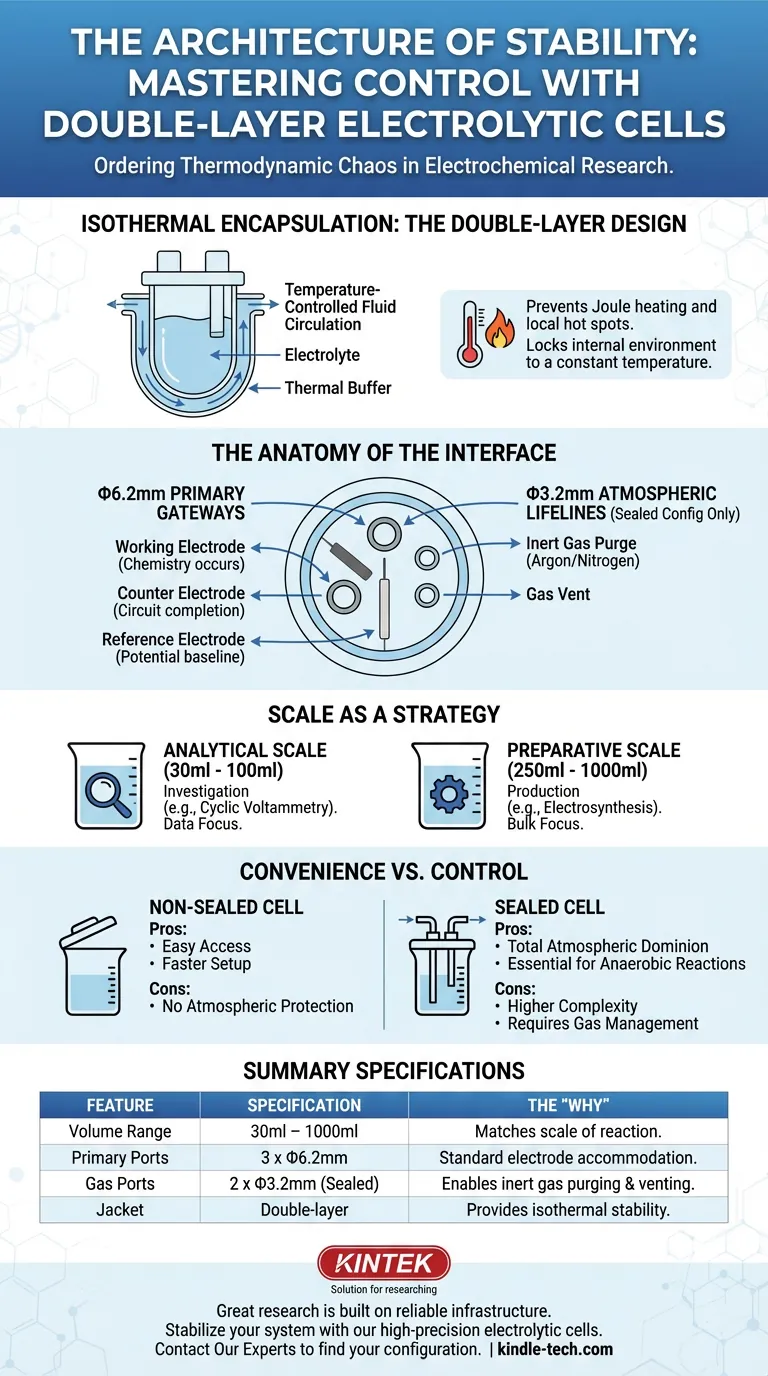
The double-layer design solves this through isothermal encapsulation.

By circulating temperature-controlled fluid through an outer jacket, the cell acts as a massive thermal buffer. It prevents local hot spots on electrode surfaces and locks the internal environment to a specific temperature. It turns a variable into a constant.

The Anatomy of the Interface

A cell is defined by how it interacts with the outside world. This interface is governed by its aperture configuration.

The standard industry design is not random; it is a calculated layout intended for the classic Three-Electrode System.

The Primary Gateways (Φ6.2mm)

Whether sealed or non-sealed, the cell typically features three primary ports with a 6.2mm diameter. These are the docking stations for your core sensors:

  • The Working Electrode: Where the chemistry happens.
  • The Counter Electrode: Completing the circuit.
  • The Reference Electrode: Providing the potential baseline (often via a Luggin capillary).

The Atmospheric Lifelines (Φ3.2mm)

This is where the distinction between "good enough" and "precision" lies.

In a sealed configuration, the cell includes two additional, smaller ports with a 3.2mm diameter.

These are not vestigial. They are the lifelines for gas management. They allow you to purge the system with inert gases like argon or nitrogen, removing oxygen for anaerobic experiments. They allow the cell to breathe without becoming contaminated.

Scale as a Strategy

The volume of your cell is not just about how much liquid you have. It is a strategic decision about the intent of your research.

Standard volumes range from 30ml to 1000ml, but the utility shifts across this spectrum:

  1. Analytical Scale (30ml - 100ml): These are built for investigation. You use them for cyclic voltammetry or when your electrolyte is expensive (e.g., ionic liquids). The goal is data, not product.

  2. Preparative Scale (250ml - 1000ml): These are built for production. When moving to bulk electrolysis or electrosynthesis, you need a larger thermal mass and reservoir to prevent rapid depletion of reactants.

The Trade-off: Convenience vs. Control

Every engineer knows that optimization requires trade-offs. The same applies to selecting your cell type.

The Non-Sealed Cell

  • Pros: Easy access, faster setup, robust for air-stable reactions.
  • Cons: No protection against atmospheric interference.

The Sealed Cell

  • Pros: Total atmospheric dominion. Essential for reduction reactions sensitive to oxygen.
  • Cons: Higher complexity. Requires gas lines, septa, and disciplined handling.

Summary Specifications

For the engineer who thinks in specs, here is the breakdown of the standard architecture:

Feature Specification The "Why"
Volume Range 30ml – 1000ml Matches the scale of reaction (Analytical vs. Bulk).
Primary Ports 3 x Φ6.2mm Accommodates standard Working, Counter, and Reference electrodes.
Gas Ports 2 x Φ3.2mm (Sealed units only) Enables inert gas purging and venting.
Jacket Double-layer Provides isothermal stability via water bath circulation.

Conclusion

In experimental science, you cannot control what you cannot measure. But more importantly, you cannot measure accurately what you cannot stabilize.

The double-layer electrolytic cell is a vessel, but its function is insurance. It ensures that when you see a spike in your data, it’s because of your chemistry, not because the AC turned off in the lab.

At KINTEK, we understand that great research is built on reliable infrastructure. We provide high-precision electrolytic cells designed to eliminate the variables that keep you up at night.

Ready to stabilize your system? Contact Our Experts to find the exact configuration for your research needs.

Visual Guide
The Architecture of Stability: Mastering Control with Double-Layer Electrolytic Cells Visual Guide

Related Products

Related Articles

Related Products

Double-Layer Water Bath Electrolytic Electrochemical Cell

Double-Layer Water Bath Electrolytic Electrochemical Cell

Discover the temperature-controllable electrolytic cell with a double-layer water bath, corrosion resistance, and customization options. Complete specifications included.

Battery Lab Equipment Battery Capacity and Comprehensive Tester

Battery Lab Equipment Battery Capacity and Comprehensive Tester

The scope of application of the battery comprehensive tester can be tested: 18650 and other cylindrical, square lithium batteries, polymer batteries, nickel-cadmium batteries, nickel-metal hydride batteries, lead-acid batteries, etc.

H-Type Double-Layer Optical Electrolytic Electrochemical Cell with Water Bath

H-Type Double-Layer Optical Electrolytic Electrochemical Cell with Water Bath

Double-layer H-type optical water bath electrolytic cells, with excellent corrosion resistance and a wide range of specifications available. Customization options are also available.

Super Sealed Electrolytic Electrochemical Cell

Super Sealed Electrolytic Electrochemical Cell

Super-sealed electrolytic cell offers enhanced sealing capabilities, making it ideal for experiments that require high airtightness.

Electrolytic Electrochemical Cell with Five-Port

Electrolytic Electrochemical Cell with Five-Port

Streamline your laboratory consumables with Kintek's Electrolytic Cell with five-port design. Choose from sealed and non-sealed options with customizable electrodes. Order now.

Double Layer Five-Port Water Bath Electrolytic Electrochemical Cell

Double Layer Five-Port Water Bath Electrolytic Electrochemical Cell

Experience optimal performance with our Water Bath Electrolytic Cell. Our double-layer, five-port design boasts corrosion resistance and longevity. Customizable to fit your specific needs. View specs now.

Customizable PEM Electrolysis Cells for Diverse Research Applications

Customizable PEM Electrolysis Cells for Diverse Research Applications

Custom PEM test cell for electrochemical research. Durable, versatile, for fuel cells & CO2 reduction. Fully customizable. Get a quote!

Quartz Electrolytic Electrochemical Cell for Electrochemical Experiments

Quartz Electrolytic Electrochemical Cell for Electrochemical Experiments

Looking for a reliable quartz electrochemical cell? Our product boasts excellent corrosion resistance and complete specifications. With high-quality materials and good sealing, it's both safe and durable. Customize to meet your needs.

PTFE Electrolytic Cell Electrochemical Cell Corrosion-Resistant Sealed and Non-Sealed

PTFE Electrolytic Cell Electrochemical Cell Corrosion-Resistant Sealed and Non-Sealed

Choose our PTFE Electrolytic Cell for reliable, corrosion-resistant performance. Customize specifications with optional sealing. Explore now.

Optical Water Bath Electrolytic Electrochemical Cell

Optical Water Bath Electrolytic Electrochemical Cell

Upgrade your electrolytic experiments with our Optical Water Bath. With controllable temperature and excellent corrosion resistance, it's customizable for your specific needs. Discover our complete specifications today.

Electrolytic Electrochemical Cell for Coating Evaluation

Electrolytic Electrochemical Cell for Coating Evaluation

Looking for corrosion-resistant coating evaluation electrolytic cells for electrochemical experiments? Our cells boast complete specifications, good sealing, high-quality materials, safety, and durability. Plus, they're easily customizable to meet your needs.

H Type Electrolytic Cell Triple Electrochemical Cell

H Type Electrolytic Cell Triple Electrochemical Cell

Experience versatile electrochemical performance with our H-type Electrolytic Cell. Choose from membrane or non-membrane sealing, 2-3 hybrid configurations. Learn more now.

Side Window Optical Electrolytic Electrochemical Cell

Side Window Optical Electrolytic Electrochemical Cell

Experience reliable and efficient electrochemical experiments with a side window optical electrolytic cell. Boasting corrosion resistance and complete specifications, this cell is customizable and built to last.

Customizable Swagelok Type Test Cells for Advanced Battery Research Electrochemical Analysis

Customizable Swagelok Type Test Cells for Advanced Battery Research Electrochemical Analysis

The KINTEK Swagelok-type test cell is a modular, T-shaped device constructed from high-quality, chemically inert materials.

Electrolytic Electrochemical Cell Gas Diffusion Liquid Flow Reaction Cell

Electrolytic Electrochemical Cell Gas Diffusion Liquid Flow Reaction Cell

Looking for a high-quality gas diffusion electrolysis cell? Our liquid flow reaction cell boasts exceptional corrosion resistance and complete specifications, with customizable options available to suit your needs. Contact us today!

FS Electrochemical Hydrogen Fuel Cells for Diverse Applications

FS Electrochemical Hydrogen Fuel Cells for Diverse Applications

KINTEK's FS Electrochemical Cell: Modular PEM fuel cell stack for R&D and training. Acid-resistant, scalable, and customizable for reliable performance.

Flat Corrosion Electrolytic Electrochemical Cell

Flat Corrosion Electrolytic Electrochemical Cell

Discover our flat corrosion electrolytic cell for electrochemical experiments. With exceptional corrosion resistance and complete specifications, our cell guarantees optimal performance. Our high-quality materials and good sealing ensure a safe and durable product, and customization options are available.

Thin-Layer Spectral Electrolysis Electrochemical Cell

Thin-Layer Spectral Electrolysis Electrochemical Cell

Discover the benefits of our thin-layer spectral electrolysis cell. Corrosion-resistant, complete specifications, and customizable for your needs.

Customizable CO2 Reduction Flow Cell for NRR ORR and CO2RR Research

Customizable CO2 Reduction Flow Cell for NRR ORR and CO2RR Research

The cell is meticulously crafted from high-quality materials to ensure chemical stability and experimental accuracy.

Button Battery Disassembly and Sealing Mold for Lab Use

Button Battery Disassembly and Sealing Mold for Lab Use

The simple sealing and disassembly mold can be directly used on ordinary tablet presses, which can save costs, is convenient and fast, and can be used to encapsulate and disassemble button batteries. Other specifications can be customized.


Leave Your Message