Blog The Invisible Architecture of Precision: Mastery Before the Current Flows
The Invisible Architecture of Precision: Mastery Before the Current Flows

The Invisible Architecture of Precision: Mastery Before the Current Flows

1 week ago

The Invisible Architecture of Precision: Mastery Before the Current Flows

Data is a lagging indicator of preparation.

In the laboratory, we are often seduced by the result—the curve on the monitor, the efficiency calculation, the publication. But in electrochemistry, the result is merely the final echo of a process that began hours before the potentiostat was turned on.

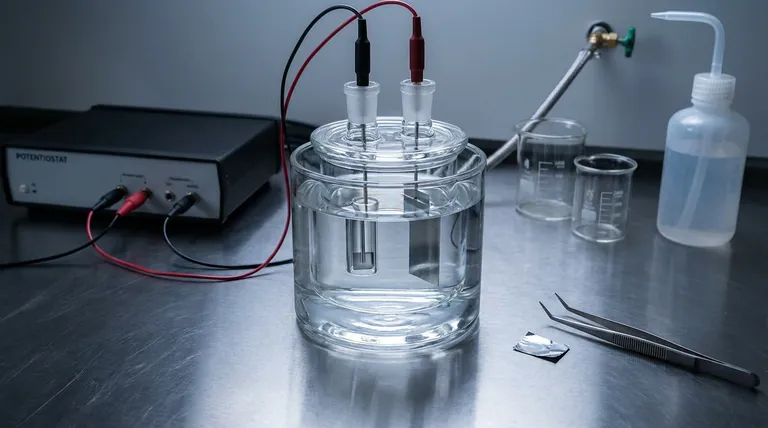
The double-layer water-bath electrolytic cell is a marvel of thermal control and reaction isolation. Yet, it is an unforgiving instrument. It does not tolerate shortcuts.

If you treat the setup as a formality, you introduce noise. If you treat it as a ritual, you manufacture truth.

Here is the anatomy of a flawless setup, designed to remove the human variable from the scientific equation.

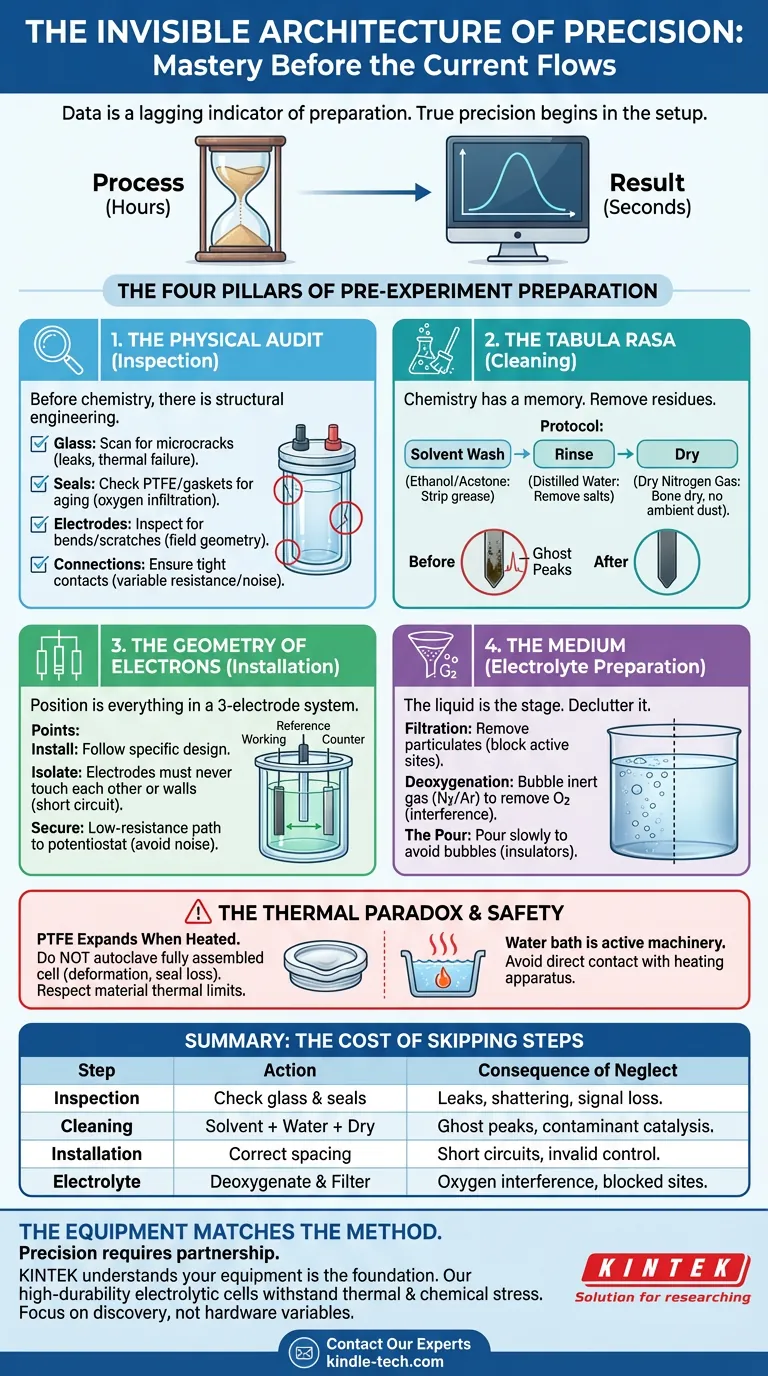
The Four Pillars of Pre-Experiment Preparation

There is a difference between a setup that looks ready and one that is ready. That difference is usually found in the invisible details.

1. The Physical Audit (Inspection)

Before chemistry, there is structural engineering.

A double-layer cell operates under thermal stress. The outer jacket circulates water; the inner chamber holds the reaction. A microscopic fracture in the glass is not just a cosmetic defect; under the thermal expansion of a water bath, it is a catastrophic failure waiting to happen.

The Checklist:

  • The Glass: Scan for microcracks. If the light catches a fracture, the cell is compromised.
  • The Seals: PTFE (Teflon) is miraculous but finite. Check the lid and gaskets for brittleness or aging. A bad seal means oxygen infiltration, and oxygen is the enemy of precision.
  • The Electrodes: These are your sensors. A bent auxiliary electrode or a scratched working electrode changes the geometry of the field.
  • The Connections: A loose wire is a variable resistor you didn’t account for. Ensure contacts are tight.

2. The Tabula Rasa (Cleaning)

Chemistry has a memory.

Residues from last week’s experiment are the ghosts that haunt today’s data. If you skip meticulous cleaning, you are not testing a new reaction; you are testing a mixture of your current hypothesis and your past negligence.

The Protocol:

  • Solvent Wash: Use ethanol or acetone to strip organic grease.
  • The Rinse: Follow with distilled or deionized water. You are removing the solvent and inorganic salts.
  • The Dry: Use dry nitrogen gas. Do not let it air dry with ambient dust. The cell must be bone dry.

3. The Geometry of Electrons (Installation)

In a three-electrode system, position is everything.

The electric field is shaped by the physical location of your components. If the working electrode touches the wall, you have a short. If the reference electrode is too far, you introduce uncompensated resistance.

  • Install according to the specific design.
  • Isolate the electrodes. They must never touch each other or the glass walls.
  • Secure the path. The wire connecting to the potentiostat must offer low resistance. High resistance here looks like noise in your data.

4. The Medium (Electrolyte Preparation)

The liquid is the stage. If the stage is cluttered, the actors cannot perform.

  • Filtration: If there are particulates, filter them. A particle sticking to an electrode surface blocks the reaction site.
  • Deoxygenation: This is the step most often rushed. Oxygen is electrochemically active. If you do not bubble inert gas (Nitrogen/Argon) through the solution, you will see oxygen reduction peaks that mimic or mask your data.
  • The Pour: Pour slowly. Bubbles are insulators. A bubble on your electrode is a blind spot in your vision.

The Thermal Paradox

The double-layer cell exists to control temperature, but temperature control introduces material constraints.

The outer jacket keeps the internal environment uniform. Reaction rates and diffusion coefficients are slaves to temperature; without the water bath, they fluctuate wildly.

However, you must respect the materials. PTFE expands when heated.

If you autoclave the fully assembled cell, the PTFE lid will deform and never fit again. You can sterilize the glass, but the plastics have thermal limits. Respect the coefficient of expansion, or you will lose your seal.

Safety as a System

The water bath is an active energy source. It gets hot.

The cell contains chemicals.

Avoid direct skin contact with the heating apparatus. Treat the water bath not as a bucket of water, but as a piece of active machinery.

Summary: The Cost of skipping Steps

We often skip steps to save time. But a failed experiment costs days. A rigorous setup costs minutes.

Step The Action The Consequence of Neglect
Inspection Check glass & seals Leaks, thermal shattering, signal loss.
Cleaning Solvent + Water + Dry Ghost peaks, catalysis from contaminants.
Installation Correct spacing Short circuits, invalid potential control.
Electrolyte Deoxygenate & Filter Oxygen interference, blocked active sites.

The Equipment Matches the Method

You can have the most disciplined process in the world, but you cannot overcome the limitations of inferior hardware. Precision requires a partnership between the scientist's method and the manufacturer's engineering.

At KINTEK, we understand that your equipment is the foundation of your research. We specialize in lab equipment and consumables—including high-durability electrolytic cells—that are built to withstand the rigors of thermal stress and chemical exposure. We build the reliability so you can focus on the discovery.

Don't let your hardware be the variable you can't control.

Contact Our Experts

Visual Guide

The Invisible Architecture of Precision: Mastery Before the Current Flows Visual Guide

Related Products

Related Articles

Related Products

Platinum Sheet Electrode for Battery Lab Applications

Platinum Sheet Electrode for Battery Lab Applications

Platinum sheet is composed of platinum, which is also one of the refractory metals. It is soft and can be forged, rolled and drawn into rod, wire, plate, tube and wire.

Button Battery Disassembly and Sealing Mold for Lab Use

Button Battery Disassembly and Sealing Mold for Lab Use

The simple sealing and disassembly mold can be directly used on ordinary tablet presses, which can save costs, is convenient and fast, and can be used to encapsulate and disassemble button batteries. Other specifications can be customized.

Glassy Carbon Sheet RVC for Electrochemical Experiments

Glassy Carbon Sheet RVC for Electrochemical Experiments

Discover our Glassy Carbon Sheet - RVC. Perfect for your experiments, this high-quality material will elevate your research to the next level.

Manual button battery sealing machine

Manual button battery sealing machine

The manual button battery sealing machine is a high-precision packaging device designed specifically for small button batteries (such as CR2032, LR44 and other models). It is suitable for laboratory research and development, small batch production and teaching demonstrations.

Manual button battery sealing machine (digital display)

Manual button battery sealing machine (digital display)

The manual button battery sealing machine is a small device specially used for button battery packaging. It is easy to operate and suitable for laboratories and small batch production to ensure that the battery is firmly sealed and improve production efficiency.

XRF & KBR plastic ring lab Powder Pellet Pressing Mold for FTIR

XRF & KBR plastic ring lab Powder Pellet Pressing Mold for FTIR

Get precise XRF samples with our plastic ring lab powder pellet pressing mold. Fast tableting speed and customizable sizes for perfect molding every time.

Cylindrical Press Mold with Scale for Lab

Cylindrical Press Mold with Scale for Lab

Discover precision with our Cylindrical Press Mold. Ideal for high-pressure applications, it molds various shapes and sizes, ensuring stability and uniformity. Perfect for lab use.

Laboratory manual slicer

Laboratory manual slicer

Manual microtome is a high-precision cutting device designed for laboratories, industry and medical fields. It is suitable for the preparation of thin slices of various materials such as paraffin samples, biological tissues, battery materials, food, etc.

Vacuum Cold Trap Direct Cold Trap Chiller

Vacuum Cold Trap Direct Cold Trap Chiller

Improve vacuum system efficiency and extend pump life with our Direct Cold Trap. No chilling fluid required, compact design with swivel casters. Stainless steel and glass options available.

Oil Free Diaphragm Vacuum Pump for Laboratory and Industrial Use

Oil Free Diaphragm Vacuum Pump for Laboratory and Industrial Use

Oil-free diaphragm vacuum pump for labs: clean, reliable, chemical-resistant. Ideal for filtration, SPE, and rotary evaporation. Maintenance-free operation.

Laboratory Benchtop Water Circulating Vacuum Pump for Lab Use

Laboratory Benchtop Water Circulating Vacuum Pump for Lab Use

Need a water circulating vacuum pump for your lab or small-scale industry? Our Benchtop Water Circulating Vacuum Pump is perfect for evaporation, distillation, crystallization, and more.

Variable Speed Peristaltic Pump

Variable Speed Peristaltic Pump

KT-VSP Series Smart Variable Speed Peristaltic Pumps offer precise flow control for labs, medical, and industrial applications. Reliable, contamination-free liquid transfer.

Laboratory Jaw Crusher

Laboratory Jaw Crusher

Discover the small jaw crusher for efficient, flexible, and affordable crushing in labs and small mines. Ideal for coal, ores, and rocks. Learn more now!

Molybdenum Disilicide (MoSi2) Thermal Elements Electric Furnace Heating Element

Molybdenum Disilicide (MoSi2) Thermal Elements Electric Furnace Heating Element

Discover the power of Molybdenum Disilicide (MoSi2) Heating Element for high-temperature resistance. Unique oxidation resistance with stable resistance value. Learn more about its benefits now!

1700℃ Muffle Oven Furnace for Laboratory

1700℃ Muffle Oven Furnace for Laboratory

Get superior heat control with our 1700℃ Muffle Furnace. Equipped with intelligent temperature microprocessor, TFT touch screen controller & advanced insulation materials for precise heating up to 1700C. Order now!

High Performance Laboratory Freeze Dryer

High Performance Laboratory Freeze Dryer

Advanced lab freeze dryer for lyophilization, preserving biological & chemical samples efficiently. Ideal for biopharma, food, and research.

Non Consumable Vacuum Arc Induction Melting Furnace

Non Consumable Vacuum Arc Induction Melting Furnace

Explore the benefits of Non-Consumable Vacuum Arc Furnace with high melting point electrodes. Small, easy to operate & eco-friendly. Ideal for laboratory research on refractory metals & carbides.

Circulating Water Vacuum Pump for Laboratory and Industrial Use

Circulating Water Vacuum Pump for Laboratory and Industrial Use

Efficient circulating water vacuum pump for labs - oil-free, corrosion-resistant, quiet operation. Multiple models available. Get yours now!

Precision Machined Zirconia Ceramic Ball for Engineering Advanced Fine Ceramics

Precision Machined Zirconia Ceramic Ball for Engineering Advanced Fine Ceramics

zirconia ceramic ball have the characteristics of high strength, high hardness, PPM wear level, high fracture toughness, good wear resistance, and high specific gravity.

Laboratory Rotary Vane Vacuum Pump for Lab Use

Laboratory Rotary Vane Vacuum Pump for Lab Use

Experience high vacuum pumping speed and stability with our UL-certified Rotary Vane Vacuum Pump. Two-shift gas ballast valve and dual oil protection. Easy maintenance and repair.


Leave Your Message