The Hidden Flaw in the Squeeze
Imagine an engineer designing a complex ceramic component—a turbine blade, perhaps. The powder is meticulously prepared, the mold is perfect. A powerful press applies immense force, and a seemingly solid part emerges.
But after the final, high-temperature sintering stage, cracks appear. Or the part warps, its precise dimensions lost.
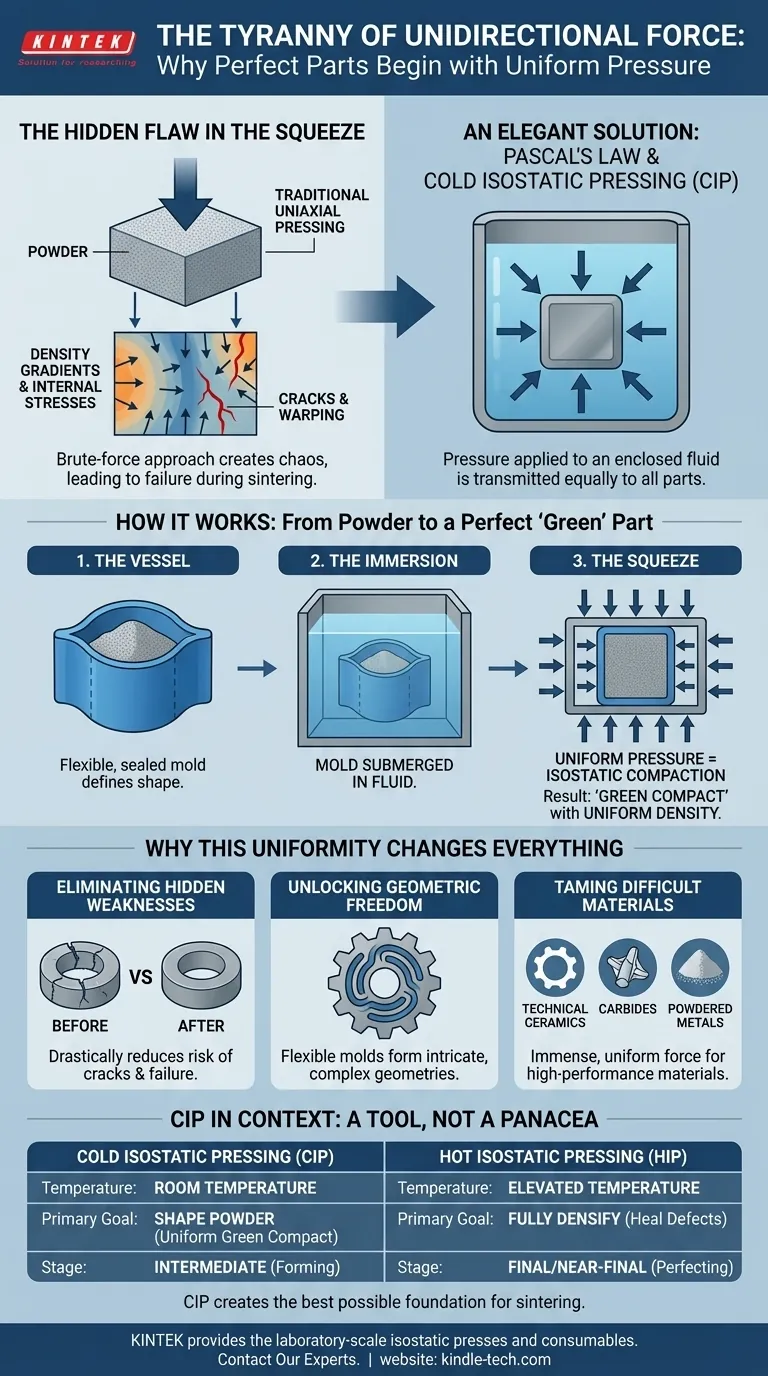
The failure wasn't in the material or the heat. It was in the pressure itself. Traditional uniaxial pressing—squeezing from one direction—is a brute-force approach that creates a hidden world of chaos within the material. Density varies, internal stresses build up, and weak points form. It plants the seeds of failure before the process is even halfway done.
An Elegant Solution from a 17th-Century Principle
The solution to this modern engineering problem is found in a principle from the 1600s: Pascal's Law. It states that pressure applied to an enclosed fluid is transmitted equally, and undiminished, to all parts of the fluid.
Think of an object deep underwater. The crushing pressure doesn't just come from above; it comes from every direction at once.
Cold Isostatic Pressing (CIP) harnesses this beautifully simple principle. Instead of fighting against the powder with a rigid die, it surrounds it with a liquid and lets the fundamental laws of physics do the work. This is the engineer's romance: solving a complex problem with an elegant, foundational truth.
How It Works: From Powder to a Perfect 'Green' Part
The CIP process is as logical as it is effective. It exchanges mechanical complexity for fluid dynamic certainty.
-
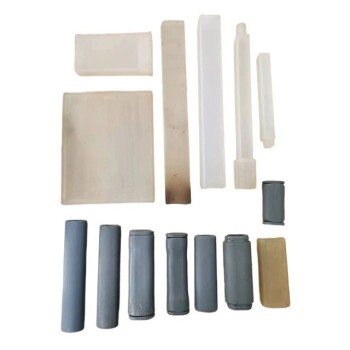
The Vessel: A powdered material is loaded into a flexible, sealed mold, often made of rubber or urethane. This mold acts as a barrier, defining the part's shape.
-
The Immersion: The sealed mold is submerged in a pressure chamber filled with a liquid—typically water or oil.
-
The Squeeze: An external pump pressurizes the chamber. The fluid, governed by Pascal's Law, transmits this pressure uniformly onto every single point of the mold's surface.
The powder inside isn't just compacted; it's isostatically compacted. The result is a "green compact," a part with enough strength to be handled but not yet fully solidified. Crucially, it is almost perfectly uniform in density.
Why This Uniformity Changes Everything
Achieving a uniform green compact is not a minor improvement. It fundamentally changes the outcome of the entire manufacturing process.
Eliminating Hidden Weaknesses
Because pressure is applied from all sides, the density gradients and internal stresses common in uniaxial pressing simply vanish. This creates a part that is internally consistent, drastically reducing the risk of cracks or failure during the final sintering phase. You gain predictability.
Unlocking Geometric Freedom
Rigid dies limit you to simple shapes. A flexible mold and fluid pressure can form intricate, complex geometries—undercuts, internal channels, and non-symmetrical designs—that would be impossible otherwise. It removes the constraints on innovation.
Taming Difficult Materials
Advanced materials like technical ceramics, carbides, and powdered metals are notoriously difficult to compact. Their hardness and particle characteristics resist traditional pressing. CIP provides the immense, uniform force needed to form them into a viable green body, unlocking their high-performance potential.
CIP in Context: A Tool, Not a Panacea
It's crucial to understand where Cold Isostatic Pressing fits within a larger workflow. It’s a specialized tool for a specific, critical job.
-
It's an Intermediate Step: CIP produces a green compact. This part requires a subsequent thermal treatment, like sintering, to fuse the particles and achieve its final density and mechanical properties. CIP creates the best possible starting point for that final step.
-
It's Not Hot Isostatic Pressing (HIP): The two are often confused, but serve different purposes.
| Process | Temperature | Primary Goal | Stage |
|---|---|---|---|
| Cold Isostatic Pressing (CIP) | Room Temperature | Shape powder into a uniform green compact | Intermediate |
| Hot Isostatic Pressing (HIP) | Elevated Temperature | Fully densify a part, heal defects | Final / Near-Final |
In essence, CIP is for forming, while HIP is for perfecting.
The Foundation of Flawless Components
The pursuit of perfection in manufacturing is often a battle against hidden variables and uncertainty. The subtle, non-uniform pressures of conventional methods create deep-seated problems that only manifest at the end, resulting in wasted time, material, and effort.
Cold Isostatic Pressing offers a more intelligent approach. By starting with a foundation of perfect uniformity, it ensures that every subsequent step in the process builds upon a stable, predictable base. It’s a method that replaces guesswork with the certainty of physics.
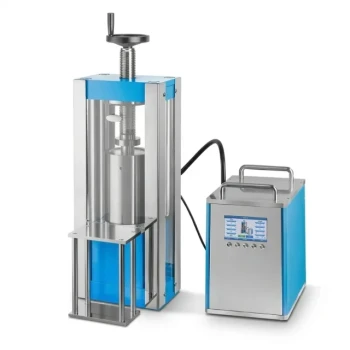
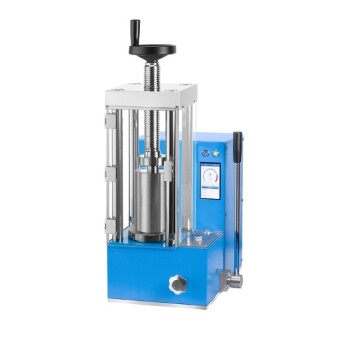
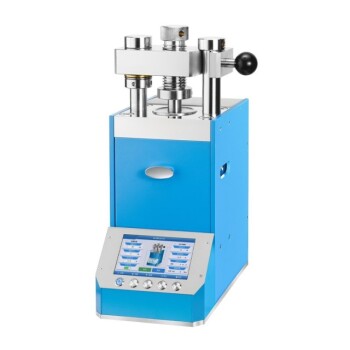
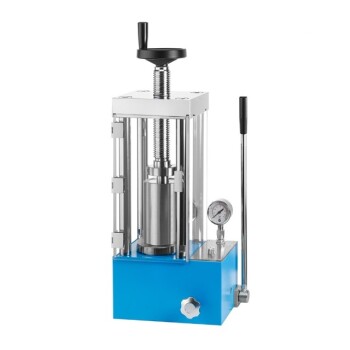
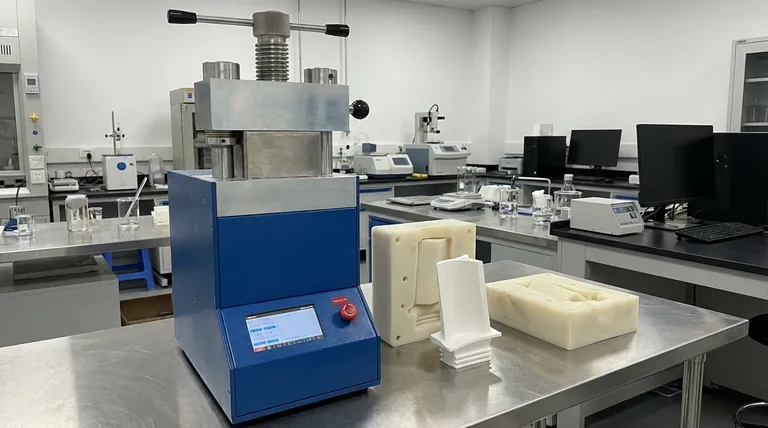
Achieving this level of precision and control requires specialized equipment designed for repeated, high-pressure cycles. KINTEK provides the laboratory-scale isostatic presses and consumables necessary to turn these principles into tangible results, enabling researchers and engineers to build better parts from the ground up. If you are ready to move beyond the limitations of traditional pressing, Contact Our Experts.
Visual Guide
Related Products
- Electric Split Lab Cold Isostatic Press CIP Machine for Cold Isostatic Pressing
- Electric Lab Cold Isostatic Press CIP Machine for Cold Isostatic Pressing
- Automatic Lab Cold Isostatic Press CIP Machine Cold Isostatic Pressing
- Manual Cold Isostatic Pressing Machine CIP Pellet Press
- Warm Isostatic Press for Solid State Battery Research