You’ve been here before. You’ve spent weeks, maybe months, trying to perfect a new material synthesis in your lab’s rotary kiln. The chemistry is sound. The temperature profile is dialed in. Yet the results are a frustrating roller coaster. One batch is perfect—exactly the crystal phase and morphology you need. The next, under the exact same settings, is under-processed. The one after that is burnt.
You’re stuck in a loop of endless tweaking, burning through expensive precursor materials and even more valuable time. Your project is stalled, and you’re starting to question if the process is even scalable.
Chasing Ghosts: The Vicious Cycle of Trial and Error
This experience is incredibly common in materials science labs and R&D departments. When faced with inconsistent output from a rotary kiln, the team's reaction is predictable. We start chasing ghosts:
- "Let's re-calibrate the thermocouples. Maybe the temperature is off."
- "Let's adjust the ramp rate. Maybe we're heating it too quickly."
- "Let's change the gas flow. Maybe the atmosphere isn't right."
- "Let's tweak the precursor formula. Maybe the chemistry is too sensitive."
Each adjustment requires a new set of runs, more analysis, and more time. The commercial consequences are severe. Project timelines stretch from months to years. R&D costs balloon, eating into your budget. Most importantly, you lose confidence in your process. How can you recommend scaling up a process that you can't even get to work reliably at the lab scale?
This cycle of failure happens because we are often trying to solve the wrong problem.
It’s Not the Heat, It’s the Tumble: The Mechanical Root of Thermal Failure

The fundamental misunderstanding is thinking of a rotary kiln as just a tube that gets hot. It’s not. A rotary kiln is a precision machine for material transport and mixing. Its primary job is to ensure every single particle of your material is exposed to the exact same thermal conditions for the exact same amount of time.
Think of roasting coffee beans. If you just heat them on a static tray, the beans on the bottom will burn while the ones on top remain raw. It's the constant, even tumbling that ensures every bean is roasted to perfection.
Your material is no different. The rotation of the kiln creates a gentle "cascading" action, constantly mixing the material bed and exposing new surfaces to the heat from the kiln walls and the gas flowing through it.
Here’s the critical insight: When your results are inconsistent, it’s often because this mechanical tumbling action is unstable.
The "common fixes" mentioned earlier fail because they are thermal solutions to what is, at its core, a mechanical problem. A wobbly, unstable, or inconsistently rotating kiln will never produce consistent material, no matter how perfectly you control the temperature. This mechanical instability stems from:
- Poor Alignment: In many basic kiln setups, the massive weight of the tube, combined with thermal expansion, can cause tiny shifts in alignment. This leads to uneven wear, vibration, and erratic tumbling.
- Inconsistent Drive: A basic motor and gear system may not deliver a truly constant rotational speed. Small fluctuations in speed change how the material tumbles and, critically, how long it spends in the kiln (its retention time).
- Mechanical Wear: The key components—the support rollers, riding rings, and drive gears—are under immense stress. On less robust systems, they wear down quickly, introducing slop and vibration into the rotation that directly ruins process stability.
From Unreliable Motion to Precision Control: Engineering for Repeatability
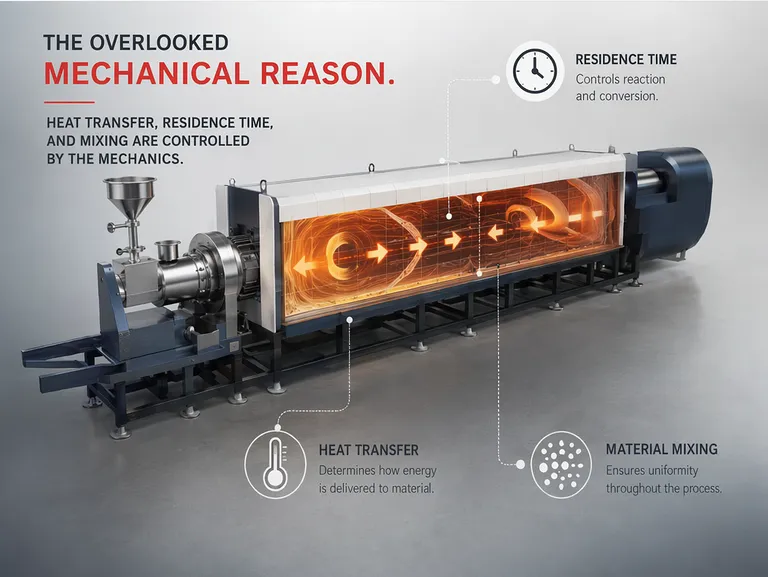
To achieve reliable and scalable results, you don't need a better thermometer. You need a system that treats rotation not as an afterthought, but as the critical, controllable process variable it is. You need a system engineered for mechanical stability from the ground up.
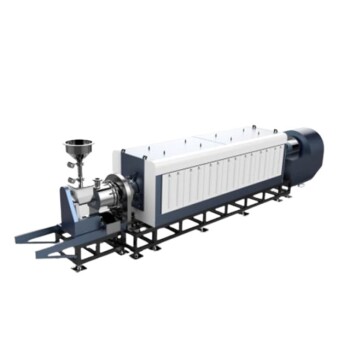
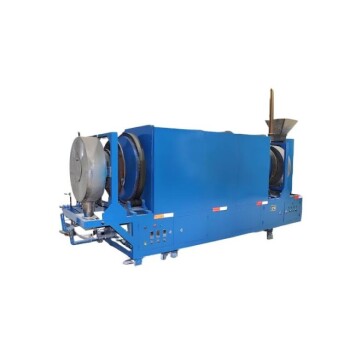
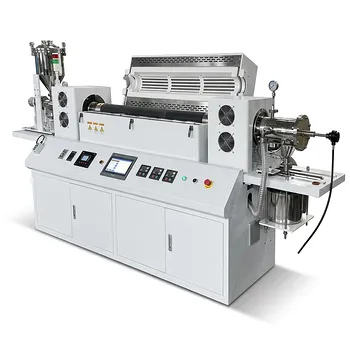
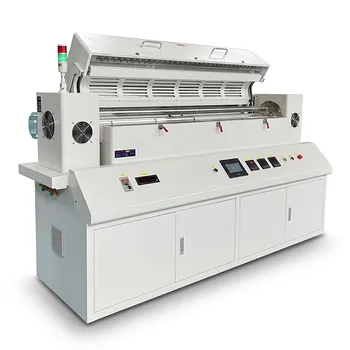
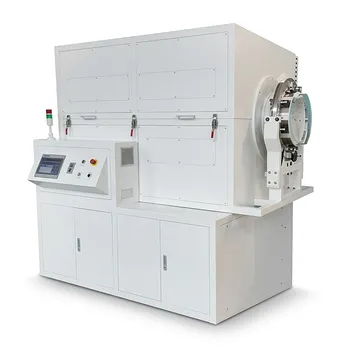
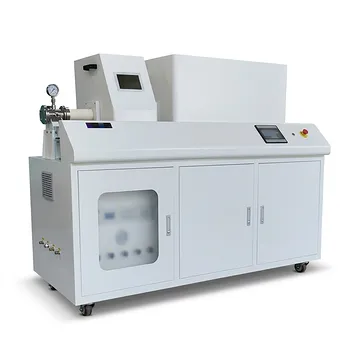
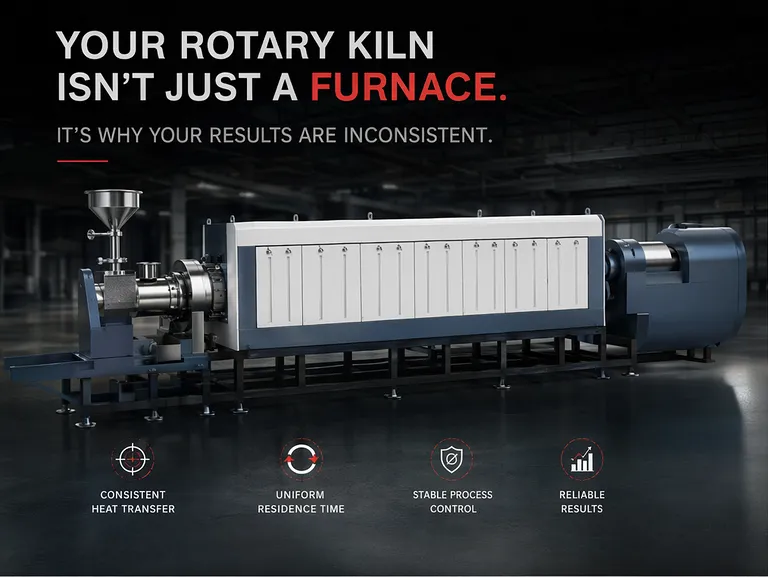
This is precisely the philosophy behind KINTEK’s laboratory rotary kilns. They are not merely furnaces that happen to spin; they are integrated processing systems designed to eliminate the mechanical variables that cause inconsistency.
How a Precision-Engineered Kiln Solves the Root Problem:
- Tackling Instability: A KINTEK kiln is built on a heavy-duty, rigid frame with precision-machined support rollers and riding rings. This robust construction ensures the kiln tube remains perfectly aligned and rotates smoothly without wobble or vibration, even during heat-up and cool-down cycles. Your material tumbles predictably, every single time.
- Mastering Retention Time: Our systems feature a high-precision drive motor paired with a digital controller. You set the rotation to 1.5 RPM, and it delivers exactly 1.5 RPM, hour after hour. Combined with a simple, accurate tilting mechanism, you gain direct, repeatable control over retention time—the single most important factor for process consistency.
- Designed for Durability: We understand the immense stresses involved. We use high-quality bearings, hardened gears, and robust materials for all mechanical components. This isn't just about longevity; it's about ensuring the "as-new" precision is maintained over years of use, so your process remains stable.
Beyond Consistency: What’s Possible When Your Process Just Works?
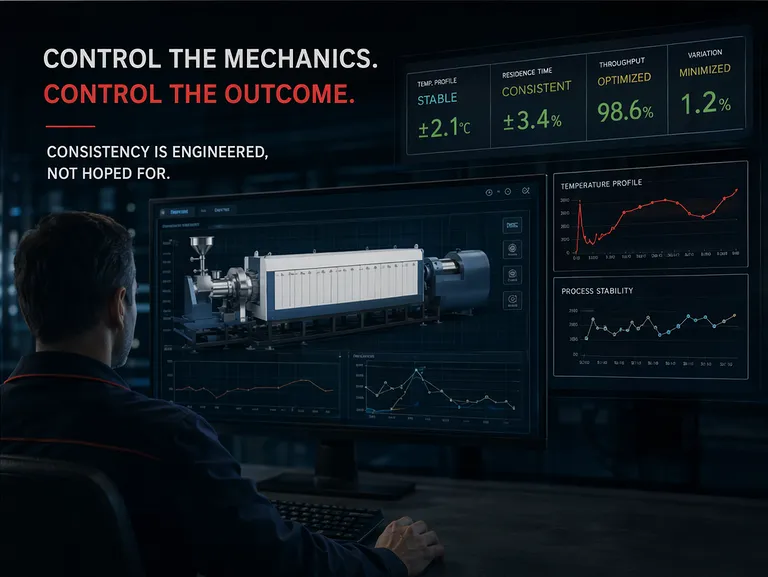
When you finally solve the riddle of inconsistency, you don’t just get a reliable process. You unlock entirely new possibilities for your R&D.
Instead of fighting your equipment, you can focus on innovation. You can confidently generate the clean, repeatable data needed for publications, patents, and process validation. You can begin to explore more sensitive materials with narrow processing windows, knowing your equipment can deliver the required stability.
Most importantly, you can finally build a reliable bridge from lab-scale discovery to pilot-scale production. Because the parameters you define (temperature, rotation speed, tilt angle) are now meaningful and repeatable, scaling up becomes a predictable engineering challenge, not a gamble. You can accelerate your time-to-market and give your organization a decisive competitive edge.
Your lab’s next breakthrough shouldn’t be held back by mechanical guesswork. It's time to move beyond the frustrating cycle of trial and error and embrace a system designed for control. Let our team help you understand how a stable, precise thermal processing platform can transform your material development projects from a source of frustration into a driver of innovation. Contact Our Experts.
Related Products
- Electric Rotary Kiln Small Rotary Furnace Biomass Pyrolysis Plant
- Electric Rotary Kiln Continuous Working Small Rotary Furnace Heating Pyrolysis Plant
- Electric Rotary Kiln Small Rotary Furnace for Activated Carbon Regeneration
- Electric Rotary Kiln Pyrolysis Furnace Plant Machine Calciner Small Rotary Kiln Rotating Furnace
- Vacuum Sealed Continuous Working Rotary Tube Furnace Rotating Tube Furnace
Related Articles
- Mastering Rotary Kilns: A Comprehensive Guide to Operation, Applications, and Maintenance
- Why More Fuel Isn't Fixing Your Rotary Kiln—And What Will
- Your Rotary Kiln Process is Failing. The Problem Isn't Temperature—It's Purity.
- Your Rotary Kiln is Wasting Energy and Money. The Reason is Hiding in Plain Sight.
- Your Rotary Kiln Isn't an Oven: The Secret to Consistent Thermal Processing