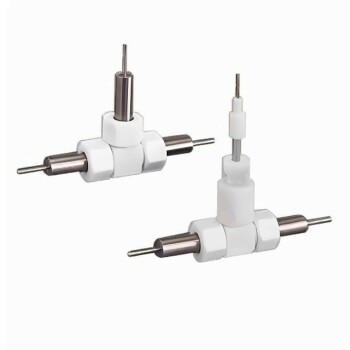
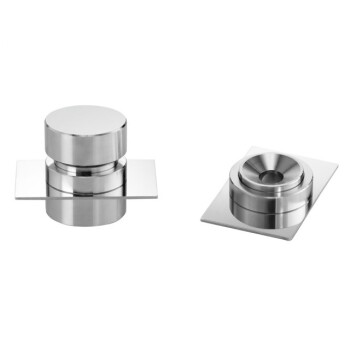
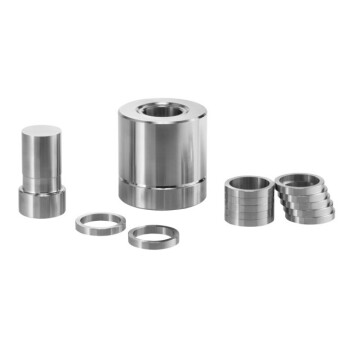
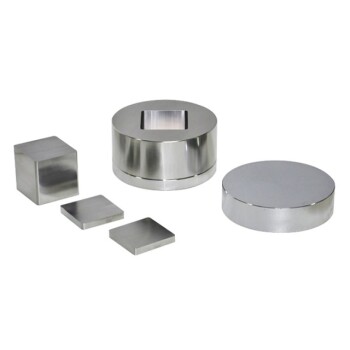
Beyond simple powder containment, insulating molds function as critical electrical barriers and mechanical stabilizers within the all-solid-state battery architecture. Their primary role is to electrically isolate the stainless steel current collectors (pistons) to prevent short circuits, while simultaneously channeling immense pressures—often several hundred megapascals—directly onto the active material layers to ensure structural integrity and accurate data collection.
Core Takeaway The definitive role of the insulating mold is to decouple the electrical pathway from the mechanical load path. By isolating the opposing pistons, the mold allows for the application of massive pressures required to minimize interfacial resistance without risking internal short circuits or electrochemical interference.
Electrical Isolation and Signal Integrity
Preventing Internal Short Circuits
The most immediate function of an insulating mold, such as one made from PEEK, is the electrical isolation of the conductive components.
In a pressurized cell, stainless steel pistons act as current collectors at both ends. Without an insulating sleeve, these pistons could bridge, causing an immediate internal short circuit.
Ensuring Accurate Electrochemical Data
During in-situ testing, the mold ensures that the data collected represents the battery chemistry, not the test fixture.
By using chemically stable materials, the mold prevents side reactions between the housing and the active components. This guarantees that results from Electrochemical Impedance Spectroscopy (EIS) reflect the true state of the electrode-electrolyte interface.
Mechanical Integrity During Fabrication
Withstanding Molding Pressures
Solid-state electrolytes require extreme densification to function correctly.
Insulating molds must withstand powder compression molding pressures ranging from 200 to 450 MPa. The mold confines the powder, forcing densification rather than lateral displacement or equipment deformation.
Directing Force to Active Layers
The mold plays a geometric role in force distribution.
It ensures that the externally applied pressure acts solely on the active material layers. This precision prevents force dissipation into the housing structure, ensuring the pellet achieves uniform density.
Managing Volume Changes During Cycling
Compensating for Anisotropic Expansion
All-solid-state batteries, particularly those with high-nickel cathodes or lithium metal anodes, undergo significant physical changes during operation.
The active materials experience anisotropic volume expansion and contraction during charge-discharge cycles. A specialized pressure-retaining mold constrains this movement, maintaining the cell's physical dimensions.
Maintaining Interfacial Contact
Solid-solid interfaces are prone to delamination.
During cycling, continuous external stack pressure (typically 1.5 MPa to over 10 MPa) is applied via the mold setup to compensate for lithium stripping and deposition. This constant pressure maintains tight contact between particles, reducing interfacial resistance and preventing crack propagation that leads to battery failure.
Understanding the Trade-offs
Chemical Stability vs. Mechanical Strength
While PEEK is excellent for insulation, its mechanical limits must be respected relative to the pressures required.
If the molding pressure exceeds the material's yield strength, the mold will deform, leading to uneven pellet density. Conversely, using a harder ceramic mold increases pressure tolerance but may be brittle or harder to machine to precise tolerances for sealing.
Dynamic Pressure Management
A static mold cannot passively adapt to volume changes; it requires an active spring or hydraulic mechanism.
If a mold is too rigid without a pressure-compensation mechanism, volume expansion can cause localized stress spikes that fracture the solid electrolyte. If the mold system is too compliant, contact is lost during contraction (delamination), destroying the cycle life.
Making the Right Choice for Your Goal
To select the correct mold configuration for your specific testing needs:
- If your primary focus is Powder Densification: Prioritize molds rated for high-yield strength (capable of >400 MPa) to ensure maximum compaction without lateral deformation.
- If your primary focus is Long-Term Cycling: Prioritize molds integrated with constant-pressure mechanisms (maintaining ~8 MPa) to compensate for volume expansion and prevent interface separation.
- If your primary focus is Electrochemical Analysis (EIS): Prioritize chemically inert materials like PEEK to eliminate parasitic side reactions that could skew impedance data.
The insulating mold is not just a vessel; it is an active mechanical component that defines the validity of your electrochemical results.
Summary Table:
| Function | Key Benefit | Critical Mechanism |
|---|---|---|
| Electrical Isolation | Prevents Short Circuits | Decouples conductive pistons from the housing |
| Mechanical Stability | High-Density Compaction | Withstands 200–450 MPa molding pressures |
| Signal Integrity | Accurate EIS Data | Eliminates parasitic reactions and electrical noise |
| Interface Retention | Low Resistance | Maintains contact during volume expansion/contraction |
| Force Direction | Uniform Pellets | Concentrates pressure directly on active material layers |
Elevate Your Battery Research with KINTEK Precision
Don't let equipment limitations compromise your electrochemical data. KINTEK specializes in high-performance laboratory solutions, providing the precision insulating molds, hydraulic presses, and battery research tools essential for advanced all-solid-state battery development. Whether you require high-strength PEEK components for densification or specialized reactors for in-situ testing, our expert team ensures your lab is equipped for success.
Ready to optimize your battery assembly process? Contact KINTEK Today to Consult with an Expert
Related Products
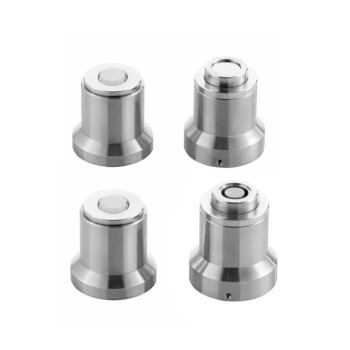
- Button Battery Disassembly and Sealing Mold for Lab Use
- Button Battery Tablet Press Sealing Mold for Lab Use
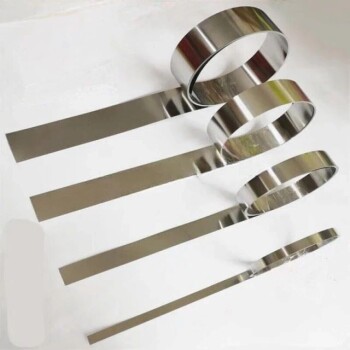
- Battery Lab Equipment 304 Stainless Steel Strip Foil 20um Thick for Battery Test
- Polyethylene Separator for Lithium Battery
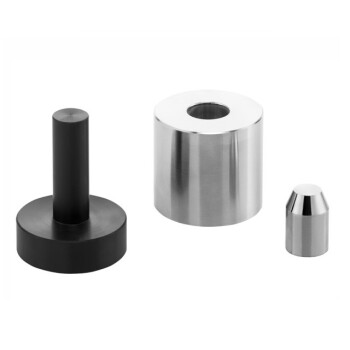
- Assemble Square Lab Press Mold for Laboratory Applications
People Also Ask
- What role do battery test molds or coin cell cases play? Optimize Your All-Solid-State Battery Assembly Today
- What are the parts of a mold assembly? A Guide to Injection Mold Components
- What is a molding tool used for? A Guide to Mass Production Efficiency
- What is a mold assembly? The Critical Final Step to a Functional Injection Mold
- What advantages do standardized laboratory compression-cell molds provide for c-LLZO? Optimize Battery Data Accuracy