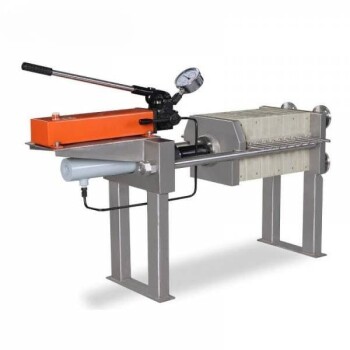
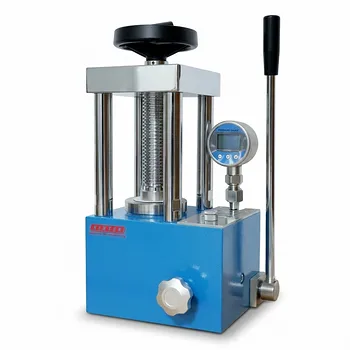
High-precision laboratory hydraulic presses and molds serve as the primary mechanism for establishing the initial gap size between nuclear fuel pellets and their cladding. By exerting exact control over axial pressure and geometric confinement, this equipment dictates the pellet's initial density and physical dimensions, which are the deciding factors in delaying the onset of Pellet-Cladding Interaction (PCI).
Core Takeaway The safety of a fuel rod relies on a specific physical gap that acts as a buffer against thermal expansion and swelling. High-precision pressing equipment is essential to manufacture pellets that meet these strict geometric tolerances, thereby optimizing the gap design and significantly reducing the risk of cladding rupture.
The Critical Role of the Gap
Defining the Interface
The primary function of the hydraulic press in this context is to create a "green body" (un-sintered pellet) that will shrink to a precise diameter after heating.
This process targets a specific gap between the fuel pellet and the cladding, typically ranging between 60 and 85 micrometers.
Buffering Thermal Expansion
During reactor operation, fuel pellets undergo thermal expansion and swelling.
If the initial gap is too small due to manufacturing inaccuracies, the pellet will contact the cladding prematurely. High-precision molds ensure the gap is sufficient to accommodate this growth without stressing the containment walls.
Controlling Pellet Geometry and Density
Managing Sintering Shrinkage
The final dimension of a nuclear fuel pellet is heavily influenced by how it behaves during the high-temperature sintering process.
Precision presses control the packing density of the powder to minimize internal porosity. This ensures that the rate of shrinkage during sintering is predictable and consistent, resulting in a final product that matches the required tolerances.
Eliminating Internal Gradients
Uniform application of axial pressure is essential to prevent internal density gradients within the compressed powder.
If pressure is applied unevenly, the pellet may warp, deform, or crack during sintering. A deformed pellet leads to unpredictable gap sizes and localized stress points on the cladding, accelerating PCI failure.
Understanding the Trade-offs
The Heat Transfer vs. Safety Balance
While a larger gap helps delay PCI, it introduces a thermal challenge. A wide gap creates resistance to heat transfer, causing the fuel temperature to rise, which can actually induce further swelling.
Therefore, the goal is not simply to create a large gap, but a precise one. High-precision equipment allows manufacturers to hit the narrow "Goldilocks" window where the gap is small enough for heat transfer but large enough to buffer expansion.
Defect Propagation
Inconsistencies in the pressing stage cannot be fixed later.
Microscopic defects or density variations introduced by a low-precision press will propagate into macroscopic defects during sintering. These structural weaknesses compromise the integrity of the fuel rod regardless of the initial gap design.
Making the Right Choice for Your Goal
Achieving the optimal balance between manufacturing consistency and reactor safety requires selecting equipment based on your specific quality targets.
- If your primary focus is delaying PCI onset: Prioritize mold geometric accuracy to maintain the upper limit of the gap tolerance (closer to 85 micrometers) to maximize the expansion buffer.
- If your primary focus is thermal efficiency: Focus on high-precision pressure control to maximize density and minimize the gap (closer to 60 micrometers) without risking immediate contact.
- If your primary focus is structural integrity: Ensure your press delivers uniform axial pressure to eliminate density gradients that lead to warping and cracking.
Precision in the pressing stage is the only way to guarantee the predictable geometric behavior required for safe nuclear fuel performance.
Summary Table:
| Factor Affected | Role of High-Precision Press/Mold | Impact on PCI |
|---|---|---|
| Gap Dimension | Maintains tolerance (60-85 μm) | Prevents premature cladding contact |
| Pellet Density | Controls powder packing & porosity | Predicts sintering shrinkage accurately |
| Pressure Uniformity | Eliminates internal density gradients | Prevents warping and localized stress |
| Thermal Transfer | Enables tight 'Goldilocks' window | Balances expansion buffer with heat flow |
| Structural Integrity | Minimizes microscopic defects | Reduces risk of cladding rupture |
Elevate Your Nuclear Research with KINTEK Precision
Ensure the highest safety standards for your nuclear fuel research by leveraging KINTEK’s industry-leading laboratory solutions. We specialize in high-precision hydraulic presses (pellet, hot, isostatic) and custom-engineered molds designed to achieve the exacting geometric tolerances required for PCI mitigation.
Beyond pellet preparation, KINTEK offers a comprehensive portfolio including high-temperature furnaces (muffle, vacuum, CVD), crushing and milling systems, and high-pressure reactors to support every stage of your material science workflow.
Ready to achieve the 'Goldilocks' window in your pellet manufacturing? Contact us today to discuss your specific laboratory requirements.
References
- Daniel de Souza Gomes. Uranium nitride and silicide composite fuels used to reduce fuel oxidation. DOI: 10.22533/at.ed.3174172421065
This article is also based on technical information from Kintek Solution Knowledge Base .
Related Products
- Laboratory Hydraulic Press Lab Pellet Press Machine for Glove Box
- Laboratory Hydraulic Press Split Electric Lab Pellet Press
- Laboratory Hydraulic Press Lab Pellet Press for Button Battery
- Automatic Laboratory Hydraulic Press for XRF & KBR Pellet Press
- Automatic Laboratory Hydraulic Pellet Press Machine for Lab Use
People Also Ask
- What is the function of a laboratory hydraulic press in W-Cu composites? Control Porosity and Material Ratio
- What is the role of a laboratory hydraulic press in the initial stages of Li6PS5Cl preparation? Key to Green Pellets
- What role does a laboratory hydraulic press play in triboelectric testing? Achieve Precision Alloy Sample Prep
- How can a laboratory hydraulic press be applied to chitosan for wastewater treatment? Optimize Pores & Strength
- How do a precision laboratory hydraulic press and specialized molds contribute to the fabrication of spherical ceramic samples? Achieving High-Density Material Precision