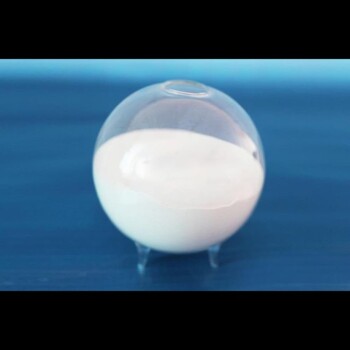
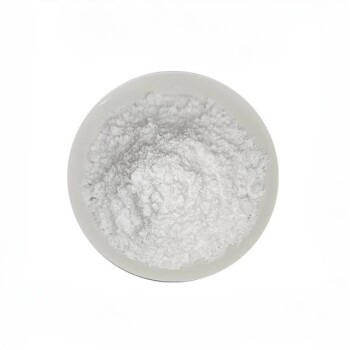
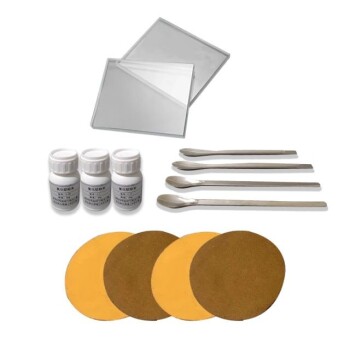
Micron-level alumina suspensions and high-purity cerium oxide polishing powders serve as the critical final step in the mechanical polishing of high-entropy alloy samples. By utilizing the grinding action of extremely fine particles, these consumables effectively remove the minute scratches remaining from previous abrasive paper steps, transforming the alloy's surface into a mirror-like state.
Achieving a defect-free surface is not merely for aesthetics; it is a technical necessity. These polishing agents provide the requisite smoothness to ensure high-resolution imaging and accurate chemical analysis in high-entropy alloy research.
The Mechanics of Final Polishing
Eliminating Micro-Scratches
The primary function of these powders is to refine the surface topography.
Previous preparation steps using abrasive papers inevitably leave behind a network of fine scratches. Alumina and cerium oxide powders act as ultra-fine abrasives to grind away these final imperfections.
Achieving a Mirror-Like Finish
The goal of using micron-level particles is to transition the sample from a rough, ground state to a highly reflective, smooth state.
This process targets the cross-section of welded joints or base materials. It produces a mirror-like finish that is free from topographical artifacts that could mislead an observer.
The Impact on Analytical Techniques
Prerequisites for Metallography
High-resolution metallographic observation requires an unobstructed view of the microstructure.
Without the smoothing action of these polishing powders, surface scratches would obscure grain boundaries and phase features. The powders ensure clarity for optical analysis.
Enabling Scanning Electron Microscopy (SEM)
For advanced imaging via SEM, surface topography is critical.
A rough surface causes electron scattering that degrades image quality. The smoothness provided by alumina and cerium oxide minimizes these artifacts, allowing for sharp, interpretable electron micrographs.
Ensuring Accurate EDS Analysis
Chemical composition analysis using Energy Dispersive Spectroscopy (EDS) is highly sensitive to surface geometry.
If a surface is rough, the X-ray signals can be distorted. The use of these polishing powders is a direct prerequisite for accurate EDS results, ensuring that composition data reflects the alloy's true chemistry rather than surface irregularities.
Common Pitfalls to Avoid
The Risk of Incomplete Polishing
If the polishing stage is shortened or if these specific powders are omitted, "phantom" structures may appear.
Scratches left by coarser abrasives can be mistaken for microstructural features. You must persist with the micron-level powders until all previous abrasion marks are fully erased.
Ignoring the "Prerequisite" Status
It is a mistake to treat this step as optional for "quick" observations.
As indicated by the technical requirements, this level of smoothness is a non-negotiable prerequisite for reliable SEM and EDS data. Skipping this step renders high-fidelity data collection impossible.
Making the Right Choice for Your Goal
To ensure your high-entropy alloy samples yield reliable data, align your preparation with your analytical needs:
- If your primary focus is Optical Microscopy: Ensure you polish until the surface is reflective enough to reveal grain structure without scratch interference.
- If your primary focus is SEM/EDS Analysis: You must achieve a strictly mirror-like finish using these powders to prevent topographic errors in your chemical data.
Proper use of these fine polishing agents is the bridge between a rough raw sample and a scientifically valuable specimen.
Summary Table:
| Polishing Agent | Particle Level | Primary Function | Analytical Benefit |
|---|---|---|---|
| Micron Alumina | Ultra-fine Suspension | Removes final micro-scratches | Enables high-resolution SEM imaging |
| Cerium Oxide | High-purity Powder | Achieves mirror-like finish | Prerequisite for accurate EDS chemical data |
| Combined Use | Final Stage | Eliminates surface topography | Prevents 'phantom' structures in metallography |
Elevate Your Material Analysis with KINTEK Precision Consumables
Don't let surface imperfections compromise your research data. KINTEK specializes in high-performance laboratory solutions, providing the high-purity alumina and cerium oxide polishing powders essential for defect-free high-entropy alloy preparation. Beyond polishing, we support your entire workflow with our comprehensive range of crushing and milling systems, high-temperature furnaces, and hydraulic pellet presses.
Whether you are performing advanced SEM/EDS analysis or fundamental metallography, our team is ready to provide the tools and consumables you need for scientifically valuable specimens. Contact KINTEK today to optimize your lab's efficiency!
References
- Ionelia Voiculescu, Elena Scutelnicu. Effect of Diffusion on Dissimilar Welded Joint between Al0.8CoCrFeNi High-Entropy Alloy and S235JR Structural Steel. DOI: 10.3390/met12040548
This article is also based on technical information from Kintek Solution Knowledge Base .
Related Products
- High Purity Alumina Granulated Powder for Engineering Advanced Fine Ceramics
- Advanced Engineering Fine Ceramics Low Temperature Alumina Granulation Powder
- Engineering Advanced Fine Ceramics Aluminium Oxide Al2O3 Ceramic Washer for Wear-Resistant Applications
- Advanced Engineering Fine Ceramics Alumina Ceramic Saggar for Fine Corundum
- High Quality Alumina Ceramic Screw for Engineering Advanced Fine Ceramics with High Temperature Resistance and Insulation
People Also Ask
- What is the function of high-purity alumina powder in pack cementation? Ensure Uniform Aerospace Blade Coatings
- How should alumina powder be selected for polishing a disc electrode, and what is the procedure for removing scratches? Achieve a Perfect Mirror Finish
- What are the properties and handling precautions for alumina powder as a polishing material? Achieve a Flawless Finish with Precision
- Why is it necessary to apply alumina powder to graphite molds for TiC10/Cu-Al2O3? Ensure Smooth Release.
- What measures should be taken to prevent cross-contamination when using different sizes of alumina powder?